Travel Backpack with Wheels: An Integrated Wheel-and-Trolley Selection and Ordering Guide
A travel backpack with wheels is a specific product form: a soft backpack body mounted on a built-in wheel base, with a retractable trolley handle integrated into the frame. It rolls like luggage when the ground suits it and carries like a backpack when it does not. For retail brands and corporate program buyers, this hybrid is attractive because it covers two use cases in one SKU, but it is also the most mechanically complex of the three wheeled-and-carryable forms on the market. This guide separates the form from its neighbors, explains what to specify, and walks through the ordering program.
Key takeaways for buyers
- An integrated hybrid combines a soft backpack body, built-in wheels and a retractable handle; it is not the same as a backpack with a pass-through sleeve or a wheeled duffel.
- The rolling hardware and the folding harness must be specified as one system, because they share the frame and affect balance when rolling and carrying.
- Cabin compatibility is a per-airline, per-market check, not a design claim; verify assembled dimensions with the supplier against your target market.
- Run loaded sample checks on wheel roll, handle cycling and harness stitching before releasing mass production.
In this guide
Three forms, three jobs
Buyers evaluating this category should first separate the three structures that are often grouped under one search term:
Integrated wheel-and-trolley backpack. The wheel base and retractable handle are built into the backpack itself. The bag stands and rolls on its own. This is the form this article covers.
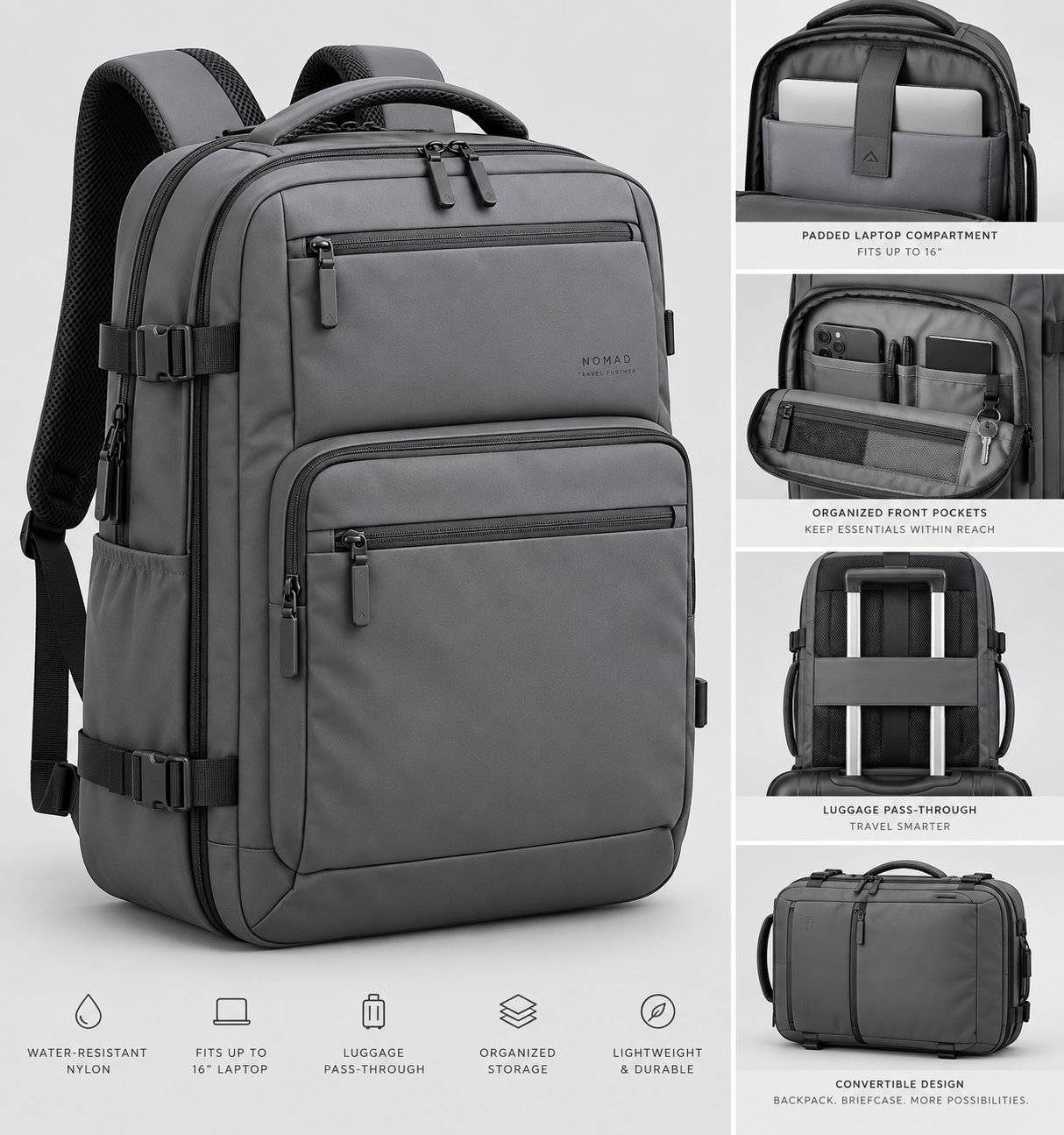
Backpack with pass-through sleeve. The backpack has no wheels; it slides over the telescopic handle of a separate trolley case. This keeps the backpack light and simple but makes it dependent on a second piece of luggage. Our separate guide covers external pass-through sleeves in detail. As a capability reference, the published Convertible Travel Backpack 35L offers this structure: a 35-liter water-resistant nylon pack with a trolley pass-through and padded laptop compartment.
Wheeled duffel. A soft duffel body on a wheel base, with no harness. It maximizes volume and packability but loses the carry-like-a-backpack function. For programs where capacity matters more than carrying comfort, see our guide to wheeled duffel bags.
The integrated hybrid fits programs where users alternate between paved transit and stairs or rougher surfaces, and the bag must stand upright on its own; otherwise a sleeve backpack is lighter and cheaper, or a wheeled duffel wins on volume.
Specifying the wheel and trolley system
The rolling system of an integrated hybrid borrows most of its engineering from trolley luggage, so the selection criteria carry over directly:
Wheel size and type. Larger wheels roll more easily over thresholds, cobblestones and carpet; smaller spinner-style wheels maneuver better in tight aisles but are more sensitive to rough ground. Inline skate-style wheels on a two-wheel base are the usual choice where the bag will leave smooth floors.
Axle and base frame. The wheel base carries the full load of a packed soft body, which flexes more than a hardshell. The base plate must be rigid enough to keep the wheels aligned, and the axle mounts should be fixed to a frame member, not just to fabric.
Handle tube gauge and telescoping stages. Thicker-walled tubes resist wobble; two-stage handles keep the closed profile shorter for cabin use, while three-stage handles extend higher for taller users. The handle should retract fully below the top panel so it does not snag when the bag is carried as a backpack.
Because these components match luggage hardware, the QC knowledge from hard-side production is directly relevant: our article on double-wheel spinner systems and trolley frame QC and our walkthrough of trolley and wheel assembly quality control inside a case factory describe the checks that apply. A manufacturer that already builds trolley cases in-house, with wheel, handle and zipper function checks built into the workflow, can apply the same assembly discipline to a hybrid body.
Folding harness and center of gravity
The part unique to this form is the harness. When the bag rolls, the shoulder straps must fold away behind a panel so they do not drag on the ground or catch in the wheels. Three details decide whether that works in daily use:
Panel position and protection. The folded harness should sit behind a stiff or padded shield panel between the straps and the load, so the weight of the pack does not press the straps into the contents, and so the straps cannot contact the wheel zone.
Padding placement. When worn, the bag sits high on the back while the wheel base hangs at the bottom. Padding concentrated in the shoulder straps and at the lower back panel keeps that bottom weight from pulling the bag away from the wearer's spine. Load-lifting straps, as used on hiking platforms like the published Outdoor Hiking Pack 40L, help pull the top of the load toward the shoulders.
Sample checks. On a physical sample, deploy and stow the harness twenty times in a row: the straps should fold flat without twisting, and nothing should pinch. Extend the handle fully and confirm there is clearance between the handle rails and the folded straps. Then roll the fully loaded bag across a carpeted floor and a floor seam: a harness that hangs low, or a pack that tips because the wheel base is set too far back, shows up immediately.
Stability when rolling depends on geometry, not on padding alone: the wheel base must sit far enough behind the loaded center of gravity for the bag to tilt and tow without falling backward, but not so far that the folded harness hits the ground when the bag tilts.
Cabin compatibility and size planning
Carry-on limits vary by airline and market, and the handle housing and wheel base add height to a soft body that would otherwise fit a stated dimension. Treat cabin compatibility as a rule to verify per airline and per market, not as a claim built into the design. In practice, integrated hybrids concentrate in the 30-40 liter band: enough volume for short trips, with a body height that can meet common carry-on envelopes once wheels and handle are added. Confirm assembled height, width including wheel protrusion and weight with the supplier against your target market's airline requirements before locking the size spec.
Channel planning for one platform
A single wheeled-backpack platform can serve several channels with controlled variations. Travel retail responds to durability cues and cabin-size messaging. Commuter and corporate programs favor the laptop compartment, luggage pass-through compatibility and restrained colorways; the same core platform can be stripped of wheels into a sleeve backpack for the lightest-cost tier. E-commerce channels benefit from the form's story, one bag that does both jobs, which photographs and demos well. Plan the platform with shared wheel base and handle hardware across tiers so tooling is amortized, and vary fabric, color and internal layout by channel. Fabric selection logic is covered separately in our comparison of nylon, polyester, canvas and RPET.
How the ordering process runs
An integrated hybrid combines soft-goods sewing with luggage hardware assembly, so the OEM sequence deserves explicit stages:
- Design handover. Your team provides sketches or references plus target capacity, size envelope, channel and branding. The manufacturer's in-house design studio develops the style, selects materials and prepares the first sample.
- Sample approval. Evaluate the sample against the checkpoints below, not only against appearance.
- Mass production. Cutting, sewing, assembly and inspection under one roof shortens internal handoffs; Wellmax produces about 150,000 pieces per month across a 12,000 m2 facility, supported by an ISO 9001:2015-certified quality management system and BSCI social compliance audit, both held at company level.
- Inspection and export. Finished-product inspection stations check bags and trolley cases before packing; define hybrid-specific checks for this category in advance.
Commercial terms depend on the final specification. As listed catalog baselines only: backpack products on the site carry a listed MOQ of 500 pieces and a listed lead time of 30-35 days after sample approval, while trolley products carry a listed MOQ of 300 pieces; the 40L hiking pack is listed at 300 pieces MOQ and 35-40 days. A hybrid draws on both categories, so confirm MOQ, lead time and tooling cost per spec directly with the supplier rather than assuming either baseline.
Buyer checkpoints for the pre-production sample
Before releasing mass production, define and run these checks on the pre-production sample yourself or through a third party:
- Wheel roll test. Roll the fully loaded bag over smooth floor, carpet, a door threshold and a floor seam; observe wobble, tracking and any rubbing of the body on the wheel base.
- Handle cycling. Extend and retract the handle through a defined number of cycles; watch for play at the joints, uneven extension and clearance issues against the folded harness.
- Harness stitching. Inspect the strap attachment points and the seams of the stow panel; these carry the wearer's full weight and sit close to the stress concentrated by the frame.
- Zipper grade. Confirm the specified zipper series for the main compartment, since a packed soft body flexes and loads the sliders differently than a rigid shell.
The integrated travel backpack with wheels rewards buyers who specify the rolling hardware and the harness as one system rather than as two separate features. Specify the geometry, run the checks above on loaded samples, confirm commercial terms against the final spec, and the form delivers: luggage that carries, and a backpack that rolls.