
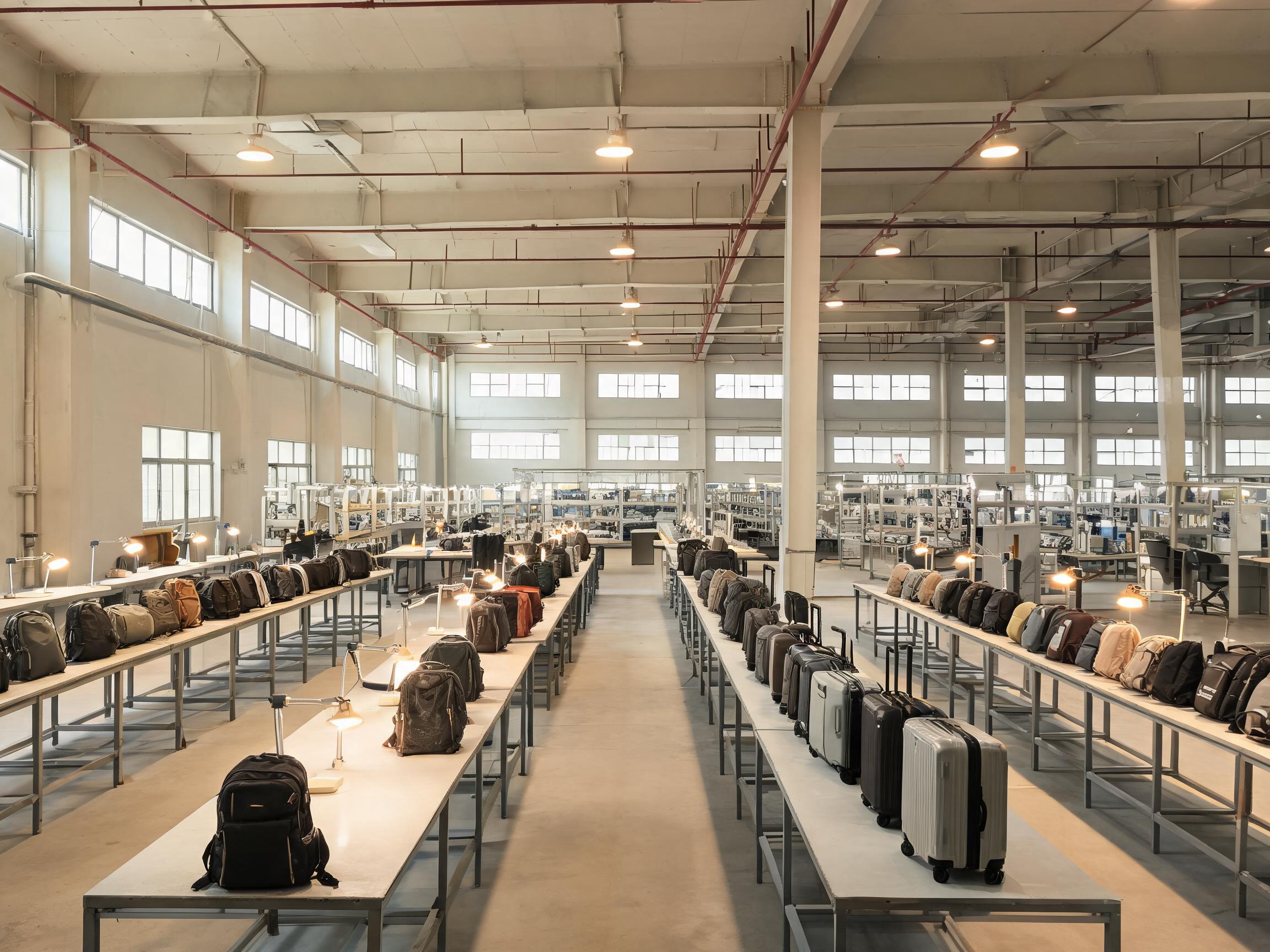
Factory & QC Guide
Four-wheel spinner luggage is the default construction for hard-shell and many softside ranges sold into North America and Europe. For buyers sourcing from China, the phrase "4 wheel suitcase" describes an outcome — smooth rolling in any direction — but the purchase decision sits in two assemblies that are hard to inspect after the container arrives: the double-wheel spinner system and the trolley frame. This guide explains how a factory builds and checks both, from the viewpoint of bulk OEM production rather than retail product copy.
Why 4-Wheel Spinner Construction Matters for Bulk Buyers
A four-wheel spinner case puts load onto four caster assemblies at once, so it rolls upright and moves in any direction. That convenience changes what a factory must control. Every wheel must turn freely, all four must sit on the same plane, and the frame that carries them has to hold its shape under a fully packed case. A single wheel that binds or a frame that tilts makes the whole unit feel defective, even when the shell and zipper are fine.
Wheel and frame issues are also the hardest defects to resolve after shipment. Shell scratches are cosmetic and visible at receiving; a spinner that only starts to wobble after a few trips is a warranty return. For B2B orders, the practical goal is not to find the cheapest wheel — it is to lock in a wheel-and-frame specification that the factory can reproduce across a production run and prove at pre-shipment inspection.
Double vs Single Wheel Selection Principles
"Double wheel" means two wheels share one caster housing, giving a wider contact footprint than a single-wheel caster. Wider contact spreads load, which matters most on larger, heavier cases. The trade-off is weight, cost, and housing clearance. The table below frames the selection decision as a set of questions a buyer can put to any supplier — the answers should match the case size, target load and market positioning.
| Selection factor | Single wheel | Double wheel |
|---|---|---|
| Typical case size | Cabin and light carry-on | Checked and medium-to-large spinners |
| Load distribution | Narrower contact point | Wider footprint across two wheels |
| Weight and cost | Lower per unit | Higher per unit |
| What to confirm | Wheel diameter and housing material | Axle retention, wheel spacing, housing strength |
For a program that spans sizes, the same double-wheel specification is not automatically right for every SKU. A 20-inch ABS cabin trolley and a 26-inch polycarbonate expandable checked case can share a wheel supplier but should not share load assumptions. Ask the factory to map each SKU to a wheel spec and to explain why that spec suits the case size. Wellmax Luggage, for example, builds a 24-inch softside spinner and a 26-inch polycarbonate expandable checked case, both on four spinner wheels — different shells, different internal volumes, so the wheel and frame spec should be reviewed per size rather than copied across the range.
How Trolley Frames and Telescopic Handles Are Assembled
The trolley frame is the internal skeleton: two vertical tubes, a base plate or bracket that ties into the wheel housings, and a telescopic handle that slides inside or alongside the tubes. On hard-shell cases the frame is usually fixed to the shell with screws or rivets through reinforced bosses; on softside cases it slides into a fabric channel and is anchored at a base plate. Assembly order matters because the frame must be aligned before the lining or shell is closed.
Failure risk concentrates at a few points:
- Tube-to-base joint. This takes the load when the case is pulled at an angle. A weak joint shows up as a tilt in the handle.
- Handle locking positions. The detents that hold the handle extended must engage at the same height on both tubes, or the handle racks side to side.
- Wheel housing mounting. Housings must sit flush and be fastened so that all four wheels touch the floor together.
- Rivet or screw torque into thin shell. Over-tightening cracks the boss; under-tightening lets the frame move.
Because these points are inside the case, buyers should ask the supplier to demonstrate them rather than take a finished photo as proof. Reasonable requests include a cutaway or open-frame sample, the handle extended and locked at each position, and a check that all four wheels contact a flat surface simultaneously.
QC Checkpoints Before Packing
In a factory that runs full-cycle production — sampling, tooling, mass production, QC, export — the trolley case is checked at the finished-product inspection station before it is packed. That station is the last point where a spinner defect can be caught without unpacking a carton. The checks a buyer should expect to see documented include:
- Handle extension and retraction through every locking position, on both tubes.
- Wheel rotation by hand, with the case upright and tilted, to confirm no binding or rubbing.
- Four-wheel ground contact on a flat surface — no rocking, no lifted wheel.
- Frame alignment: handle vertical relative to the case, no visible lean.
- Shell, zipper, lining and hardware inspection against the approved sample.
Wellmax Luggage operates finished-product inspection stations that check trolley cases before packing, within an ISO 9001:2015 quality system and a BSCI-audited facility. For a buyer, the useful question is not whether inspection exists, but which of the checks above are recorded per batch and what the factory does with a failed unit — rework, replacement of the wheel assembly, or removal from the batch.
Planning a Bulk OEM Order
Bulk OEM production follows a sequence, and each stage should be signed off before the next begins:
- Sampling. Confirm shell material and size, wheel type, frame spec and handle. The approved sample becomes the reference for mass production.
- Tooling. Molds for shells, wheel housings or branded components are made and test-shot. Tooling approval locks the dimensions that QC will later check.
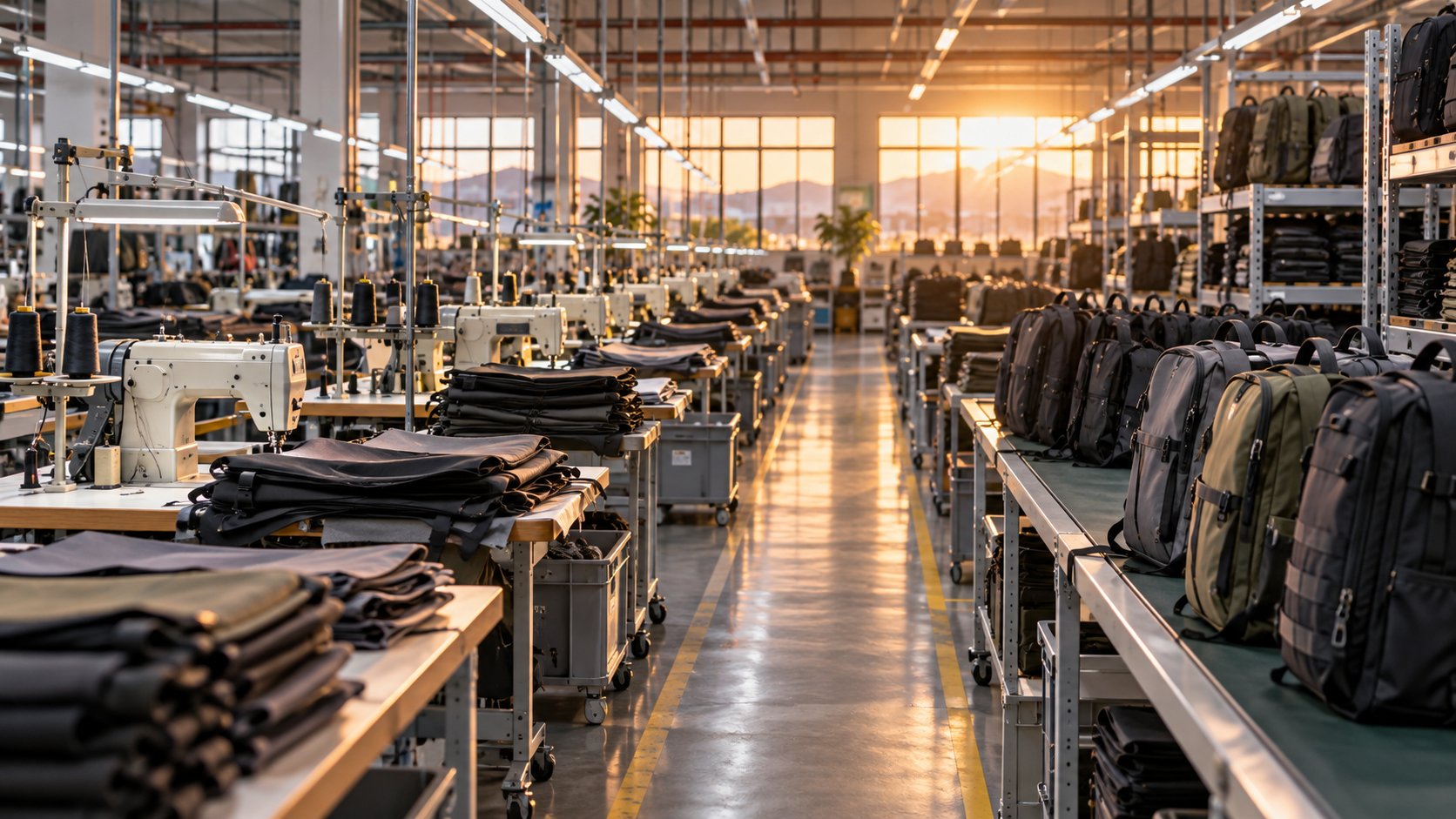
- Mass production. Shells, linings, wheels and frames are produced and assembled; softside lines sew components before the frame is fitted.
- QC. In-process checks plus finished-product inspection at the station described above.
- Export. Packing, carton marking and shipping documentation.
Two planning points are worth settling at sampling stage. First, decide whether the double-wheel spec is fixed per SKU or allowed to vary by size, and write it into the sample approval. Second, agree which inspection records will be shared with each shipment. Buyers should also confirm current MOQ and lead time with the supplier directly, since these depend on the specific case, tooling and order mix.
If you are comparing shell materials and customization timelines across a range, the PC vs ABS spinner OEM selection guide covers that decision. For size and material planning across a trolley case program, see the China trolley case buying guide.
FAQ
Should every case size use double spinner wheels?
Not necessarily. Double wheels suit larger, heavier checked cases because two wheels share the load. For a 20-inch ABS cabin trolley, a single-wheel caster may be sufficient. Map the wheel spec to each SKU and confirm it in the approved sample.
How can I verify trolley frame quality before shipment?
Ask the factory to demonstrate handle locking at each position, four-wheel ground contact, and frame alignment on a finished unit. Request the finished-product inspection records for your batch and confirm how failed units are handled.
What should a sample approval cover?
Shell material and size, wheel type (single or double), frame and telescopic handle spec, and the inspection checks that will apply in mass production. The approved sample is the reference QC works against.
Do I need separate tooling for each size?
It depends on the shell and components. Molds for shells and branded parts are size-specific; shared wheels or handles may cover several SKUs. Confirm the tooling list at sampling stage so the cost and timeline are clear.
Next Step
If you are planning a bulk order of four-wheel spinner luggage, send the supplier your target sizes, shell material preference, wheel type (single or double), and any branding requirements. Ask for a sample plan, the tooling list, and the inspection checks that will apply to the finished product before packing. Those three items tell you more about a factory than any catalog photo.