
A trunk suitcase is the most recognizably vintage form in hard luggage: a boxy, squared case with a flat or gently arched lid, external hardware and visible corner protection. For retail and brand buyers, it is also one of the clearest ways to signal a premium tier inside a hardside range, because the details that define the look — riveted edges, metal corner guards, latch hardware — read at shelf distance. This article covers how the trunk form is built on modern production, what to specify at sampling, and how the finished product sits against conventional spinners in a lineup.
- The trunk silhouette is a structural choice first: flat faces concentrate stress at corners and edges, so the corner and edge system matters more than on a curved spinner.
- Two construction routes exist — a molded flat-face shell with applied trim, or a frame-and-panel build. They differ in tooling, cost, lead time and how much of the hardware is genuinely load-bearing.
- Finish consistency across latches, corner guards, rivets and logo plates is a specification item, not a QC afterthought.
- Latch-and-frame closure changes both the defect profile (hinge alignment, seam gaps) and the compliance questions to resolve before production.
- Trunk hardware is component-heavy. Price the tier on its own cost base instead of treating it as a cosmetic variant of an existing spinner.
- What defines the trunk form
- Shell and structure: how the look is engineered
- Corner guards, trim and edge detailing
- Hardware and locking
- Interior layout
- Retail positioning and where the frame set fits
- How to request a trunk-style development
What defines the trunk form
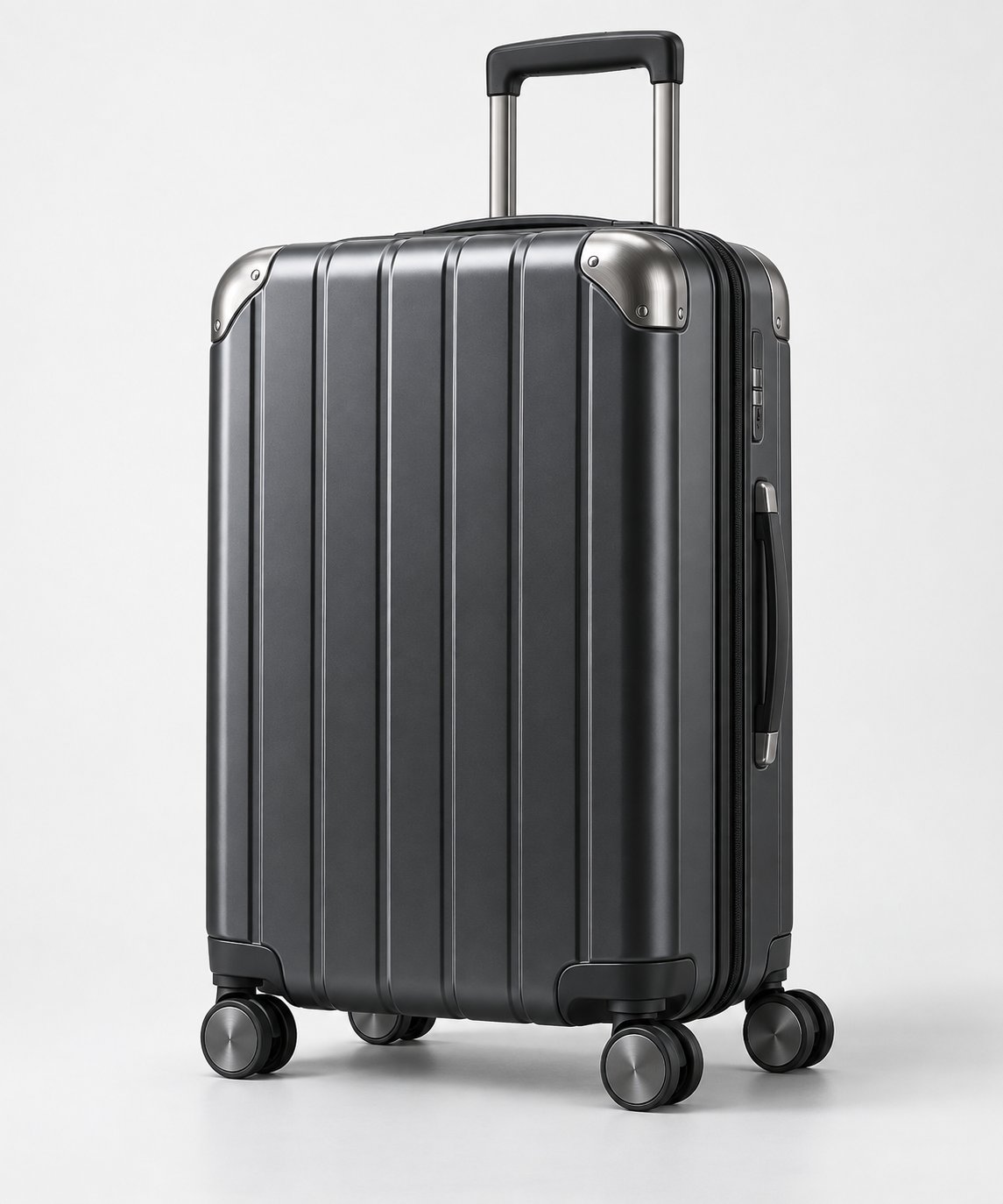
Set a trunk beside a standard vertical spinner and the differences are structural, not just stylistic. A trunk case is roughly rectangular with a low aspect ratio: wider and deeper relative to its height, with a squared silhouette rather than the tapered, barrel-like profile of a spinner. The lid is flat or slightly arched and usually opens wide on external hinges. Protection sits on the outside of the shell — metal or reinforced corner guards, riveted edge bands, sometimes leather-look trim — instead of relying on a resilient molded shell alone. Hardware is exposed by design: latches, locks and corner fittings are part of the visual language rather than components to be concealed.
That last point drives most of the development work. Because the hardware is meant to be seen, finish consistency across latches, corner guards, rivets and logo plates becomes a design requirement rather than an afterthought. It also means the shell cannot be a purely cosmetic exercise; the corners and edges have to reinforce the case if the styling is to hold up in airline and retail handling.
Shell and structure: how the look is engineered

Modern trunk styling is built along two main routes, and buyers should know which one a supplier is quoting before comparing prices.
The first is a molded flat-face shell: the tooling produces large flat panels and squared corners, and the trunk character is carried by mold geometry plus applied trim. It is the simpler route and keeps tooling closer to that of a conventional hard case.
The second is frame construction: an aluminum or metal frame around the shell carries the latches, hinges and locking, with the shell panels set into the frame. This route most closely matches the historical trunk aesthetic because the hardware is genuinely structural rather than decorative. It also changes the cost structure and lead time, and adds hardware items that need their own tolerances.
Material choice interacts with the silhouette. Polycarbonate gives flexibility and impact resistance but is commonly associated with curved, ribbed spinner shells; ABS is stiffer to mold into flat faces and is frequently used in frame-and-shell combinations. The flex, scratch and impact trade-offs between these materials are covered in the site's guides on how PC, ABS and PP shells are built and on ABS vs PC shell specification and drop-test standards, so they are not repeated here. The trunk-specific consequence is this: flat faces concentrate load at corners and edges, so the more squared and flat the mold, the more weight the corner and edge system carries.
Corner guards, trim and edge detailing
This is where a trunk wins or loses its premium read. Buyers typically specify some combination of the following:
- Metal corner guards — stamped or extruded fittings over each corner, fixed with rivets or screws. Check gauge and finish at sampling; thin stamped guards dent visibly and undercut the premium story.
- Riveted edge bands — a band running along the lid-to-base seam, riveted at intervals. Rivet spacing and alignment are the QC points; uneven spacing reads as cheap even when the components themselves are sound.
- Leather-look trim — PU or coated trim around edges or handles for a vintage accent. Confirm abrasion behavior and color match against the shell and hardware on the sample.
- Finish consistency — brushed, anodized or plated finishes must match across corner guards, latches, locks, rivet heads and any metal logo plates. Agree one finish standard or a physical master sample before mass production.
A useful reference for the edge-detail vocabulary on a softer silhouette is the site's Business Hardshell Trolley 26", a polycarbonate checked case with brushed metal corner details; it shows how corner treatments carry premium positioning even on a conventional spinner. On a trunk program the same treatments are specified more heavily and more visibly.
Hardware and locking
Frame-constructed trunks usually use latches rather than zippers, often with the lock integrated into the frame. That changes both the defect profile and the compliance questions.
On the defect side, the checks that belong on first production samples are latch engagement, hinge alignment between lid and base, and lock tolerance. Misaligned hinges that leave a visible gap along the seam are a common trunk-specific failure, and they show up in the finished goods rather than in the shell.On the compliance side, three items should be settled before the spec is frozen:
- Which destination markets the line ships to.
- Which lock standard those markets expect — TSA-accessible locking for US-bound retail, for example — and whether the lock needs to be part of the frame hardware or an added component.
- Whether the lock supplier can document the standard being met, so the claim on the shelf matches the component fitted.
These are market-entry decisions to resolve at specification, not assumptions to carry into production. A lock that satisfies one market's expectation does not automatically satisfy another's.
Interior layout
Trunk interiors differ from spinner interiors in one important way: access. A wide-opening flat lid exposes the full compartment at once, which favors a single large packing space with cross straps or divider panels rather than the two-bowl, zip-separated layout typical of clamshell spinners.
Buyers commonly specify fixed dividers, a zippered mesh lid panel for small items, and lining color as part of the premium treatment. Because trunk cases are frequently bought as gifts or display pieces, interior finishing — lining texture, printed labels, packing accessories — carries more weight in perceived value than it does on entry-tier spinners.
Retail positioning and where the frame set fits
In a hard luggage range, trunk-style cases generally occupy the top tier: the vintage-inspired form, external metal hardware and heavier construction justify a higher shelf price than ribbed spinners of the same size, and the form merchandises well for gifting seasons.
The practical anchor for planning such a program on this site is the Aluminum Frame Checked Luggage Set — a two-piece set in aluminum frame and ABS shell with reinforced metal corners, a frame closure with integrated lock, offered in silver, gunmetal and black. The listing gives a 200-set MOQ and a 35–40 day lead time, and states that frame profile, corner reinforcement, hardware finish, lining color, divider layout and packing accessories can be specified, with metal logo plates, molded marks, hang tags and branded packaging quotable. That specification list is effectively a trunk-development checklist already; a dedicated trunk program extends the same specification points toward a flatter, squared mold.
One caution on margin logic: trunk hardware is component-heavy. Latches, rivets, corner guards and frame sections add unit cost that flat-molded zipper spinners avoid, and hinge alignment adds inspection time. Price the tier accordingly rather than treating trunk styling as a cosmetic variant of an existing spinner cost base.
How to request a trunk-style development
A structured first brief is what keeps sampling rounds short. The following sequence covers the decisions a supplier will ask about anyway:
- Silhouette — reference images defining the boxy proportions, lid curvature and size range (checked versus cabin trunk sizes).
- Structure route — state whether you want a molded flat-face shell with applied trim or a frame construction, since this drives tooling, cost and lead time.
- Hardware and finish — latch style, lock requirement by destination market, corner guard material, riveted band, and one finish standard across all metal parts.
- Interior — divider layout, lining material and color, straps and any packing accessories.
- Branding and packaging — logo application method, hang tags and retail packaging, especially for gifting positioning.
- Commercial terms — MOQ, lead time, tooling cost and sample schedule confirmed in writing against the agreed spec; terms differ by construction route.
At the sample stage, check the points that distinguish a premium trunk from a styled spinner: corner guard gauge and finish, rivet spacing along the band, hinge alignment and seam gap on the latch side, and whether interior finishing matches the lining color and label spec agreed in the brief. Fixing these on the sample is far cheaper than catching them on the production line.
Frame construction has its own tooling and hardware considerations, covered in more depth in the site's aluminum frame luggage OEM guide. The trunk form rewards buyers who specify precisely: the details that make it premium are exactly the details a supplier needs on paper before the first sample.