

Two hardshell suitcases can look almost identical on a showroom floor and behave completely differently in the field, because what separates them is invisible from the outside: the resin the shell is made from, the process that formed it, and the structure that closes it. For a buyer sourcing from a suitcase factory, those three choices explain most of the price and durability spread inside a supplier's hardshell range. This guide compares the materials and processes from the buyer's side and closes with what to evaluate in a factory that will actually make the shells.
Key takeaways
- Resin sets the failure mode: PC flexes and recovers, rigid ABS can crack under a sharp knock, PP flexes with strong crack resistance.
- The forming process decides consistency: injection moulding gives tight repetition at the cost of a fixed steel tool; vacuum forming suits more shapes and shorter runs but varies wall thickness more.
- Closure structure is a separate line item: a zipper keeps weight and cost down, an aluminum frame adds perimeter rigidity and carries the structural load at the joint.
- Ask per style, not per catalog: resin grade, forming process and closure configuration should each be pinned to the quoted style in the order documents.
The three shell resins: PC, ABS and PP
Polycarbonate, ABS and polypropylene cover most hardshell luggage on the market, and each occupies a distinct point on the price-versus-behavior curve.
Polycarbonate (PC) is the elasticity leader among common luggage resins. A PC shell deforms under impact and springs back, which is why impact damage on PC cases tends to show as scuffs rather than cracks. It is also lighter than ABS at a comparable wall section, which matters in the shipping carton and on the retailer's scale, where weight is a visible specification. In the current Wellmax Luggage range, PC carries the hardshell line from the Polycarbonate Cabin Luggage 22" with a TSA lock, through the Expandable Checked Luggage 26" with its expandable zipper panel, up to the Hardshell Trolley Case 28" PC Spinner at roughly 95 liters with a textured shell surface.
ABS is the rigid economy resin. It moulds at lower cost and holds a crisp, glossy surface, but it is less elastic than PC: under a sharp knock a rigid ABS shell is more likely to crack than to flex and recover. That trade-off defines its role. The Lightweight ABS Cabin Trolley 20" at approximately 38 liters shows the pattern — a volume-priced cabin case in white, black and navy at a 300-piece minimum — and ABS also serves as the shell material inside premium constructions, which the aluminum frame section below explains.
Polypropylene (PP) sits between them on durability: it flexes well and resists cracking, and is often the lightest of the three, with surface hardness as its usual trade-off. The current Wellmax range runs ABS and PC shells plus an aluminum-frame construction; PP is an option a buyer can raise for weight-critical programs, and the honest purchasing question is whether the factory runs PP shells as a standing capability or quotes it case by case. That distinction — listed range versus quoted capability — is exactly the kind of gap a factory conversation should close.
| Resin | Impact behavior | Weight | Typical role |
|---|---|---|---|
| PC | Flexes and recovers; scuffs rather than cracks | Light for its wall section | Mid and premium tiers |
| ABS | Rigid; can crack under sharp impact | Heavier at equal strength | Economy and volume tiers |
| PP | Flexible; strong crack resistance | Often lightest | Weight-critical programs, quoted per case |
How the shell gets its shape: forming processes
The resin is only half of the shell equation; the forming process decides how consistent the shells are across a production run.
Injection moulding forces molten resin into a closed steel mould under high pressure. It produces dimensionally consistent shells with crisp detail and tight repetition, which suits high-volume ABS programs. Its constraint is the mould: the tool is a fixed cost and a fixed shape, so the process rewards styles that will run in volume and penalizes frequent shape changes.
Vacuum (thermo) forming heats a flat sheet of resin until it softens, then pulls it over a mould with vacuum so the sheet takes the shell shape. Tooling is generally less demanding, which supports shorter development cycles and shell shapes that would be difficult or costly to inject. The trade-offs live in the details: material distribution across a deep draw is less uniform than in injection, so wall thickness varies more from point to point on the shell, and the formed sheet needs trimming and joining before it becomes a case.
For a buyer, the process question is not which is better but which fits this order. A single style committed across seasons justifies mould investment and benefits from injection consistency; a program needing several shell shapes at moderate volumes, or expecting style changes between seasons, is often better served by forming. Asking which process a quoted style actually uses — and seeing a cut section of a sample shell, where wall thickness is visible — answers more about long-run durability than any catalog photograph.
Closure structure: aluminum frame versus zipper
The third structural decision is how the two shell halves join and close.
A zipper closure joins the halves with a zip sewn or welded into the shell perimeter, often carried on a flexible trim. It keeps case weight low, allows expandable designs — the mechanism behind the expandable panel on the 26-inch PC checked case — and costs less in materials and assembly. Its wear point is the zip itself, which makes zipper grade a genuine specification item: the range confirms wheel, handle and zipper specifications per line before sampling so the approved sample matches the target price.
An aluminum frame joins the halves through a rigid extruded frame that closes over a seal. The frame makes the case structure far more rigid, resists crushing loads on the perimeter, and integrates a frame lock — the configuration on the Aluminum Frame Checked Luggage Set, a two-piece medium and large set with reinforced metal corners in silver, gunmetal or black. The costs sit in materials and assembly labor, which is visible in the order terms: the set runs at a 200-set minimum with a 35-40 day lead time, against 300 pieces and 30-35 days on the zipper-closure case lines.
One nuance worth knowing when comparing quotations: frame constructions do not require frame-grade shells. The aluminum set in this range pairs its rigid frame with an ABS shell, because the frame — not the resin — carries the structural load at the joint. A supplier quote for a "premium" case should therefore be read for its closure structure and shell material separately; either combination can be correct, depending on which failure mode the buyer is insuring against.

What to evaluate in the factory behind the shells
Material and process comparisons only matter if the factory can hold them in production. Four evaluation points, kept distinct from the general audit checklist a buyer may run separately:
- Shell material traceability. Ask which resin grades are used per line and whether the specification is written into the order documents, so that the resin named in the quotation is the resin in the shells.
- Forming process per style. Confirm whether each quoted style is injection moulded or vacuum formed, and what that implies for wall thickness consistency and tooling lead time on reorders.
- Structural assembly. Frame and corner assemblies, such as the reinforced metal corners on the aluminum set and the brushed metal corners on the Business Hardshell Trolley 26", are fit-and-finish items that show up first on a sample. Inspect the sample's joints, not only its surfaces.
- In-line and final inspection. Assembly and finished-product inspection should be part of the stated workflow — in this range, inspection is built in before packing — with the buyer free to add third-party inspection and define Incoterms, both confirmable order terms on the product pages.
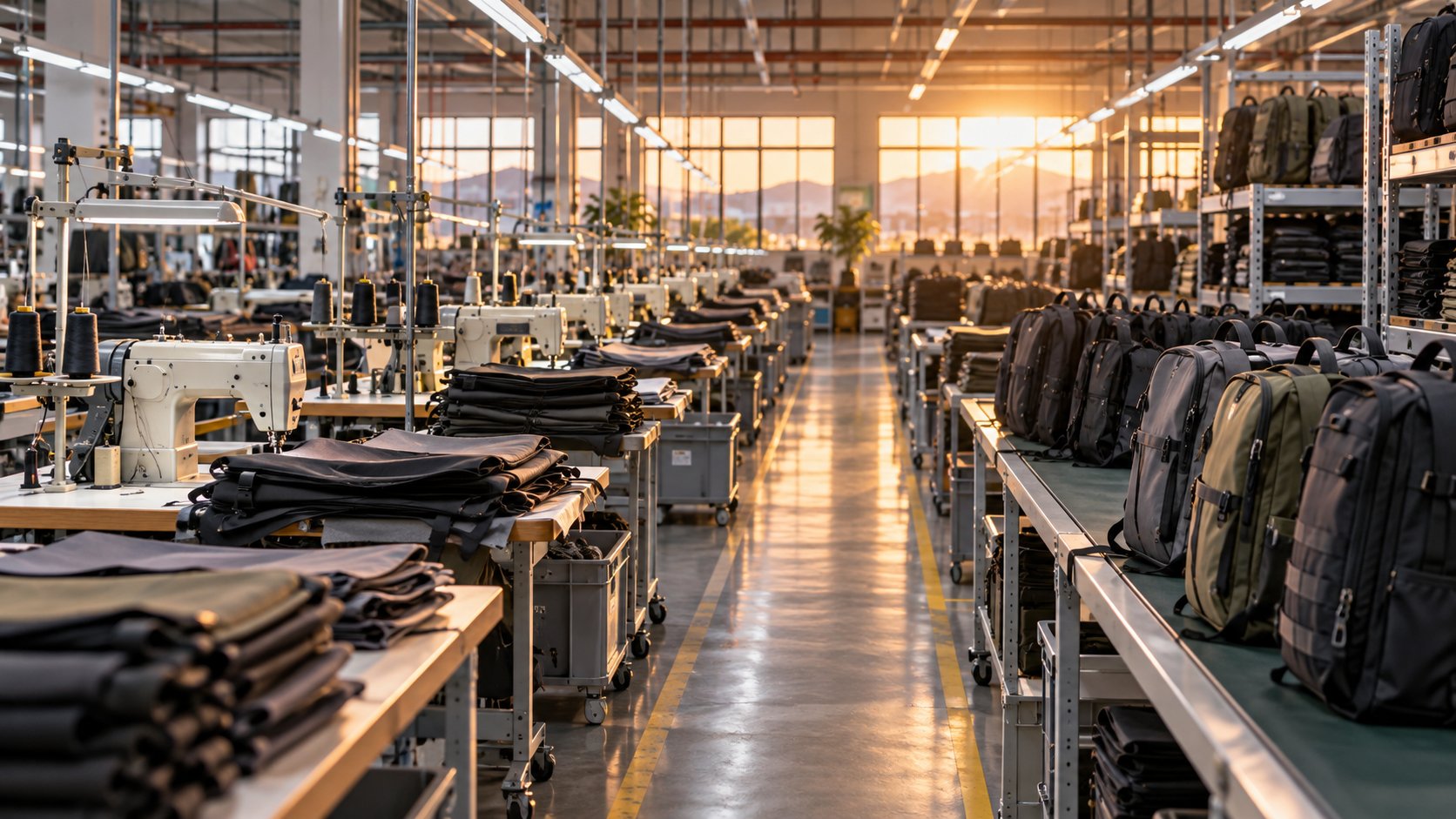
The company-level facts sit around this: Wellmax Luggage is an OEM/ODM luggage and bag manufacturer founded in 2013 in Quanzhou, Fujian, with a 12,000 m² facility, about 320 people producing roughly 150,000 pieces per month and buyers in more than 40 countries. Its quality management system is certified to ISO 9001:2015 and the facility is audited under the BSCI framework; both apply at company and factory level rather than as a product-specific performance claim.
FAQ
Is a PC shell always the more durable choice?
PC's elasticity gives it strong crack resistance under typical impact, and it is lighter than ABS at comparable strength. Durability in service also depends on wall section, forming consistency and hardware grades, so a resin name alone does not settle the comparison — the specification sheet and the sample do.
Does the aluminum frame set have a higher minimum because it is premium?
Its minimum is 200 sets with a 35-40 day lead time, measured in two-piece sets rather than individual cases, so the committed volume and calendar differ from the 300-piece, 30-35 day case lines. The terms reflect the construction's materials and assembly, not a premium on the case lines.
Next step
Buyers comparing shell constructions can send target sizes, resin preferences and quantities in one inquiry, and ask the three process questions directly — resin grade per line, forming process per style, and closure structure per configuration — so quotation, sample plan and reorder terms answer the same specification.