If you are sourcing a waterproof backpack for commuter, cycling or outdoor retail channels, the real question is not whether a sample looks sealed — it is whether the sealing method, fabric coating and closure design will hold up when the same pack runs through a full production batch. This guide breaks down how a roll-top waterproof backpack is actually built, then gives you a concrete checklist to verify it with your factory before and during production.
Waterproof vs water-resistant: what buyers should ask for
These two terms describe different constructions, not different marketing moods. A water-resistant pack — like our Technical Daypack 25L Water-Resistant — is typically built with stitched seams and a water-repellent face fabric. It handles rain and splashes, but water can migrate through needle holes and zipper gaps under sustained exposure.
A waterproof roll-top pack closes that gap in three places at once: a coated fabric body, seams that are bonded or welded rather than stitched, and a top closure that folds onto itself and buckles down. When you specify a waterproof backpack, ask your supplier to confirm each of these three points explicitly, and to state which closure and seam method the quoted price actually includes.
Construction anatomy of a roll-top waterproof pack
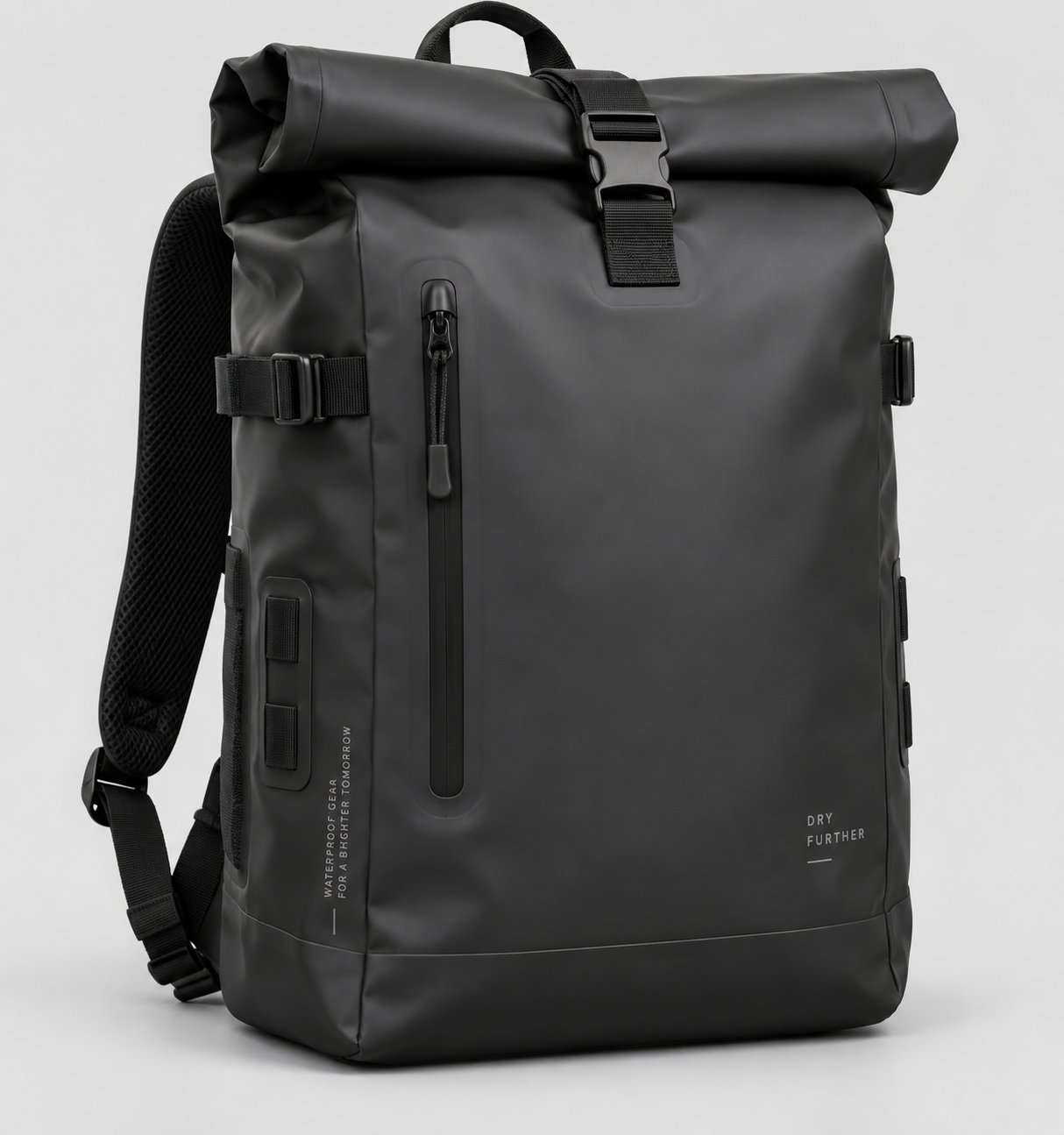
Using our Roll-Top Waterproof Backpack 30L as a reference build, here is what each component contributes — and where QC attention should land.
Roll-top closure and buckle sealing
The roll-top is a compression-and-fold system. The user loads the bag, rolls the top edge down two or three times, and secures it with the side-release buckle. Each roll creates a compressed fold that resists water entry from the top, while the buckle keeps the fold under tension instead of springing open in a pack or on a rack.
What buyers should verify at sampling: the roll height is sufficient for at least two full folds at rated capacity; the buckle holds under load without slipping; and the fabric at the fold line is flexible enough that repeated rolling does not create hard creases. Ask the factory to demonstrate the roll with the pack filled to capacity, not empty.
Welded seams vs stitched seams
Standard stitched seams leave needle perforations along every load-bearing join. On a waterproof build, those joins are instead welded or high-frequency bonded so the fabric surfaces fuse into a continuous layer. The 30L pack uses welded seams for this reason.
Welded seams change the QC picture. Instead of checking stitch density and thread tension, you inspect bond width, bond continuity, edge alignment and whether the coating has been disturbed at the seam. Ask for a section of seam to be shown on a sample, and look for uniform width along the full length — narrow or inconsistent bonding is where field failures start.
TPU-coated fabric and coating quality
The 30L body is built from TPU-coated fabric. The coating is what blocks liquid water; the base fabric provides tear and abrasion resistance. Coating quality shows up in three ways: evenness across the roll (no thin patches), adhesion to the base cloth (no lifting or bubbling), and flexibility after repeated folding.
When reviewing samples, handle the fabric at the fold lines and stress points. Ask the factory how coating weight and adhesion are controlled in incoming-material inspection, and request the material documentation they hold for the lot they intend to use on your order.
How buyers verify waterproofing before and during production
Verification is a sequence, not a single test. Run it in three stages: on samples, at the production line, and through the documentation your supplier can provide.
Fabric and coating checks on samples
- Compare the sample against the approved specification — base fabric, coating type and colour lot.
- Fold and crease the fabric along the roll-top path by hand; look for coating cracking or whitening at the crease.
- Check that coating coverage is uniform on both sides of the fabric where the construction requires it.
- Confirm the colour is consistent across panels, especially on black, olive and charcoal builds where batch variation is easier to spot.
Seam and weld inspection points
- Bond width: is it consistent along the entire seam, including curves and corners?
- Continuity: are there gaps, skips or bubbles where water could track through?
- Edge alignment: is the fabric edge captured fully inside the bond, or left exposed?
- Fold-line behaviour: does the welded area remain flexible after repeated rolling?
- Reinforcement points: are buckle anchors, haul loops and shoulder-strap attach points welded or otherwise sealed?
Exposure checks and test evidence to request from your factory
Samples can be checked for spray and rain behaviour, but the method and the result must be stated by the factory — do not accept a verbal "it's waterproof." Ask the following as questions, and confirm the exact method and results with your factory:
- Which spray or rain-exposure method will be used on the sample, and what parameter defines a pass?
- How many units from the batch will be inspected, and at which production stage?
- What documentation can be shared for the specific fabric lot used on your order?
- How are seam and weld inspections recorded, and can you review those records before shipment?
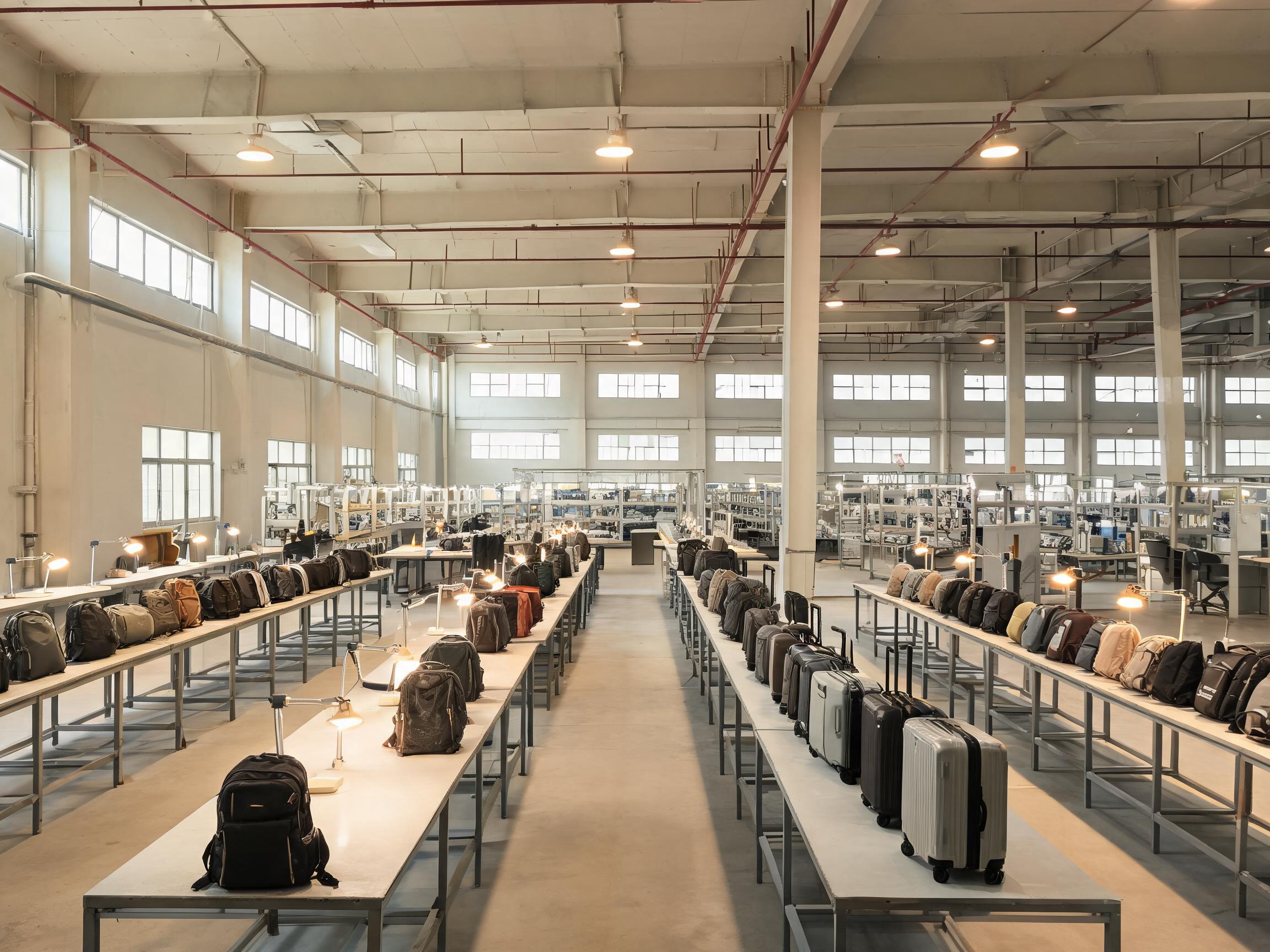
Our facility operates under an ISO 9001:2015 certified quality management system and is BSCI-audited, with dedicated sewing lines and finished-product inspection before packing. These are company-level credentials; the specific checks and results for your order still need to be documented by the factory and reviewed with you.
Positioning the product across commuter, cycling and outdoor channels
The same 30L roll-top platform serves three buyer groups with different priorities:
| Channel | What matters most | Construction implication |
|---|---|---|
| Commuter / urban retail | Clean finish, laptop-friendly interior, colour range | Padded back panel; black, olive or charcoal; colour and lining customisation |
| Cycling / bike retail | Compression stability, weather exposure on the rack | Roll-top folds under load; buckle retention; welded seams |
| Outdoor / trekking | Abrasion resistance, capacity for day use | TPU-coated fabric body; 30-litre capacity; reinforced attachment points |
If your range also needs a lighter everyday pack, the water-resistant daypack linked above is a different construction and should be specified separately — do not present the two as equivalent in waterproof terms.
Ordering notes (MOQ, lead time, customization)
For the Roll-Top Waterproof Backpack 30L: MOQ is 500 pcs, with a lead time of 30–35 days. OEM customisation of colour, lining and hardware is available; confirm the options and their minimums before sampling, since hardware and lining changes can affect the sampling timeline.
Packing is individual poly bag plus carton. If you need retail-ready packaging or a specific carton configuration, raise it during the sampling stage so it is captured in the approved specification.
As a Fujian-based OEM/ODM manufacturer founded in 2013, Wellmax Luggage operates a 12,000 m² facility with about 320 staff and a monthly output of roughly 150,000 pieces, serving buyers in more than 40 countries.
FAQ
- Can the 30L roll-top pack be used in heavy rain?
- The construction — TPU-coated fabric, welded seams and a buckled roll-top — is designed to resist water entry in wet conditions, but we do not state an absolute guarantee for every possible exposure. Ask your factory for the specific test method and results applicable to your order.
- How do I confirm the fabric and coating before bulk production?
- Approve a physical sample with the exact fabric and coating, and request the material documentation for the lot that will be used on your production run. Confirm the inspection method with the factory rather than relying on appearance alone.
- What customization is possible, and does it change the MOQ or lead time?
- Colour, lining and hardware can be customised. Minimums and timing for specific options should be confirmed before sampling, because hardware and lining changes may affect tooling and the sampling schedule.