Order Execution Guide
What buyers actually need to plan before placing a handbag order
Once you have shortlisted a China handbag manufacturer, the next question is not whether the factory can make a bag — it is whether it can make your bags, at your volume, inside a window your retail calendar can absorb. That depends on three things buyers can plan against: the factory's real monthly capacity, the craftsmanship checkpoints that must be locked before bulk sewing starts, and a lead-time schedule built from sample approval rather than from inquiry date.
This guide covers order execution only: how to read capacity, what to verify at each quality gate, and how to sequence a lead time so your goods ship without a last-minute scramble. Factory-selection criteria and material-cost calculations are handled elsewhere; here we stay on the production run itself.
Key takeaways
- Ask for monthly output by category, not one total number — a 150,000 pcs/month figure across all categories is a plant-wide ceiling, not a handbag-only promise.
- Lock hardware, lining, color and flap behavior at sample approval; changes after that point reset the clock.
- Treat 30–35 days after sample approval as the standard window for a 500-piece run; every late spec change pushes shipment day-for-day.
- Book your sewing-line slot before the Chinese New Year and pre-holiday peaks, or accept a schedule built around other orders.
Reading a factory's production capacity for handbags
"How many handbags can you make per month?" is the wrong question in isolation. A factory that also produces luggage, backpacks and travel items allocates capacity across categories, so the number that matters is the share of capacity your program can actually claim during your production window.
Monthly output is a scope, not a single figure
A mid-sized OEM/ODM bag plant — for example, a 12,000 m2 facility with cutting, sewing, assembly and inspection under one roof — might report roughly 150,000 pieces per month across all categories. That figure is a plant ceiling. It tells you the factory is not a trading desk reselling other factories' output, but it does not tell you how many satchels can run in October. Ask for two clarifications:
- Category mix: how many active handbag programs the factory typically runs at once, and which sewing lines they occupy.
- Line allocation: whether your order gets a dedicated sewing line or shares one with another style. Dedicated lines are the norm for OEM programs because they reduce changeover errors in hardware and lining.
Cutting, sewing and assembly capacity move at different speeds
Cutting is the fastest step and rarely the bottleneck. Sewing is where capacity is truly consumed: each style has its own stitch sequence, and a satchel with a magnetic flap and structured body takes measurably more sewing minutes than a simple open-top tote. When a factory quotes a lead time, it is quoting a sewing-line slot, not a cutting schedule. If a supplier promises a turnaround well below their stated standard window on a structured bag in peak season, that is a scheduling warning, not a competitive advantage.
How to book your production slot early
Capacity is reserved, not queued. The practical sequence is:
- Confirm MOQ and target ship window in writing before sampling; for reference, standard OEM handbag runs start at MOQ 500 pcs.
- Ask the factory to provisionally hold a sewing-line slot from a named week, conditional on sample approval by a stated date.
- Reconfirm the slot when the sample is approved — this is the trigger date the 30–35 day clock runs from.
Craftsmanship checkpoints that decide bulk quality
Handbag defects that survive to final inspection almost always originate in decisions made — or left unmade — before the sewing lines start. Three checkpoints carry most of the risk.
Sample approval: define the reference standard
The approved sample becomes the physical standard every bulk unit is measured against, so approval must be specific. For an OEM handbag program, confirm at this stage:
- Color and finish: PU shade under both daylight and store lighting, and whether the leather grain direction is controlled.
- Lining: weight, color, and how it is anchored at the top edge and interior seams.
- Hardware: finish (brushed, polished, antique), plating color, magnetic snap or closure strength, and zipper pull type.
- Structure: flap alignment, edge stitching distance, reinforcement in the base, and how the bag stands when empty.
- Labels and packaging: main label placement, dust bag, and carton configuration.
Photograph and annotate the approved sample; keep a signed copy on file. If any of these elements change after approval, treat it as a new sampling round, not an adjustment.
Inline inspection during sewing
Final inspection is too late to correct a systematic stitching error across a whole run. Inline checks caught on the line prevent the two most expensive handbag defects:
- Panel mismatch: left and right body panels cut or sewn to different proportions — a defect that only shows when the bag is filled and carried.
- Hardware alignment: flap hardware, snaps and strap anchors set off-center, which reads as a quality issue to the end customer even if tolerances are technically met.
Ask how the factory performs inline checks: who inspects, at which operation, and what happens when a batch is flagged. A factory that stops and re-checks the batch is safer to work with than one that pulls individual pieces off the line and continues.
Finished-product inspection before packing
Good OEM factories inspect finished products before packing, not after. This is the last point where a bag can be corrected without breaking packaging or missing a carton count. Confirm the inspection covers:
- Dimensional check against the approved sample (body length, height, handle drop).
- Function check: magnetic flap or snap open/close, strap attachment, interior pocket seams.
- Visual check: stitch consistency, edge paint neatness, glue or thread residue, hardware scratches.
- Packing check: dust bag, hangtag, polybag and carton count per carton.
Building a lead-time plan from sample approval to shipment
Lead-time plans fail most often because buyers use the inquiry date as day one. In an OEM/ODM cycle, sampling is part of the order process, and the production clock only starts when the sample is approved and the line slot is confirmed.
Sample rounds: plan for more than one
For new styles or branded programs, assume two sample rounds: an initial sample to assess construction and finish, and a confirmatory sample after any changes to hardware, lining or color. Include both rounds in your schedule. Compressing sampling to hit a ship date shifts risk into bulk production, where fixes are far more costly.
The standard 30–35 day production window
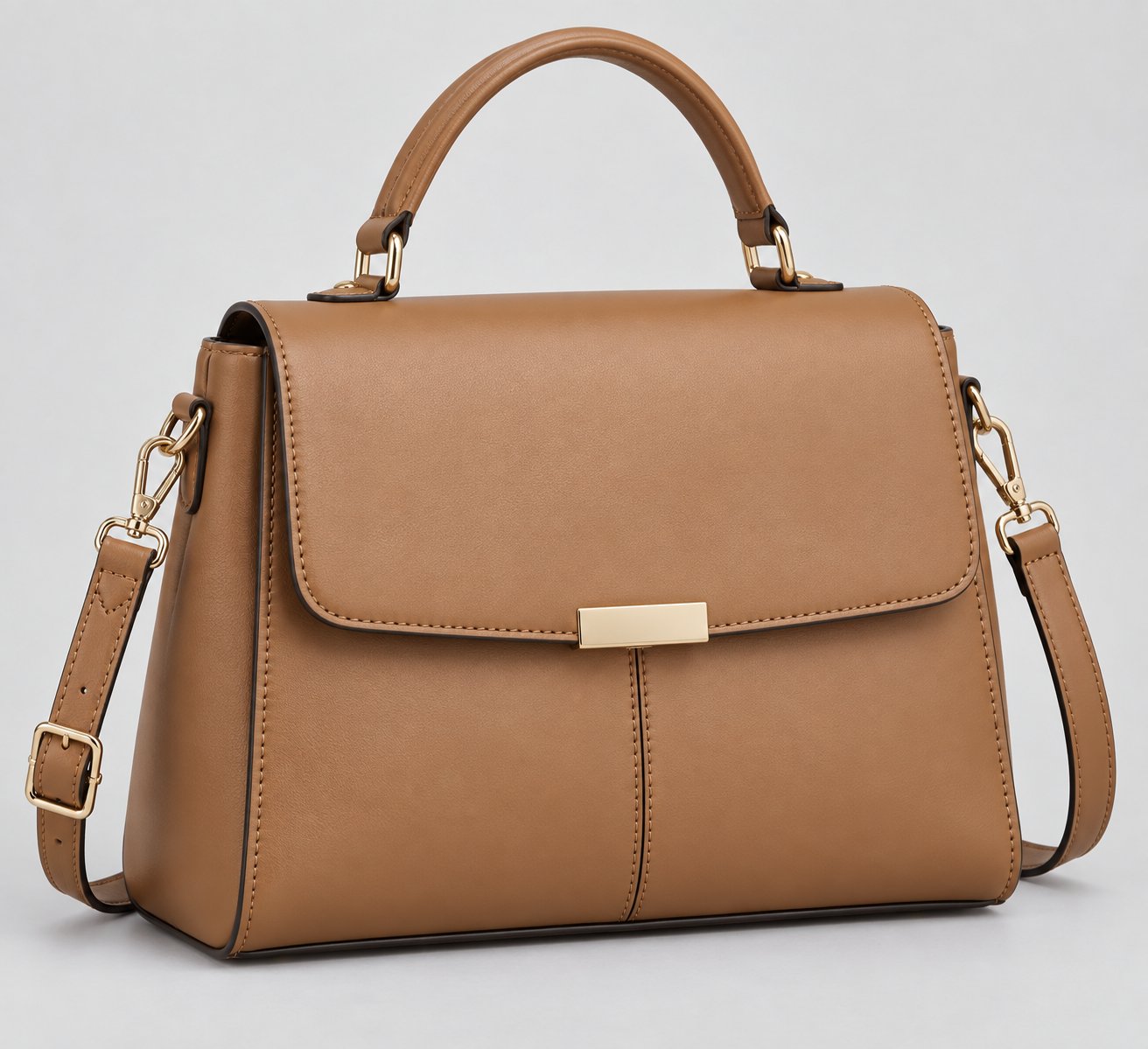
Once the sample is approved, a 500-piece handbag run on a dedicated line typically ships within 30–35 days. That window covers material pull, cutting, sewing, assembly, finished-product inspection and packing. Reference programs such as the PU leather satchel with magnetic flap and the PU leather tote with magnetic snap both run on this 30–35 day standard after sample approval, at MOQ 500 pcs.
Buyers can use the window as a planning baseline, but should treat it as production time only. Add your own buffers for sample rounds, inspection scheduling and freight before finalising a delivery-to-warehouse date.
What moves the schedule — and by how much
| Factor | Effect on lead time | How to manage it |
|---|---|---|
| Spec change after sample approval | Restarts the sampling and production clock | Freeze color, lining and hardware before approval |
| Peak season (pre-holiday, pre-CNY) | Line slots book out earlier; watch for slot slippage | Reserve the line slot well ahead of your production window |
| Third-party inspection | Adds days if booked after packing | Schedule inspection for the finished-but-unpacked stage |
| Custom packaging | Can delay cartoning if artwork or supplier lags | Approve dust bag and carton artwork with the sample |
Coordinating packaging and third-party inspection
If your program uses third-party inspection, align it deliberately with the factory's inspection stage. Booking inspectors after goods are packed means unpacking cartons and repacking, which adds handling time and risk. Book the inspection window for when finished products are ready but not yet sealed into cartons, and give the factory the inspection date when you confirm the production slot.
Packaging is the other frequent late-stage delay. Dust bag, hangtag and carton artwork should be approved alongside the sample, not after bulk sewing begins. When packaging is confirmed early, the 30–35 day window holds; when it is not, cartoning — not sewing — becomes the constraint.
Practical next steps for your order
- Request the factory's monthly output by category and confirm which sewing line will run your style.
- Lock a provisional line slot tied to a named sample-approval date.
- Approve hardware, lining, color, labels and packaging in one sampling round.
- Schedule third-party inspection for the finished-but-unpacked stage.
- Build your delivery date from approval-day plus 30–35 days — not from inquiry day.
Wellmax Luggage is an OEM/ODM luggage and bag manufacturer in Fujian, China, founded in 2013, operating a 12,000 m2 facility with cutting, sewing, assembly and inspection under one roof. OEM buyers can customize color, lining and hardware, with orders running on dedicated sewing lines and finished-product inspection before packing.