Sourcing Guide
Ordering handbags from a Chinese manufacturer is a well-established process, but for a first-time buyer it can feel opaque: what happens after you send an inquiry, how long each stage takes, and what you must prepare to avoid delays. This guide walks through the full buying journey—inquiry, sampling, confirmation, mass production, inspection, payment and shipment—so you can plan your order with realistic expectations and fewer surprises.
- A complete written specification and a formally approved sample are what the whole order is measured against.
- Agree the inspection standard before production starts, not after defects appear.
- Payment milestones belong in the proforma invoice so both teams work from the same document.
What this guide covers
Step 1: Make an Inquiry That Gets Accurate Answers
The quality of the quotation you receive depends almost entirely on the quality of your inquiry. Before contacting a supplier, prepare: target styles or reference images, material preferences (PU leather, genuine leather, nylon, canvas), approximate order quantity, target market, and any branding requirements such as logo placement and hangtags.
A capable handbag factory will reply with questions of its own: closure type, hardware finish, lining, color range and packaging format. For example, at Wellmax Luggage our handbag range covers structured totes, crossbody flap bags, bucket bags, satchels and quilted shoulder bags in PU leather, nylon and canvas—so an inquiry that specifies “PU leather tote, magnetic snap closure, black/camel/tan, individual dust bag + carton packaging” can be quoted far faster than a one-line request. When you compare quotations across suppliers, make sure each one is quoting the same specification; a cheaper quote often reflects thinner material or simpler hardware.
Step 2: Sampling and Sample Approval
Once the specification is agreed, the factory’s design and development team prepares a sample. For OEM styles based on an existing design this is usually straightforward; for ODM development—where the factory’s designers create or adapt a style for your brand—expect an extra design round before anything is cut. Always evaluate the physical sample, not photos: check stitching density, seam alignment, hardware feel, zipper smoothness, lining fit and how the bag holds its shape when loaded.
Approve the sample formally and in writing. The approved sample becomes the quality benchmark for mass production, and any later dispute is settled against it. If you need small changes after seeing the sample—handle length, pocket layout, logo size—confirm them in a revised specification sheet rather than verbally.
Step 3: Confirm the Commercial Terms
With the sample approved, lock down the commercial details: final unit price and what it includes (packaging, labels, freight terms), order quantity, Incoterms (FOB, EXW or CIF depending on your logistics setup), production lead time, payment terms and warranty arrangements for defects. MOQs vary by material and construction, so confirm them for your specific style rather than assuming a category-wide number.
Step 4: Mass Production
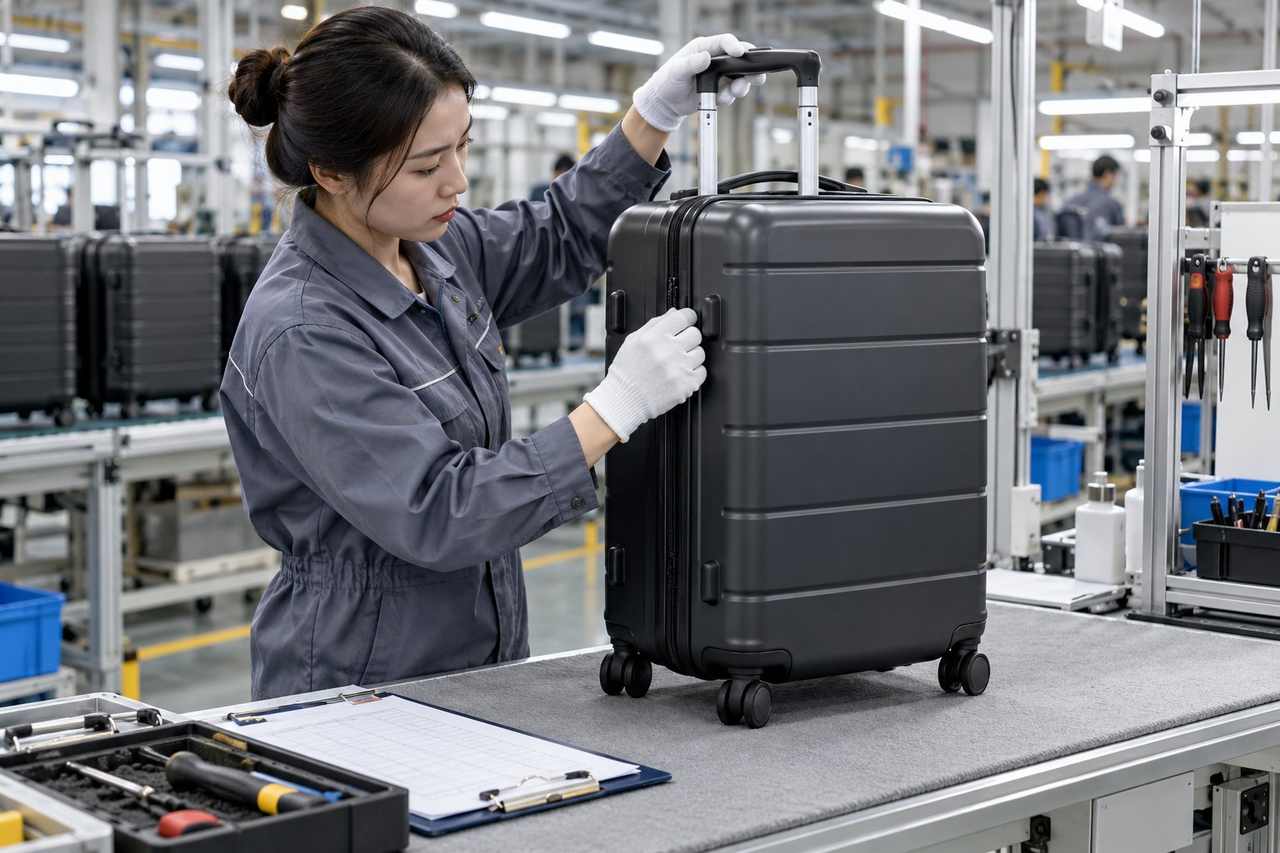
Production in a well-run factory follows a fixed sequence: material inspection and cutting, component preparation, sewing lines, assembly, and finishing. Wellmax operates a 12,000 m² facility in Fujian with cutting, sewing, assembly and inspection under one roof, producing roughly 150,000 pieces per month across trolley cases, backpacks, business bags and handbags—so capacity is rarely the constraint; specification discipline is. Ask the factory for a pre-production sample or production photos at the start of the run, and define the inspection standard (typically AQL-based) before production begins, not after.
Step 5: Quality Inspection
Before packing, finished handbags should be checked against the approved sample: workmanship, hardware function, color consistency across the batch, and packaging accuracy. You can inspect in person, appoint a third-party inspection company, or rely on the factory’s internal finished-product inspection stations—many buyers combine the factory’s own inspection with an independent final random inspection for first orders. Agree in advance what happens if defects exceed the agreed acceptance level: rework, replacement, or price adjustment.
Step 6: Payment
Standard practice for export orders is a deposit before production with the balance against a copy of the shipping documents. Payment methods commonly include T/T and, for established relationships, L/C. Whatever arrangement you agree, make sure the payment milestones are written into the proforma invoice so both teams work from the same document.
Step 7: Shipping and Export
After final inspection and packing, goods are loaded and shipped under the agreed Incoterm. Confirm carton markings, shipping marks and the packing list details before loading, since errors at this stage are costly to fix after departure. A factory with organized export experience—Wellmax’s export sales team handles inquiries and order follow-up for buyers in more than 40 countries—will prepare documents (commercial invoice, packing list, and where applicable certificates of origin) consistently.
What Makes the Process Smooth
Across all seven steps, three things decide whether a handbag order runs smoothly: a complete written specification, a formally approved sample, and an inspection standard agreed before production. Factories with certified quality systems—Wellmax is certified to ISO 9001:2015 and audited under the BSCI social compliance framework—provide the documentation and process discipline that make these checkpoints verifiable rather than verbal.
| Stage | What it locks in | What you should prepare |
|---|---|---|
| Inquiry | Specification basis for quotation | Style references, material, quantity, target market, branding, packaging |
| Sampling | Physical quality benchmark | Written approval and any changes on a revised spec sheet |
| Commercial terms | Price scope, Incoterm, lead time, payment terms | Confirmed MOQ for your specific style |
| Mass production | Production sequence and inspection standard | Pre-production sample or production photos |
| Inspection | Acceptance level and remedy for defects | Inspection method and acceptance criteria |
| Payment | Deposit and balance milestones | Proforma invoice reflecting agreed milestones |
| Shipping | Carton markings, packing list, export documents | Shipping mark and document checklist |
Frequently Asked Questions
How long does the whole process take?
It depends on style complexity, order quantity and the shipping schedule. Sampling typically takes the shortest time, mass production the longest. Ask your supplier for a stage-by-stage timeline for your specific style instead of relying on generic industry averages.
Can I order small quantities for a first trial?
Many factories accommodate trial orders at adjusted unit prices. Confirm the trial MOQ and its price difference before sampling so there are no surprises at the quotation stage.
Can the factory produce under my own brand?
Yes—OEM production with your logo, labels and packaging is standard. Share artwork files early, because logo methods (embossing, printing, metal plates) affect both cost and sampling time.
What information should my first inquiry include?
Style references or sketches, material, quantity, target market, branding requirements and packaging format. The more complete the inquiry, the faster and more accurate the quotation.
Planning a handbag range and want a quotation you can compare line by line? Send your style references, material, quantity, target market, branding and packaging format to our export sales team, and we will work through the seven steps above against your specification.