Product-Line Planning Guide
If you sell through family retail, kids specialty stores or gift channels, the question is not whether kids luggage sells — it is which sizes, colorways and shell weights will actually earn shelf space. This guide walks through the trade-offs that shape a kids line sourced from a China OEM/ODM factory, including a published 20-inch cartoon spinner model you can use as a reference point.
- Build a size ladder (e.g., 16/18/20 inch) as planning guidance and confirm final dimensions with your factory.
- Cartoon colorways drive shelf appeal, but colorway depth should be planned against minimums, not against shelf space alone.
- Lightweight ABS shells keep empty weight manageable for younger children; confirm weight per size before committing.
- OEM development moves through design brief → tooling → sampling → approval → mass production; confirm options and minimums first.
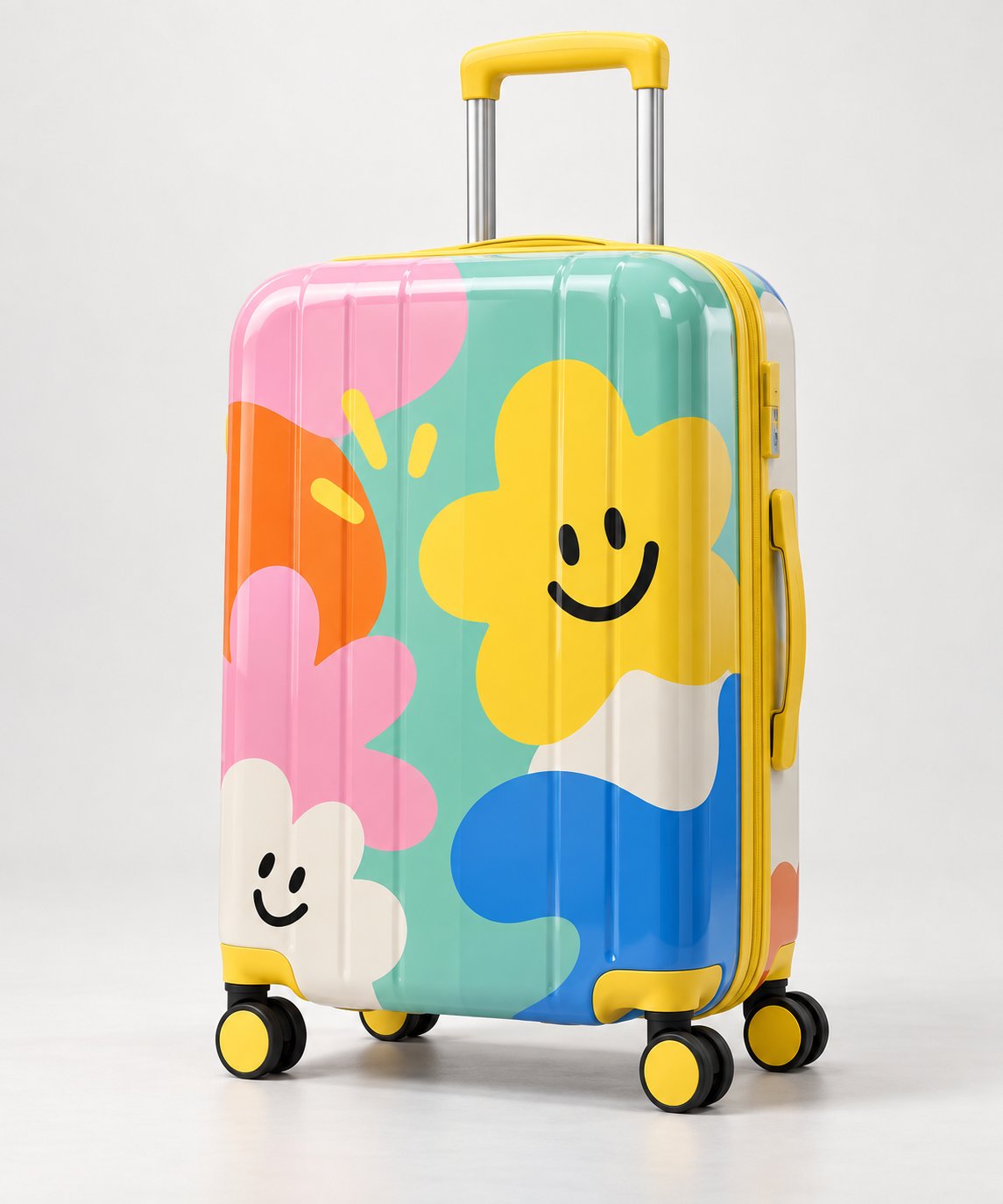
- Reference model: Cartoon Dopamine Spinner Luggage 20 inch — ABS shell, 4 spinner wheels, MOQ 300 pcs, lead time 30–35 days.
Wellmax is a Fujian-based OEM/ODM luggage manufacturer founded in 2013, operating a 12,000 m² facility with about 320 staff and roughly 150,000 pieces per month. Buyers in more than 40 countries work with us across sampling, tooling, mass production, inspection and export. That full cycle matters for a kids line because the decisions below — size, colorway, shell weight — all get locked in before mass production starts.
What family-travel buyers look for in kids luggage
Family retail buyers evaluate kids luggage differently from adult luggage. The specification that moves a purchase is usually not the shell material alone but how the piece performs for a child traveling with adults. In practice, three criteria show up repeatedly in assortment planning:
- Carry independence. Parents look for a piece a child can roll, lift and manage at an airport or station. Spinner wheels and low empty weight matter here.
- Visual identity on shelf. Kids choose by color and character before a parent checks the tag. A cartoon colorway is a merchandising decision as much as a product one.
- Price-band fit. Kids luggage sits in a specific retail band and is often bought alongside adult luggage. Consistency across the line helps the buyer present it as a family set.
The published Cartoon Dopamine Spinner Luggage 20 inch is a useful reference because it combines these three: an ABS shell, 4 spinner wheels, a cartoon dopamine colorway, and individual carton packaging. It is a cabin-size piece, which brings the market rules into play.
Planning the size ladder
A kids line rarely sells as a single size. Retailers typically want a small step-up ladder so a child can move from a compact piece to a cabin-size one as they grow. The ladder below is planning guidance for buyers to confirm with their factory — it is not a fixed Wellmax SKU set.
| Ladder position | Typical role in assortment | What to confirm with your factory |
|---|---|---|
| 16 inch (planning reference) | Entry size for younger children; low price point | Whether the shell and wheel set are offered at this size, and minimum quantity per size |
| 18 inch (planning reference) | Mid step; bridge between entry and cabin size | Dimension tolerance, trolley height, and whether it shares components with the cabin size |
| 20 inch | Cabin-size piece for older children and family sets | Published reference available: Lightweight ABS Cabin Trolley 20 inch |
Matching sizes to age groups
Age mapping is a retail heuristic, not a technical specification. A common approach is to place the smallest size at the youngest age band and the cabin size at the upper end of the kids range. The exact cut-off depends on your market's typical age for independent travel and on the physical dimensions of each piece. Because a nominal size and its measured dimensions can differ, buyers should ask for the actual height, width, depth and empty weight of each ladder position before fixing an age map.
Cabin-size rules to confirm per market
Cabin allowance is set by airlines and regulators, not by the factory. A 20-inch piece is commonly treated as cabin size, but the exact allowance varies by carrier and by fare class. Two points follow for planning:
- Treat “cabin size” as a marketing description until the dimensions are checked against the specific carriers your retail customers reference.
- Confirm the measured dimensions per size rather than relying on the nominal inch label. This is the single most common source of return claims in family channels.
If your channel sells to airlines or travel retailers, ask the factory for a dimension drawing per ladder position so you can map it to carrier rules yourself.
Colorway and graphic strategy
Cartoon colorways are the most visible differentiator in a kids assortment, and also the part most sensitive to minimum quantities. Planning colorway depth early avoids a situation where shelf appeal is strong but the order cannot meet per-color minimums.
Why cartoon colorways drive shelf appeal
In family retail, the child is often the one who picks the item off the shelf, while the parent approves the purchase. A cartoon dopamine colorway gives the child an immediate reason to choose, and gives the retailer a visual block that reads clearly from a distance. This is why the published reference model uses a cartoon dopamine colorway rather than a neutral palette. For a buyer, the practical implication is that colorways are a merchandising asset — they should be planned as a set, not as an afterthought.
Planning colorway depth across the line
Colorway depth is a trade-off between shelf impact and order feasibility. Three approaches are common:
- Single hero colorway. One strong cartoon execution across the full size ladder. Easiest to meet minimums; weakest shelf differentiation.
- Two to three core colorways. A core set repeated across sizes, giving the retailer a color story without fragmenting the order.
- Hero plus seasonal accents. A permanent core plus limited accents for holiday or back-to-school. Needs the shortest planning window and the clearest minimum confirmation.
Regardless of approach, confirm with the factory how minimums apply — per size, per colorway, or per order — before committing to a color plan. OEM customization of shell color, graphic pattern and hardware is available, but options, tooling and minimums should be confirmed with the team before sampling.
Material and weight choices
Shell material and empty weight are linked decisions. For a kids line, the goal is a shell that protects contents while staying light enough for a child to handle.
Lightweight ABS shells and why empty weight matters for kids
ABS is a widely used shell material for entry and mid-tier luggage, and it is the material specified on the published 20-inch reference model. The practical point for family retail is empty weight: a child who cannot lift or roll the case will not use it independently, and the parent effectively carries two bags. Lighter shells reduce that friction, which is why weight belongs in the specification sheet alongside dimensions.
Empty weight is also a competitive shelf metric. When two kids cases sit side by side at similar prices, a lighter piece is easier to demonstrate and easier to recommend. Buyers should request the empty weight per ladder position and compare it against the age band the piece is meant for.
OEM development flow for a kids line
OEM development follows a defined sequence. Each stage produces something the buyer approves before the next begins, which is how the line avoids surprises at mass production.
- Design brief. The buyer supplies size ladder, colorway direction and any artwork or pattern reference. This is also where the target price band and channel are stated.
- Option and minimum confirmation. The factory confirms which shell colors, graphic patterns and hardware are feasible, and what tooling and minimums apply to each.
- Tooling. Where a new shell or graphic requires tooling, this stage is scheduled before sampling.
- Sampling. A sample is produced for the buyer to review against the brief.
- Sample approval. The buyer approves the sample; the approved sample becomes the production reference.
- Mass production, inspection and export. Production follows, with inspection and export handled through the full order cycle.
For a kids line, the most common delays happen at stage two. If the colorway plan calls for more variants than the minimums support, the brief has to be revised before tooling. Confirming options and minimums before sampling keeps the schedule realistic.
Buyer checklist before requesting a quotation
Use this checklist to assemble the information a factory needs to quote accurately. Items you cannot answer yet are worth confirming internally before the request goes out.
| Item | What to specify |
|---|---|
| Size ladder | Which sizes you want (e.g., 16/18/20 inch), and whether each must share components |
| Colorway plan | Number of colorways, which are core vs. seasonal, and any artwork reference |
| Shell and weight | Preferred shell material and any maximum empty-weight target per size |
| Target channel | Family retail, kids specialty, gift distribution or travel retail |
| Quantity | Total order quantity and expected split per size and colorway |
| Packaging | Whether individual carton packaging is required, as with the published 20-inch reference model |
| Customization | Which elements you want customized — shell color, graphic pattern, hardware |
| Timeline | Required delivery window; reference lead time is 30–35 days for the published model |
Bringing these answers to the first conversation shortens the path to a usable quotation and a sample that reflects the intended line.
FAQ
- What is the minimum order quantity for a kids luggage line?
- The published 20-inch Cartoon Dopamine Spinner Luggage carries an MOQ of 300 pcs. Minimums for other sizes and colorways should be confirmed with the factory, since they can vary by shell, colorway and tooling.
- Can shell color, graphic pattern and hardware be customized?
- Yes — OEM customization of shell color, graphic pattern and hardware is available. Confirm the specific options, tooling requirements and minimums with the team before sampling.
- What is the typical lead time?
- The published 20-inch model has a lead time of 30–35 days. Lead time for a multi-size, multi-colorway line depends on tooling and sampling, so confirm the schedule against your specific brief.
If you are building a kids line for family retail, start with the size ladder and colorway plan, then confirm options and minimums with the Wellmax team before sampling. The published Cartoon Dopamine Spinner Luggage 20 inch is a working reference for a cabin-size piece, and the Lightweight ABS Cabin Trolley 20 inch shows a lightweight ABS cabin option alongside it.