Quotes from custom bag manufacturers in China look almost identical on paper: similar unit price, similar MOQ, similar lead time. The differences surface only when you probe four things a quote sheet does not show — sampling discipline, tooling ownership, communication behavior and real production capacity. This guide is written for buyers placing a first or second custom order, typically from about 1,000 to 50,000 pieces.
Sampling: What a Sample Proves, and What It Does Not
A sample proves a factory can make one good unit with its best operator. It does not prove the same factory can make 8,000 units to the same standard in week six. Treat the sample as the start of verification, not the end.
Before paying for a sample, ask:
- Will the sample be made in the sample room or on the production line? Sample rooms often have materials and machines the line does not.
- Which materials will be used — stock fabric, or the exact mill and specification you asked for? Get material name, weight, coating and finish in writing.
- Which components are branded and which are generic? Zippers, sliders and buckles are where cost quietly disappears.
- What is the stitching density, and where are bar-tacks placed?
A typical sampling lead time for a soft bag using existing materials is roughly 7–15 days; custom prints, new hardware or an unusual structure take longer. A paid sample credited against the bulk order is a normal, healthy arrangement — a free sample is often made from whatever fabric is already on the shelf.
Seal the approved sample, sign and date it, keep one copy and require the factory to keep the other, then reference it in the purchase order as the quality benchmark. Without a sealed golden sample, disputes about shade, hand-feel or stitch count become arguments rather than comparisons.
Tooling: The Hidden Cost and the Hidden Hostage
Depending on your product, tooling may include cutting dies, screen-printing frames, embossing molds, logo molds for metal hardware and sewing templates. Ask directly:
- Is tooling charged separately, and is it one-time or subject to a maintenance fee?
- What is the tooling lead time before sampling can begin?
- Is any part of the cost refundable at a volume threshold?
- Who physically holds the tooling — this factory or a subcontractor?
- If you move to another supplier later, do you receive the tooling or the files to remake it?
Put tooling ownership and transfer into a written agreement or an explicit purchase-order clause. A one-line email promise is not transferable when the salesperson changes jobs.
Communication: Test It Before You Commit
Pre-sale reply speed is not proof of good service, but it is a signal. Send three questions that require internal checking rather than a template answer — for example, what MOQ applies if the zipper pull is custom, what lead time applies to a specific quantity in a specific month, and whether you can see the format of the final inspection report. Vague, instant answers to technical questions are a warning sign; so is a refusal ever to say "let me check."
Also worth confirming during the inquiry stage: who your English-speaking technical contact is, whether a live video walkthrough of the production floor is possible, how the factory plans around Chinese New Year shutdowns, and who handles escalation when your assigned contact is on leave.
Capacity Checks: Verify Sideways
Capacity answers are easy to inflate, so verify them from several directions. Ask for monthly output for your specific bag type rather than a general figure — a factory strong in totes may be weak in structured luggage. Ask how many sewing lines and operators handle your category, which steps are in-house and which are subcontracted, what share of monthly capacity your order would represent, and the maximum comfortable order size in a single month. An order below roughly 15–20% of a factory's relevant output stays visible on the schedule; where you are a rounding error, larger clients push you back. Bag demand is seasonal, so confirm peak-month capacity in writing.
A Practical Vetting Sequence
- Shortlist three to five manufacturers from directories, trade shows and referrals.
- Send the identical RFQ with a fixed specification so answers are comparable.
- Compare tooling terms, MOQ, payment terms and lead time — not price alone.
- Order paid samples from the top two and compare them against your spec.
- Request a video walkthrough of the line that will run your order.
- Place a small trial order before committing to a full season.
- Book a third-party inspection covering during-production and pre-shipment stages.
- Scale only after the inspected trial order lands clean.
Reluctance to allow inspection or a walkthrough is itself information.
How We Handle These Steps
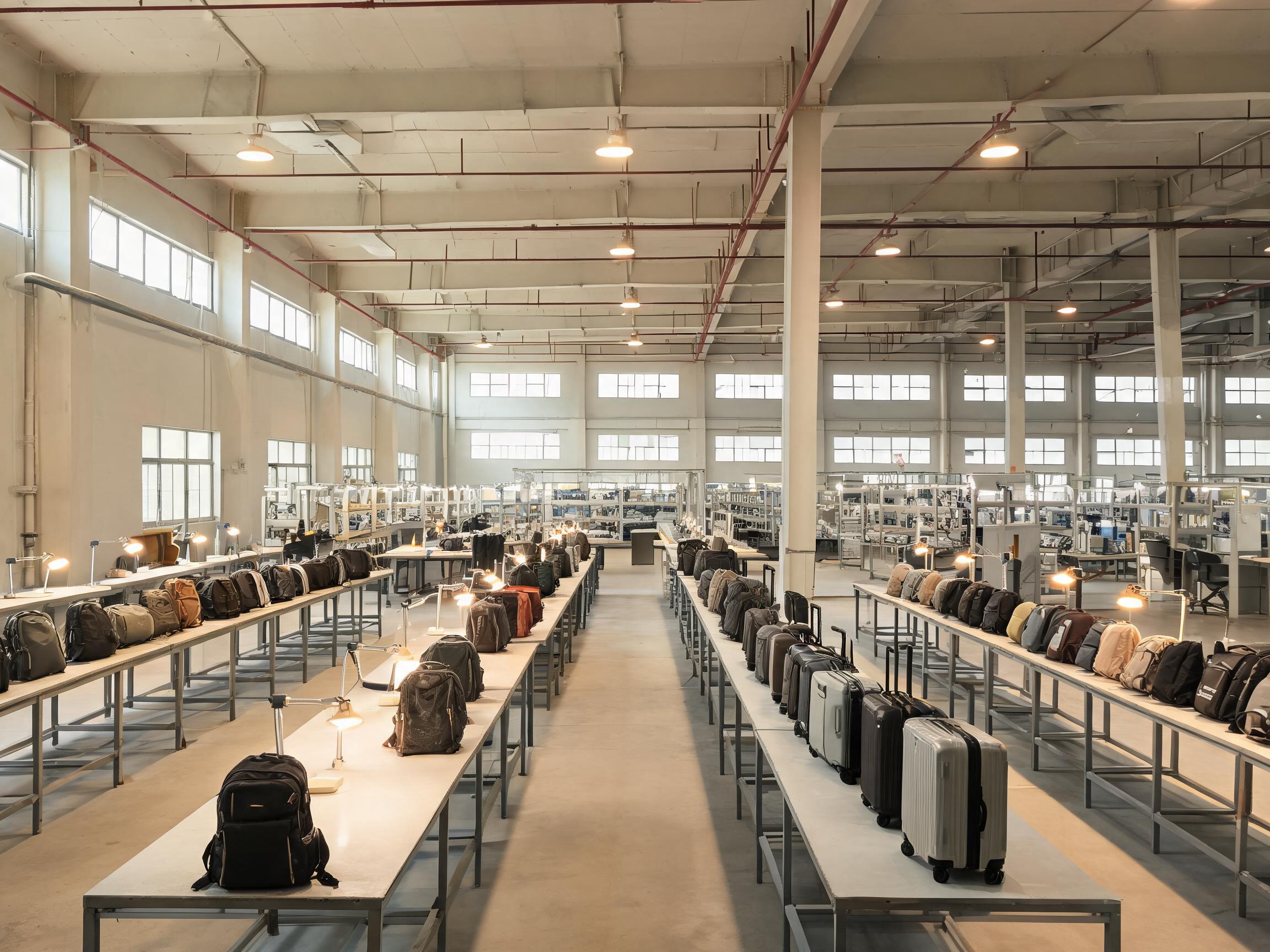
Wellmax Luggage is an OEM/ODM bag manufacturer founded in 2013 in Fujian, China, with about 320 employees in a 12,000 m² facility producing roughly 150,000 pieces per month across trolley cases, backpacks, business bags and handbags. Sampling, tooling, mass production, quality inspection and export are handled within one order cycle — our article on the OEM sampling and tooling process describes the stages in detail — and in-house designers prepare styles, materials and samples for OEM and ODM programs. Colorway and surface customization options for bag programs are covered separately in this guide. The facility is certified to ISO 9001:2015, audited under BSCI, and finished bags pass inspection stations before packing — see an example of a custom daypack program in our 25L water-resistant technical daypack.
Next Step
Send one fixed specification to three shortlisted suppliers and ask each for tooling terms, capacity share and inspection policy in writing. If one of them is Wellmax, share your specification and target volumes and we will respond with a sample plan, tooling scope and production schedule you can hold us to.