B2B Purchasing Guide
Placing a first order with a China backpack manufacturer is less about finding a factory and more about running a controlled process: a clear request for quotation, a sample both sides agree on, a purchase order that fixes the details, a payment structure you have confirmed line by line, an inspection before shipment, and a document set that lets the goods clear customs without surprises. Most first-order problems come from steps that were skipped or left vague, not from the factory being unable to sew a bag.
This guide walks through that path from a buyer's side. It covers what to put in an RFQ, how sampling and approval work, what a PO should nail down, which payment points to verify, how to organize inspection, and which export documents you and the supplier each handle. It does not cover cost breakdowns or the sewing floor — the intent is the commercial and documentary sequence, so you can move from enquiry to a repeatable order.
Key takeaways

- The RFQ defines the product; a vague RFQ produces vague quotes that cannot be compared.
- Nothing goes to bulk until a physical sample is approved and the approval is recorded.
- Payment terms are confirmed per order with the supplier — currency, deposit and balance structure, and release conditions are items to check, not assumptions to make.
- Inspection should have defined criteria and a fixed point in the timeline, before the balance is released.
- Documentation is a shared responsibility: the supplier issues commercial documents, and you check names, quantities and values against the PO before the shipment moves.
What this guide covers
Step 1 — Building an RFQ the factory can quote against
A request for quotation is the document that decides how comparable your quotes are. Send three suppliers the same thin description and you will get three quotes that cannot be lined up against each other, because each factory filled the gaps with its own assumptions about fabric, hardware, lining, packaging and quantities.
Put these items into the RFQ in writing:
- Product type and intended use. Commuter laptop pack, travel pack, business briefcase, trolley bag — the form factor changes the construction and the tooling.
- Dimensions and capacity. Give litre capacity and key external dimensions, plus what has to fit inside. For example, a laptop compartment must state the maximum screen size it has to hold.
- Materials and finishes. Fabric type, lining, zipper brand or grade if you require one, hardware finish, webbing and padding expectations. If you have no preference, say so and ask what the factory proposes.
- Colourways. List the colours you need and the quantity split across them.
- Target quantity and any tiering. State the order quantity you are planning and ask whether the price changes at higher volumes.
- Customisation scope. Logo method (embroidery, print, rubber patch, woven label), interior layout changes, hardware substitutions — anything that makes the bag yours rather than a catalogue item.
- Packaging. How each unit is packed and how units are packed for shipping.
- Compliance and documentation needs. Tell the factory which markets the goods are going to and what documentation or labelling those markets require, so it can confirm what it can support before quoting.
- Destination and shipping terms. Port or door, and the Incoterm you want quoted (FOB, EXW, and so on).
- Timeline. When you need the sample, and when you need the bulk order to ship.
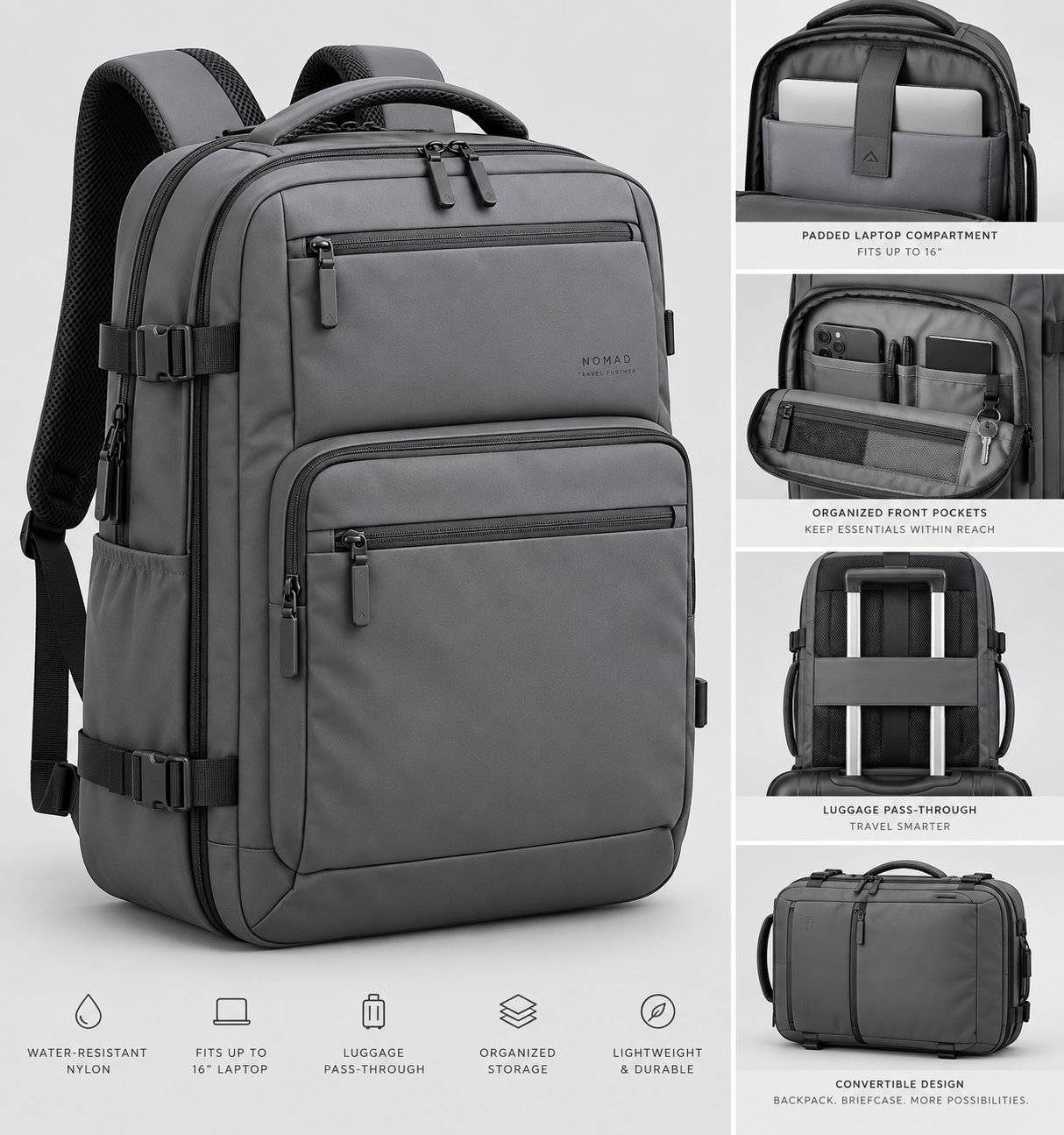
To see how these fields translate into an actual product, the specifications on the Laptop Commuter Backpack 18L — 18L capacity, polyester shell, a dedicated compartment that fits laptops up to 15.6 inches, colourways in dark grey, black and navy, MOQ 500 pieces, 30–35 day lead time after sample approval — are the kind of fixed data points you should be asking every supplier to confirm in writing at the RFQ stage. The same applies to the Convertible Travel Backpack 35L: waterproof nylon, trolley sleeve, black/grey/navy, MOQ 500 pieces, 30–35 days, and OEM adjustment of colour, lining and hardware. Notice that these specifications answer most RFQ questions before they are asked, which is why comparing quotes gets easier once both sides are working from the same numbers.
Wellmax Luggage, an OEM/ODM manufacturer based in Fujian with a 12,000 sqm facility and roughly 320 staff, produces about 150,000 pieces a month across trolley bags, backpacks, business bags and handbags for buyers in more than 40 countries — so the RFQ points above reflect the kind of fixed specifications buyers receive back in writing. Company and factory certifications such as ISO 9001:2015 and BSCI apply at the organisation and facility level, not to individual products, which is why an RFQ should ask the supplier to state, item by item, what is confirmed and what still needs to be arranged. Established in 2013, the company has built its order flow around exactly this document-first sequence.
What the quote should contain
When quotes come back, check that each one states the unit price, the price basis (per piece, with or without packaging), the MOQ, the lead time measured from sample approval, the quoted Incoterm, and the validity period. A quote missing any of these cannot be compared to another, because you are not comparing the same thing. Ask for the missing item rather than assuming the standard.
Step 2 — Sampling and sample approval
The sample is where design intent becomes a physical object, and it is the only reliable way to check that the factory understood the RFQ. The cost and timing of sampling are commercial points to agree with the supplier per project, but the sequence is usually the same: design confirmation, sample production, sample shipment, your review, revision if needed, and written approval before bulk.
Review the sample against the RFQ field by field, not on general impression. Open and close every zipper, load the laptop compartment with a device of the specified size, check strap attachment and stitching at stress points, confirm the colour against the approved colourway, and confirm the packaging matches what you specified. If something is wrong, describe it in the same terms the factory used in its quote — fabric, dimension, component — so the correction is unambiguous.
Record the approval. A sample approval that exists only in an email thread is easy to lose. Confirm in writing which sample version is approved, and keep one signed or photographed reference sample for both sides. Bulk goods should be checked against that reference, not against memory.
Step 3 — The purchase order
The purchase order converts an agreed quote into a contract. It should repeat, not cross-reference, the terms that matter, because the PO is the document both sides will go back to when something is disputed. A workable PO carries:
| PO field | What to state |
|---|---|
| Product identification | Model or item code, description, and reference to the approved sample |
| Specification | Materials, dimensions, capacity, colourways, hardware, logo method |
| Quantities | Total units and the split by colour, size or variant |
| Price | Unit price, price basis, currency, and what is included in the price |
| Incoterm and destination | The agreed trade term and the named place or port |
| Dates | Sample approval date, bulk lead time, required ship date |
| Packaging | Inner packing, master carton, and any labelling requirements |
| Inspection | Inspection point, criteria, and who attends or commissions it |
| Documents | The commercial document set the supplier will provide |
| Amendments | How changes are requested and confirmed after the PO is issued |
Keep amendments formal. Once the PO is signed, a change to quantity, colour split or packaging should be confirmed in writing and reflected in a revised PO or an amendment sheet, or the factory may produce to the original and be technically correct to do so.
Step 4 — Payment terms to confirm per order
Payment terms are negotiated for each order rather than pulled from a standard table. What matters for a buyer is that the structure is confirmed in writing before production starts, and that each element is understood on both sides. Before you commit, confirm these points with the supplier:
- Currency and invoicing entity. Which currency the invoice is issued in, and the exact legal name of the beneficiary, matched against your PO and later against the commercial documents.
- Pre-payment and balance structure. What proportion, if any, is paid before production and what proportion before or after shipment — and what event triggers each payment.
- Release conditions for documents. Whether the supplier releases the bill of lading, telex release or original documents only after the balance clears, and how that condition is worded.
- Payment method. Bank transfer, letter of credit, or another instrument, and any bank charges on either side.
- Effect of delays. What happens to the payment schedule if the sample is approved late, or if the ship date moves for reasons outside your control.
- Order changes. How a reduction or increase in quantity after payment affects the price and the schedule.
- Evidence of payment. The receipt or confirmation the supplier provides after each payment, and who is responsible for checking it against the invoice.
If any of these cannot be stated clearly in writing, that is the point to resolve before any money moves — not after the container is loaded.
Step 5 — Inspection and release
Inspection protects both sides: you get a check before the balance is released, and the factory gets an agreed definition of acceptable goods. Set the inspection point early — typically after production is complete and before the goods are packed for shipment, or before the container is loaded, depending on what you agree with the supplier.
Give the inspection a defined basis. The sample approved in Step 2 is the reference for workmanship, colour and construction. The PO defines quantity, colour split and packaging. From those two documents you can build a checklist covering:
- Unit count against the ordered quantity, and count per colour and per carton
- Workmanship against the approved sample: stitching, zipper function, hardware attachment, strap and handle attachment
- Dimensions and capacity against the specification
- Colour and material against the approved colourway
- Logo placement and quality, if customised
- Packaging: inner packing, carton strength, carton labelling and shipping marks
Agree in advance who inspects — your own third-party inspector, your agent, or the factory's own quality team with your checklist — and what happens if the result falls short: rework, replacement, a revised ship date, or a commercial adjustment. Write that outcome into the PO so it is a term, not a negotiation under time pressure.
Step 6 — Export documentation
Documentation errors delay cargo at the destination far more often than production errors do. The supplier issues the commercial and shipping documents; your job is to check them against the PO before the shipment moves, because after that the correction is expensive.
| Document | Issued by | What you check |
|---|---|---|
| Proforma invoice | Supplier | Matches PO: description, quantity, unit price, currency, Incoterm, payment terms |
| Commercial invoice | Supplier | Consistent with the proforma and the goods actually shipped; correct consignee and buyer names |
| Packing list | Supplier | Carton count, units per carton, weights and dimensions reconcile with the invoice |
| Bill of lading or airway bill | Carrier or forwarder | Consignee, notify party, port of loading and discharge, description matching the invoice |
| Certificate of origin | Issuing authority via supplier | Origin details and preferential treatment claims suit your destination market |
| Inspection or test reports | Third party or supplier | Report covers the goods on this order and the criteria you agreed |
| Insurance certificate | Insurer via supplier or you | Only if the agreed Incoterm puts insurance on one side; coverage matches the consignment value |
Two practical habits reduce most of the pain. First, compile a document checklist for your destination market and share it at the RFQ stage, so the factory confirms early what it can supply and what you must arrange yourself. Second, ask for draft documents before the goods ship and check them against the PO — the consignee name, the description of goods, the quantity and the Incoterm are the four items most often wrong and most expensive to fix after departure.
Next steps
Running this sequence once turns it into a template. Your RFQ becomes reusable, your sample approval becomes a reference standard, and your PO and document checklist carry over to the next order with only the quantities and dates changed.
Before you send the first enquiry, prepare four things: a specification sheet with dimensions, capacity, materials and colourways; a target quantity and colour split; a destination market and required documents list; and the Incoterm you want quoted. Any China backpack manufacturer can respond to that with a quote you can actually compare — and comparing comparable quotes is the step that decides whether the rest of the process runs smoothly.
If you are sourcing backpacks, laptop commuter packs or convertible travel packs and want the specification and MOQ confirmed against your own requirement, send your RFQ with the target quantity, colourways, customisation scope and destination market, and ask for the sample and production schedule in the same reply.