
Wholesale Sourcing Guide
When distributors and retail chains search for luggage wholesale options in China, the first reply is usually a price list. The harder part is deciding whether the supplier behind that list can keep delivering the same product, in the same quality, on a repeat basis. This article sets out an evaluation framework built around three areas that decide most long-term wholesale relationships: price tiers, quality consistency and replenishment handling.
Key takeaways
- Price tiers should map to volume bands you can actually forecast, and the quotation should state what changes at each band.
- Quality consistency is about run-to-run repeatability, not a single perfect sample.
- Replenishment depends on how a supplier stores and reuses approved materials, specs and artwork after the first order.
- A supplier who cannot answer structural questions before the order will rarely answer them faster after it.
Why the evaluation comes before the negotiation
Most wholesale luggage programs run for more than one season. A retail chain reorders best-selling SKUs, adds colorways, and expects the second shipment to match the first. If the supplier was chosen only on a headline unit price, every later stage — reorders, replacement parts, packaging updates — becomes a renegotiation.
The practical response is to evaluate a potential partner against a fixed set of checkpoints before discussing final numbers. The three areas below cover the points that most often cause problems after the first container.
Price tiers: what a volume ladder should actually contain
A useful wholesale price ladder is not a single discount table. It should describe what changes as volume increases, and what stays fixed. In luggage manufacturing, cost is driven by material, hardware, lining, wheel and handle assemblies, printing and packing — so a credible tier structure explains which of these are affected by volume and which are not.
Ask for a quotation that separates:
- Unit price by volume band — for example, whether the price changes at the sample, trial-order and repeat-order stage.
- What the band includes — shell material, wheels, telescopic handle, zippers, lining, logo application, hangtags, polybag or carton packing.
- What triggers a change — a different shell material, added printing, a new mould, or a change in packing method.
- Currency and validity period — how long the quoted price holds, and what happens if material costs move.
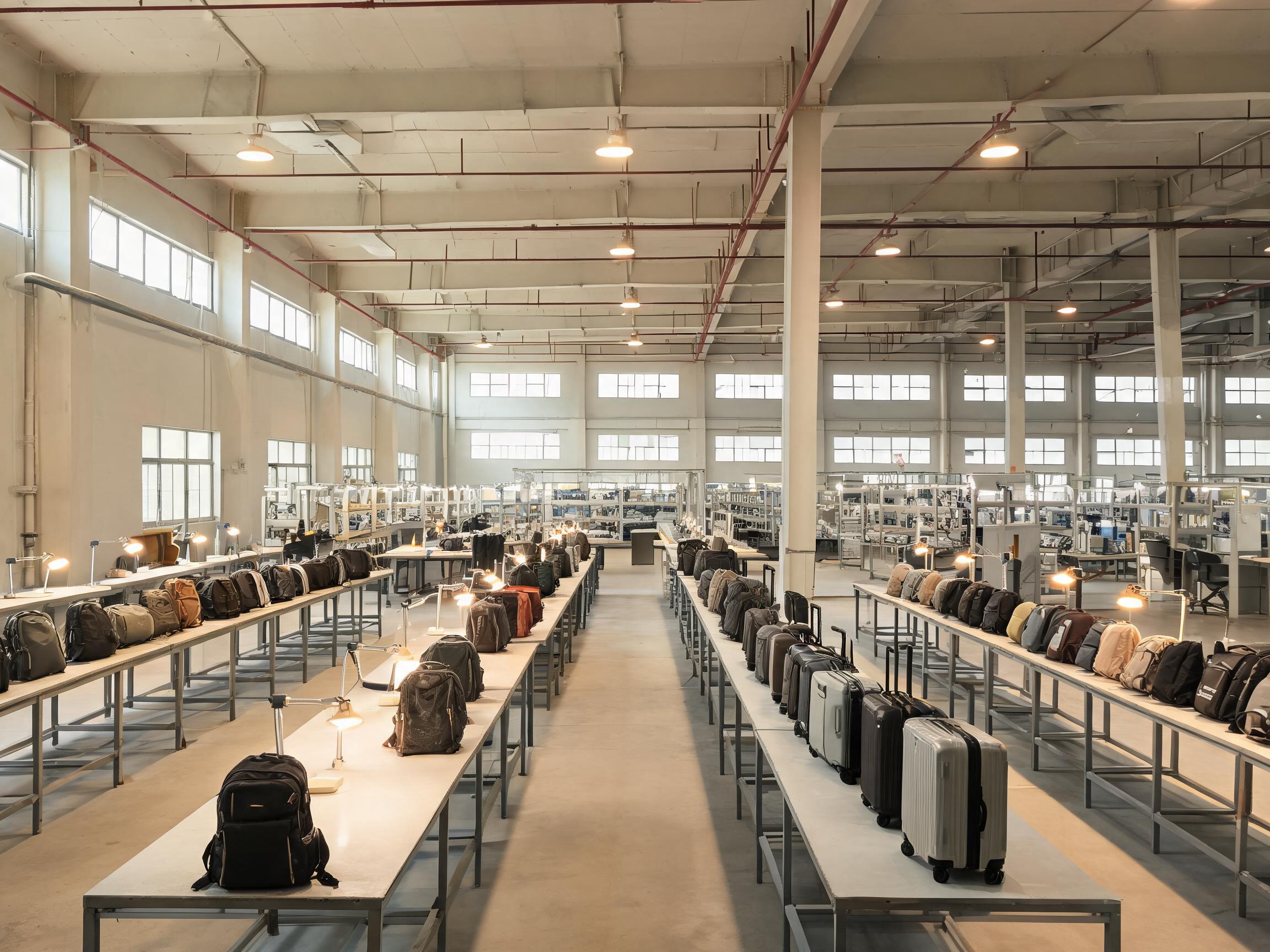
A supplier with in-house cutting, sewing, assembly and inspection can often explain these tiers more precisely, because the cost steps inside the factory are visible. Wellmax Luggage, for example, operates a 12,000 m² facility in Fujian with these processes under one roof and a capacity of roughly 150,000 pieces per month — enough detail to discuss where volume genuinely reduces unit cost and where it does not.
A price tier that promises a large jump between bands without explaining the cause is a warning sign. Ask which cost element changes, then check whether that answer matches the product spec.
Quality consistency: repeatability across production runs
Every supplier can produce a good sample. The evaluation question is different: can the factory produce the same result on run two, run five and run ten? For wholesale buyers, inconsistency shows up as mixed reviews, return rates that vary by shipment, and the cost of sorting and reworking stock.
Quality consistency is easier to verify when manufacturing stages sit in one facility. If cutting, sewing, assembly and inspection are handled by separate subcontractors, variation accumulates at each handover. A supplier with integrated processes controls more of those variables directly.
Useful checkpoints during evaluation include:
- Which quality system is in place, and whether it applies to the factory producing your order. Wellmax Luggage holds ISO 9001:2015 certification and has been BSCI audited.
- How the approved sample is controlled — whether a signed sample is retained and referenced for later production runs.
- Where inspection happens — in-line inspection during assembly, final inspection before packing, or both.
- How deviations are handled — what the supplier does when a batch does not match the approved sample, and who decides whether it ships.
- Whether test reports or material certificates can be supplied for the components you care about, such as wheels or zippers.
During the sampling stage, ask to see the production floor and the inspection point, not just the showroom sample. A supplier that can walk you through how a shell is cut, how stitching is checked and how the finished piece is inspected gives you a more useful picture than a polished catalogue.
What to look for in a sample evaluation
Compare the sample against the specification, not against the photo. Check stitching density and alignment, zipper operation, wheel movement, handle extension, lining fit and hardware finish. Record anything you accept with a note, because those notes become the reference for the bulk order. If a feature is acceptable only in the sample, state that in writing before production starts.
Replenishment: how reorders are handled
Replenishment is where wholesale partnerships are won or lost. A retail chain that reorders a proven SKU expects the same shell color, the same hardware, the same logo placement and the same packing. If the supplier has not kept the records, the reorder becomes a new development project.
The evaluation should establish how the supplier will handle reorders before you place the first one. These are questions to put to any potential partner, not claims to accept at face value:
- How long are your specifications, artwork and approved samples retained? Ask where they are stored and who can access them.
- What is the minimum reorder quantity per SKU and per colorway? Reorder terms can differ from first-order terms.
- Can you repeat the same material and hardware? Some components may be discontinued or replaced by the mill; ask how that is handled.
- How do you confirm a reorder? Is there a written confirmation that the spec is unchanged before production starts?
- What happens if a component is no longer available? Who proposes the substitute, and who approves it?
- Can you handle mixed reorders — several SKUs in one shipment — and how does that affect packing and pricing?
- Who is the contact for reorders, and is the same person available across seasons?
These questions reveal whether the supplier treats replenishment as a routine process or as a fresh negotiation each time. A partner with an in-house design and development studio and a full order cycle from sampling to export is more likely to have a documented path for reorders, because the same records used for the first order can be reused for the next.
Evaluation checklist for a luggage wholesale partner
| Area | What to confirm | Why it matters |
|---|---|---|
| Price tiers | Volume bands, what each band includes, currency, validity period | Prevents renegotiation when volumes change |
| Cost drivers | Material, hardware, printing and packing costs separated | Shows which changes affect price |
| Quality system | Certification scope, inspection points, sample control | Supports repeatability across runs |
| Sampling | Signed sample, written acceptance notes | Creates the reference for bulk production |
| Replenishment | Record retention, reorder minimums, confirmation process | Reduces friction on repeat orders |
| Communication | Named contact, order cycle steps, documentation | Keeps later stages predictable |
| Compliance | ISO 9001:2015, BSCI audit scope for the producing factory | Matches many retail-chain requirements |
How to run the evaluation in practice
Start with a written specification and a target volume range, then ask two or three suppliers to respond to the same brief. Comparing responses to one brief is more informative than comparing catalogues. Request a sample against your specification, review it against the checklist above, and ask follow-up questions about anything the sample does not show — inspection, packing, reorder handling.
Wellmax Luggage was founded in 2013, employs around 320 people and serves buyers in more than 40 countries. For a distributor evaluating a China luggage wholesale supplier, that kind of operating history is useful context, but it should still be checked against your own requirements: the certifications that apply to your order, the inspection process for your product type, and the reorder terms for your SKUs.
If you are comparing suppliers now, prepare your specification, volume forecast and target price band, and send them together. Suppliers who respond with specific questions about material, hardware and packing are usually the ones set up to handle repeat wholesale programs.
FAQ
What should I check first when choosing a luggage wholesale partner?
Start with the price tier structure and the quality system, because both affect every later order. Confirm what each volume band includes and which quality system applies to the factory that will produce your goods.
How do I verify quality consistency beyond the sample?
Ask how the approved sample is retained, where inspection happens in the production line, and how deviations are handled. If possible, review the production and inspection stages on site or through documented records.
What reorder information should be agreed before the first order?
Record retention for specifications and artwork, reorder minimums per SKU and colorway, the confirmation process for repeat orders, and how discontinued components are replaced.
Do certifications apply to every product a supplier makes?
Certification is issued for a defined scope. Ask which facility, product line or process the certificate covers and whether it applies to your specific order.