
Hardside carry-on luggage is one of the most competitive segments in travel retail, and it is also one of the easiest to get wrong at the sourcing stage. Buy a shell that is too large for your market's dominant airlines and returns climb. Pay for polycarbonate when your price point calls for ABS and margins disappear. Commit to a container you cannot fill and working capital locks up. This guide walks through the three decisions that matter most for B2B buyers: cabin size compliance, shell material selection, and how to structure a small or mixed first order with a factory.
Key Takeaways
- Spec the case to the airlines that dominate your sales channel — usually 20-inch for stricter carriers, 22-inch where sizer enforcement is looser.
- Polycarbonate (PC) flexes on impact and suits mid-market and premium assortments; ABS is rigid, cost-efficient and the workhorse of entry-level programs.
- Most carry-on returns trace back to wheels, telescopic handles and locks rather than the shell itself.
- MOQ on our listed cabin platforms is 300 pieces per style, with 30–35 days lead time after sample approval and order confirmation.
What "Cabin Compliant" Actually Means for Your Market
Cabin rules are not one global standard. Most full-service international carriers sit near the commonly cited IATA-style guidance of roughly 56 × 45 × 25 cm, while North American domestic carriers are typically tighter, commonly around 22 × 14 × 9 inches (56 × 36 × 23 cm). Low-cost carriers in Europe and Asia can be stricter still, and sizer checks have become more common at the gate. For a B2B buyer, the practical takeaway is this: decide which airlines dominate your sales channel first, then spec the case to those limits — not the other way around.
Two size anchors cover most carry-on programs:
- 20-inch cabin trolleys are the safer fit for stricter carriers and weight-limited markets. A lighter empty case means the traveler can pack more within the cabin weight allowance, which matters on carriers that weigh carry-ons.
- 22-inch cabin cases maximize packing volume where sizer enforcement is looser. They are the volume leaders in many North American and Middle Eastern retail channels.
For example, our Lightweight ABS Cabin Trolley 20" is built as a compact carry-on with approximately 38 liters of capacity and four spinner wheels, while our Polycarbonate Cabin Luggage 22" is specified as a 22-inch shell sized to fit most airline cabin limits with a TSA lock. Both are real, currently listed OEM platforms — see the internal links at the end of this article.
Buyer action: before sampling, confirm the exact external dimensions (including wheels and handles) of the case you plan to import, and check them against your top three airlines' published limits. Dimensional claims should be verified on the physical sample, not the catalog page.
PC vs ABS: Choosing the Shell Material
Polycarbonate (PC) and ABS are the two dominant hardside shell materials, and the choice drives both cost and perceived quality.
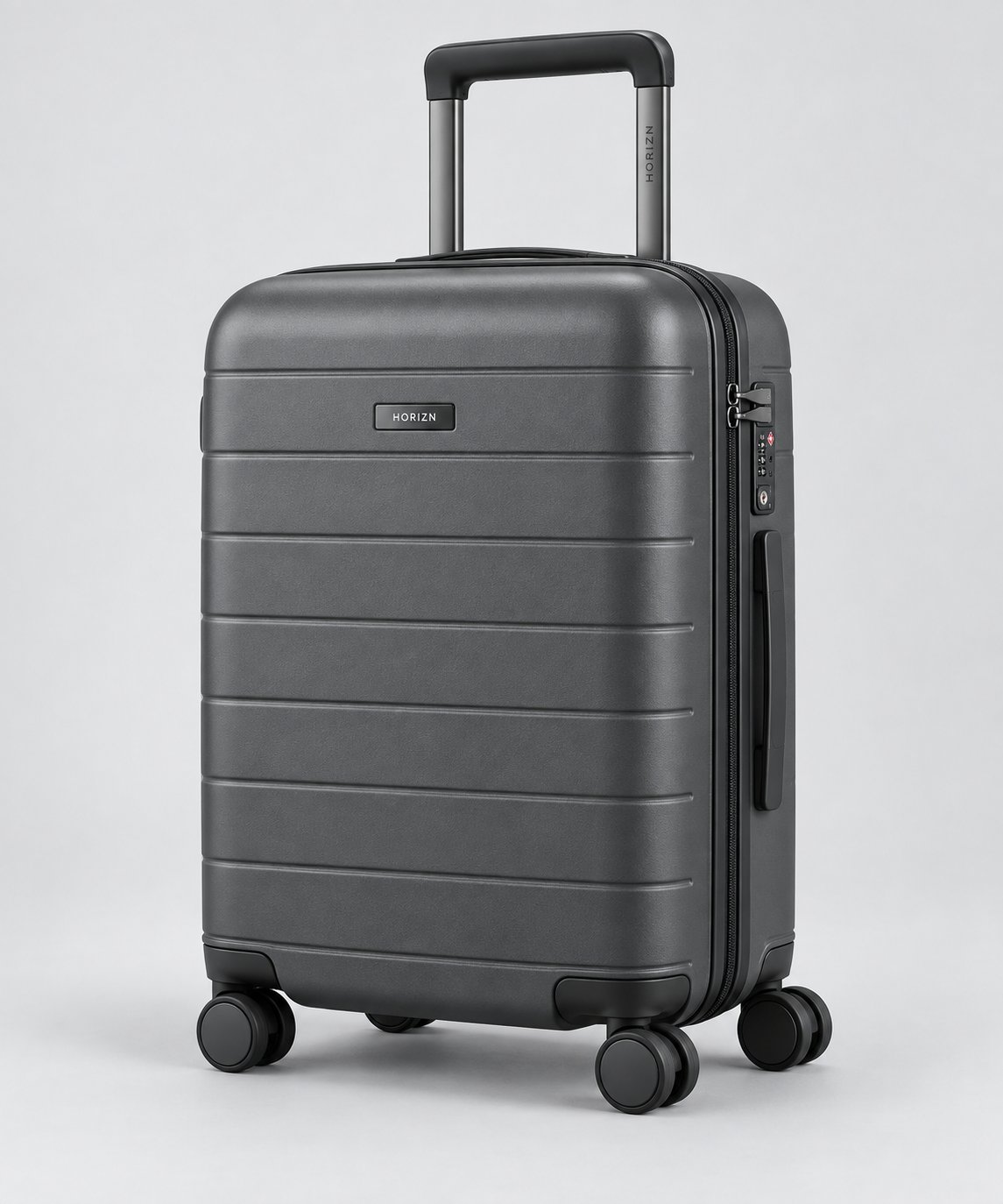
Polycarbonate is impact-resistant and has some flex, which helps it absorb knocks on the baggage belt rather than crack. It is the material we specify on the Polycarbonate Cabin Luggage 22" and on larger checked pieces such as our Hardshell Trolley Case 28" PC Spinner, where a textured shell surface also helps conceal minor scuffs and keeps the case looking newer through more trips. PC is the better fit for mid-market and premium assortments where durability perception justifies a higher retail price.
ABS is rigid, cost-efficient and easy to mold consistently, which makes it the workhorse of entry-level and mid-market hardside programs. Because it is a stable material platform, buyers can position one development across several price tiers without re-engineering. Our Lightweight ABS Cabin Trolley 20" is an example: a compact 20-inch spinner where the empty weight stays low and the shell accepts printing and molded branding.
A practical way to decide: if your channel sells on durability stories and warranty positioning, sample PC first. If your channel competes on entry price and assortment breadth, ABS will usually hit the target cost with fewer compromises. Hybrid constructions exist in the market, but you should ask any factory to document exactly what shell construction is quoted before comparing prices.
Hardware and Function Checks That Matter
The shell gets the attention, but carry-on returns usually trace back to function. On any sample review, put hands on:
- Spinner wheels — four-wheel spinners are standard on both of our cabin platforms; double spinner configurations are available on larger PC cases. Roll the loaded sample through turns and over carpet.
- Telescopic handle — check wobble at full extension and the locking stages.
- Zipper and lock — our PC cabin case ships with a zipper closure and TSA lock; confirm lock requirements for your destination market (TSA-style locks are expected for US-bound carry-ons).
- Interior — lining color, divider layout and packing straps are customizable on our cabin platforms, so match them to your market's packing habits.
Small-Order and Mixed-Container Terms
Hardside luggage has traditionally demanded large MOQs, but that is not the only way to structure a program. On our currently listed cabin platforms, the MOQ is 300 pieces per style, with a standard lead time of 30–35 days after sample approval and order confirmation (final timing depends on order volume and the production schedule). If you are planning a smaller trial run, this is something to raise directly with the export team — options for trial quantities are discussed case by case rather than promised in a catalog.
For buyers combining sizes or colors, a few structural points help:
- MOQ is per style. Mixing colors within one style is the easiest way to build assortment inside a 300-piece commitment; our PC cabin case lists charcoal, black and navy as standard colorways, and the ABS trolley lists white, black and navy.
- Packaging is standardized for export. Each case ships in an individual poly bag packed into cartons; branded packaging and hang tags can be quoted on request.
- State your inspection and shipping terms early. If you require third-party inspection, and your preferred Incoterms for the destination port, include them in the RFQ so the quotation reflects them.
- Sampling comes first. Sampling is part of the OEM/ODM order cycle: specifications go in, a sample comes back for approval, and mass production starts only after sign-off.
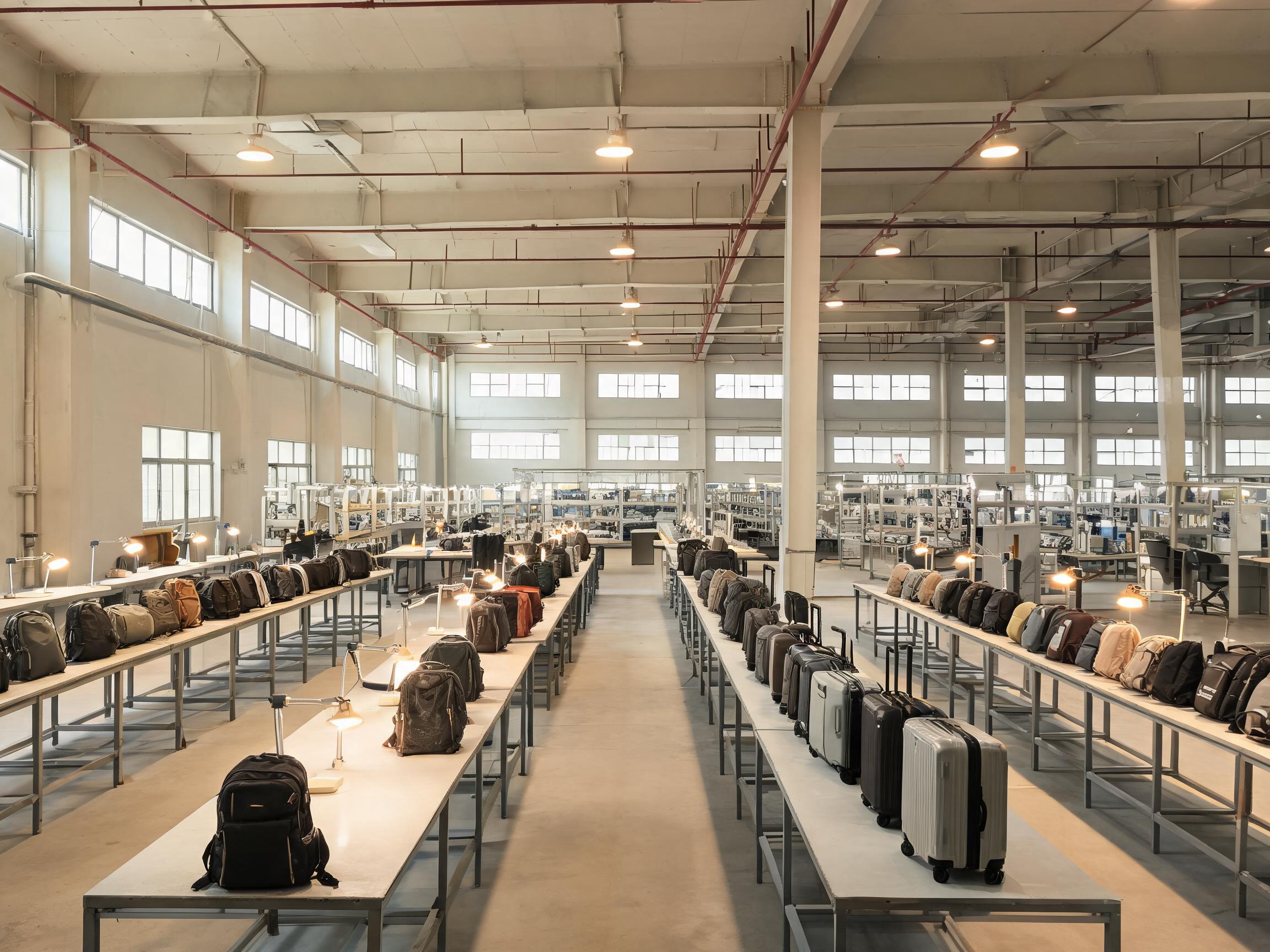
For context on the factory behind these terms: Wellmax Luggage is an OEM/ODM luggage manufacturer in Fujian, China, founded in 2013, with about 320 people working a 12,000 m² facility that houses shell molding, cutting, sewing, assembly and inspection under one roof, producing roughly 150,000 pieces per month for buyers in more than 40 countries. The quality management system is certified to ISO 9001:2015 and the facility is audited under the BSCI framework — certifications that apply at company and factory level, not as product-level performance claims.
Frequently Asked Questions
What is the MOQ for hardside carry-on luggage?
The MOQ on our listed cabin platforms (20" ABS trolley, 22" PC cabin case, 28" PC spinner) is 300 pieces per style. Smaller trial runs can be discussed with the export team.
How long does production take?
Standard lead time is 30–35 days after sample approval and order confirmation, subject to order volume and production schedule.
Can I mix colors in one order?
Yes — MOQ applies per style, so mixing standard colorways within one style is the simplest way to build assortment. Confirm the color split when you request the quotation.
Can the shell be branded?
Yes. Molded logos, printed panels, hang tags and branded packaging can be quoted on request on our cabin platforms.
Do you support third-party inspection?
Tell us your inspection requirement and preferred Incoterms in the RFQ and we will structure the quotation accordingly.
Where to Look Next
- Polycarbonate Cabin Luggage 22" — PC shell, TSA lock, 300 pcs MOQ
- Lightweight ABS Cabin Trolley 20" — ABS platform, approx. 38 L, 300 pcs MOQ
- Hardshell Trolley Case 28" PC Spinner — textured PC, double spinners, for checked programs