
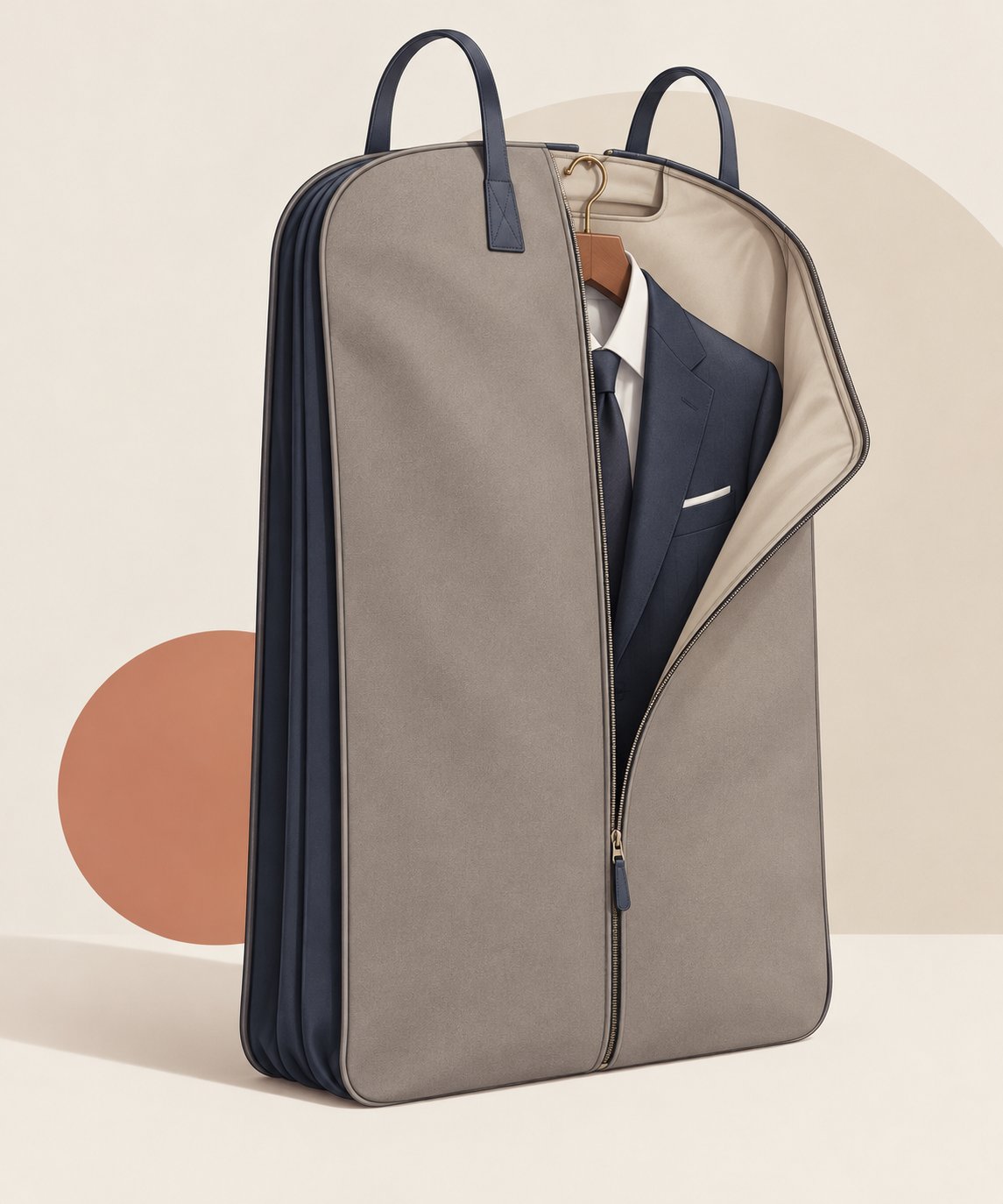
Sourcing Guide
Suit retailers, bridal shops, uniform suppliers and hotel procurement teams buy garment bags for the same basic reason: a garment has to arrive in the condition it left the pressing room. But a bag that works for one channel can be wrong for another. A bridal gown bag carries one high-value item through a long appointment; a uniform bag is issued repeatedly and often printed with a logo; a retail suit bag is partly a packaging item handed to the customer at the till. This guide explains the folding structures, material choices and OEM program differences that separate these cases, so you can specify what you actually need before sampling.
- Folding structure determines where the garment bends — the main lever on wrinkle protection.
- Material and lining choices trade off stiffness, breathability and printability; no single fabric fits all three channels.
- OEM programs differ most in branding method, packaging logic and replenishment pattern.
- QC should focus on zipper runs, gusset stitching, hanger-opening reinforcement and fold crease placement.
What this guide covers
Folding structures: how a garment bag holds the garment
The folding structure is the first decision because it controls where the garment bends. Every crease in a suit, gown or uniform jacket is a place where the fabric can take a set, so the goal is to place folds where they recover easily or stay hidden when worn.
Flat (full-length) structure
A flat bag keeps the garment hanging at full length with no fold across the body. It is the least likely to crease a jacket, which is why it is common for retail suit presentation, storage and transport where hanging space exists. The trade-off is bulk: it does not compress the garment for packing. For hospitality and uniform programs that hang garments on a rail, flat is often the default; for e-commerce shipping, it usually is not.
Bi-fold structure
A bi-fold bag folds the garment once, typically at the waist or mid-length, so the lower half lies against the upper half. This is the common compromise for suit retail and corporate uniform distribution: it reduces packing length while keeping the fold in a region where a suit jacket or trouser usually recovers after hanging. Fold position matters more than the fold itself — a fold across a structured shoulder or a beaded bridal bodice is a different problem than a fold across a trouser leg.
Tri-fold with gusset
A tri-fold bag folds the garment twice into a compact package close to the footprint of a folded shirt box. The gusset — the expanding panel along the side — gives the folded garment depth so the fabric is not crushed flat against itself. It is common where the bag doubles as a carry or shipping package. The gusset is also where construction quality shows first: if it is under-sized or stitched without enough allowance, the bag pulls tight when folded and the garment compresses at the crease lines.
Two structural features are worth specifying explicitly:
- Hanger hook opening — the reinforced aperture where the hanger hook passes through. The whole bag hangs from this high-stress point, so reinforcement is a stitching and material decision, not an afterthought.
- Full-length zipper run — a zipper along the full length lets a buyer load and remove the garment without forcing it through a narrow opening, which is exactly how creases and snags happen.
Materials and linings: matching the fabric to the channel
Material choice balances three buyer concerns: protection against creasing and dust, how the bag looks and prints, and how it behaves over repeated use. There is no universal best answer — a bridal shop and a hotel housekeeping department are optimizing different things.
Outer material considerations
- Non-woven fabric — widely used for retail and promotional bags because it accepts printing and is lightweight. Stiffness varies, so a lighter non-woven may not hold a tri-fold shape as cleanly as a heavier one.
- Woven fabric (including oxford-type constructions) — generally more durable and more tear-resistant at stress points like the hanger opening, which suits repeated-use uniform and hospitality programs.
- PEVA and similar film materials — chosen for dust and moisture protection in storage and transport, but less printable, so they fit programs where protection matters more than branding.
Linings and internal features
A lining is not just cosmetic. In a suit bag, a smooth lining reduces friction as the garment slides in and out, lowering the chance of snagging a shoulder or a button. In bridal, a soft, snag-resistant lining protects delicate fabrics, and a wider bag reduces pressure on the gown. Some programs add internal ties, loops or a hanger strap so the garment does not shift during transport — whether these belong in your spec depends on how the bag will be handled.
Breathability is a real consideration for long-term storage: a fully sealed bag can trap moisture. For storage-oriented programs, buyers often prefer a construction that allows some air movement, and how much is appropriate is a question to settle with the supplier based on where the garments will be stored.
OEM programs differ by channel, not just by bag
Two buyers can order a similar bi-fold bag and still need different OEM programs, because the bag sits inside a different business process.
| Channel | Primary job of the bag | Typical OEM emphasis | Replenishment pattern |
|---|---|---|---|
| Suit retail | Protect the garment and present the brand at handover | Branding on the bag face, retail-ready presentation, consistent look across a range | Seasonal, tied to collection launches |
| Bridal | Protect a high-value gown through fittings and storage | Softer inner surfaces, generous width and length, minimal compression | Lower volume, higher care per unit |
| Hospitality and corporate uniform | Issue, store and identify uniforms at scale | Durable outer material, logo or department marking, size identification | Repeating bulk issues plus replacements |
Branding, packaging and replenishment
Branding is where channel needs diverge most: retail buyers want the mark to sit cleanly on a visible panel and survive till handling; hospitality buyers need identification that withstands repeated use; bridal buyers often want minimal branding so the bag does not compete with the gown. Choose the marking method together with the outer material, because not every material takes every method well. Packaging matters too — flat bags ship flat, folded bags may need crease protection, printed bags may need interleaving to prevent ink transfer — and repeat buyers should ask how consistency across runs is controlled, particularly for printed or custom-colored bags, where the first order's reference standard is what later runs are matched against.
QC checks buyers verify at sampling and pre-shipment
These are qualitative checks you can carry out on a sample and repeat on a pre-shipment inspection, and they are the right things to agree on before production rather than after:
- Zipper run — open and close the full-length zipper end to end. It should travel smoothly without catching and not pull the bag out of shape when fully closed; check the bottom curve, where stress concentrates.
- Gusset stitching — stitching where the gusset meets the main panels should be even with no skipped sections. Fold the bag into its shipping position and check whether the gusset lets the garment sit without being compressed flat.
- Hanger-opening reinforcement — hang the bag with weight inside, or at least examine the reinforcement stitching. This is the point that fails first on a loaded bag.
- Fold crease placement — fold the bag as it will be packed and check where the garment creases fall; on a bi-fold or tri-fold, the crease should not land across a structured shoulder or a delicate panel.
- Inner surface and marking — run a hand along the inside for rough seams, loose threads or sharp edges, and compare print or marking against your approved reference for color, placement and durability.
Spec-sheet checklist to send a supplier
Copy this list into your RFQ. Filling it in forces the decisions that otherwise come back as questions after sampling.
| Item | What to specify |
|---|---|
| Structure | Flat, bi-fold, or tri-fold; gusset required or not; where folds should fall on the garment |
| Length and width | Based on the longest and widest garment in the range, with a little working room |
| Zipper and hanger opening | Full-length run; opening direction; two-way slider if needed; opening position and reinforcement expectation |
| Outer material | Non-woven, woven or film; weight and handle preference |
| Lining and internal features | Required or not; smoothness and snag-resistance; ties, loops or hanger strap |
| Branding | Method, placement, colors, and whether a reference standard applies |
| Packaging | Flat-packed or folded; interleaving; carton presentation |
| Sampling and inspection | What the sample will match, how deviations are approved, and which QC points you will check pre-shipment |
Next step
If you are sourcing garment bags, send your structure and material requirements in writing, along with the channels you are buying for and the branding you need. Wellmax Luggage is an OEM/ODM luggage and bag manufacturer in Fujian, China, founded in 2013, with a 12,000 m² facility where sewing and inspection run under one roof, roughly 320 staff, and output of about 150,000 pieces per month across trolley cases, backpacks, business bags and handbags for buyers in 40+ countries, operating an ISO 9001:2015 certified quality management system and a BSCI-audited facility. Garment bag programs are quoted and sampled on request — include your fold structure, material preference, branding method and packaging requirements in your first message, and ask for a sampling plan that covers the QC points in this guide.
Send your garment bag requirements
Share your structure (flat, bi-fold or tri-fold), material and lining preference, branding method, and where the bags will be used. That is enough to start a sampling discussion.