Small Business Sourcing Guide
If you run a small retail brand or an independent online store, ordering custom bags from China can feel out of reach. Many suppliers ask for volumes that only make sense for large wholesalers with mixed-container programs. But low-MOQ paths do exist, and they do not all require you to develop a brand-new product from scratch. This article explains how small businesses can approach custom bag manufacturing in China, which customization layers deliver the most value at low volumes, and how to plan a first order without overcommitting.
Key Takeaways
- Low-MOQ customization usually starts with an existing stock mold, not a new tooling project.
- Logo, color, and packaging changes are the lowest-barrier customization layers for small orders.
- Sampling before mass production reduces risk and helps you validate fit, materials, and branding.
- Mixing models within one order can help you test demand without spreading your budget too thin.
- Be cautious about suppliers who promise full ODM at very small volumes without a clear sampling and tooling process.
What Low-MOQ Customization Realistically Looks Like
When buyers search for China custom bags for small business, they often picture a fully bespoke product: a unique shape, custom hardware, custom lining, and a brand-new mold. That is possible, but it is rarely the starting point for a small brand. A more realistic path is to build on what the factory already produces.
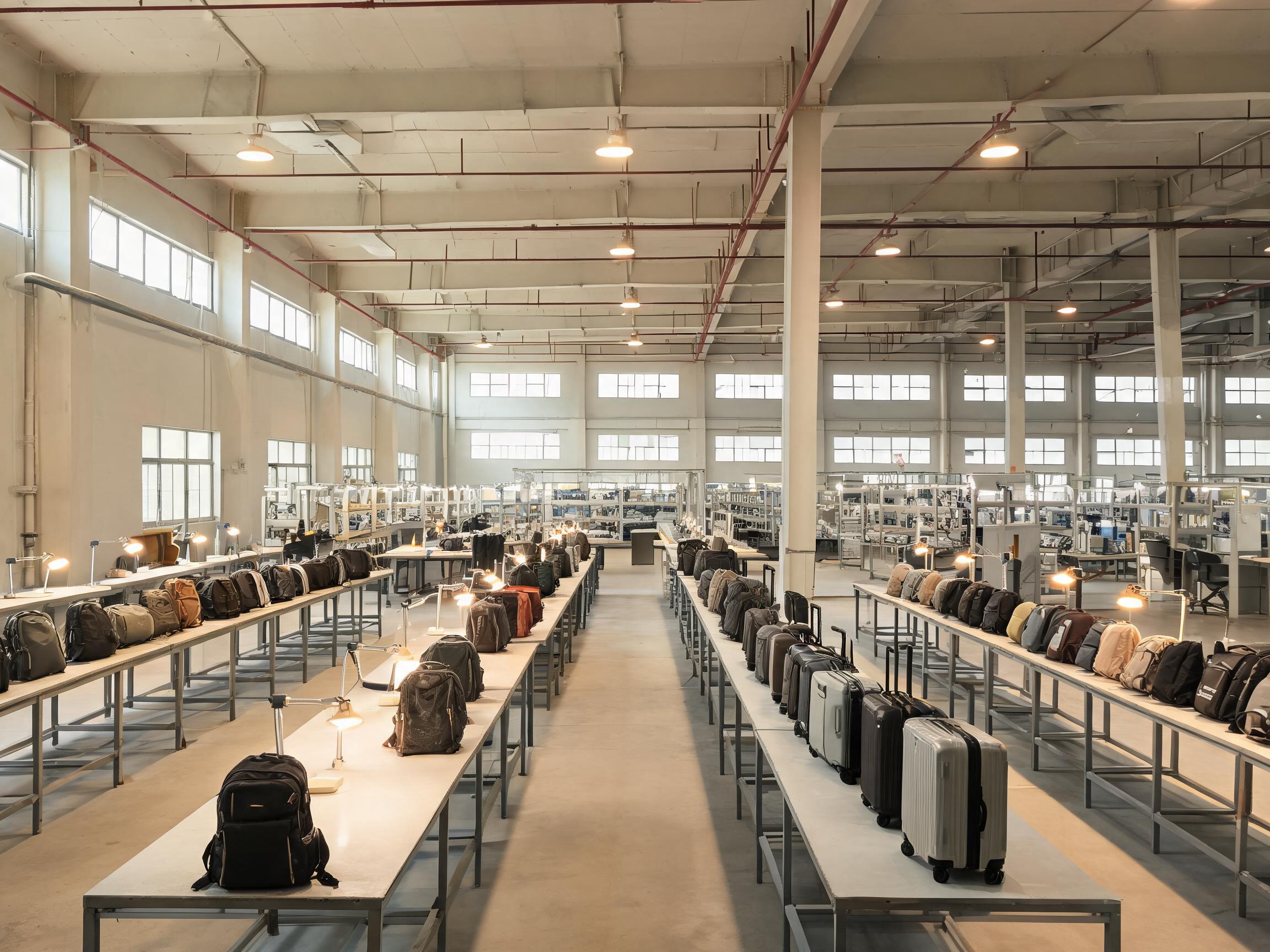
Wellmax Luggage, for example, manufactures trolley cases, backpacks, business and laptop bags, and handbags. The factory operates a 12,000 m² one-roof facility in Quanzhou, Fujian, with roughly 320 employees and a monthly output of approximately 150,000 pieces across the full range. For a small business, the practical question is not whether the factory can make a new bag from zero—it is which existing styles can be adapted to your brand at a volume you can actually sell through.
Two broad paths are available:
- Stock-mold OEM: You choose an existing bag style and apply your branding. This can include logo application, color changes, zipper pulls, lining, or packaging. The mold and basic structure already exist, so the barrier to entry is lower.
- Full ODM: You work with the factory's in-house design and development studio to develop a new style or significantly modify an existing one. This involves style development, material selection, and sampling. It typically requires more time and a higher commitment than stock-mold OEM.
For most small businesses, stock-mold OEM is the sensible first step. It lets you test the market with a product that already has a proven structure, while still putting your brand identity on the bag. Full ODM becomes more attractive once you have consistent sales data and a clear idea of what your customers want.
Which Customization Layers Cost Least
Not all customization is equal in cost or complexity. If you are working with a limited budget, prioritize the layers that add brand recognition without requiring new tooling or major production changes.
| Customization Layer | Relative Cost & Complexity | Best For |
|---|---|---|
| Logo application (printing, embroidery, labels) | Low | First orders, testing brand response |
| Color changes (fabric, zippers, lining) | Low to medium | Differentiating from generic stock |
| Custom packaging (poly bags, hangtags, boxes) | Low to medium | Retail presentation and unboxing |
| Hardware changes (pulls, buckles, wheels) | Medium | Improving perceived quality |
| New mold or structural redesign | High | Full ODM, established brands |
The lowest-barrier approach is to choose an existing stock shell and customize the logo and packaging. This is often called logo customization, and it is how many small brands place their first order without committing to new tooling. Color changes are also relatively accessible because they usually involve switching materials or components that are already in the supply chain, rather than creating a new mold.
What is worth customizing first? Focus on what your customer sees and touches at the point of sale: the logo, the packaging, and the color. These elements carry your brand identity and help you stand out on a shelf or in an online listing. Structural changes and new molds can wait until you have validated demand.
How to Plan a First Order
A first order is about learning as much as it is about selling. The goal is to validate your product-market fit without tying up too much capital in inventory that may not move. Two strategies help: mixing models and sampling first.
Mixing models within one order
Instead of ordering a large quantity of a single bag, consider mixing several models or colorways in smaller quantities. This lets you test which styles resonate with your customers. It also gives you flexibility if one model sells faster than another. When discussing this with a supplier, ask how they handle mixed-model orders and whether it affects the unit cost or production schedule. A factory that already produces a wide range—like trolley cases, backpacks, and handbags—may be better positioned to accommodate a mixed first order than a specialist in a single product type.
Sampling first
Never skip sampling. A sample lets you check the actual materials, stitching, hardware, logo placement, and overall quality before you commit to mass production. Wellmax Luggage's in-house design and development studio prepares samples for both OEM and ODM programs, which means the sampling step is integrated into their order cycle. When you request a sample, be specific about what you want to evaluate: is it the fabric hand-feel, the zipper smoothness, the logo clarity, or the packaging? Write down your criteria and compare the sample against them.
A typical order cycle runs from sampling and tooling to mass production, quality inspection, and export. For a small first order, the sampling stage is where you have the most leverage to make changes without incurring heavy costs.
Pitfalls for Small Buyers
Small buyers face specific risks when sourcing custom bags from China. Being aware of them helps you ask better questions and avoid costly mistakes.
- Assuming low MOQ means no MOQ. Every factory has minimums. The question is whether they offer a realistic low-MOQ path, such as stock-mold logo customization, rather than a fully bespoke product.
- Ignoring the sampling cost and timeline. Samples take time to produce and ship. Factor that into your launch plan, especially if you have a fixed retail season.
- Not clarifying who owns the design. In ODM programs, ask whether the design is exclusive to you or can be sold to other buyers. Get this in writing.
- Over-customizing the first order. New molds, custom hardware, and unique structural changes add cost and risk. Start with the layers that matter most to your brand and customers.
- Skipping quality inspection. Even a small order should go through a quality check before export. Ask how the factory handles inspection and what happens if issues are found.
- Choosing a supplier without export experience. A factory that regularly serves international buyers will understand documentation, packaging, and shipping requirements better than one that only sells domestically.
Wellmax Luggage's export team serves buyers in more than 40 countries, so the company is familiar with the requirements of small international orders. The factory holds ISO 9001:2015 and BSCI audits, which relate to its quality management and social compliance systems.
How Wellmax Supports Small-Business OEM/ODM Programs
Wellmax Luggage was founded in 2013 and is an OEM/ODM manufacturer based in Quanzhou, Fujian. The company covers trolley cases, backpacks, business and laptop bags, and handbags, with an in-house design and development studio that develops styles, selects materials, and prepares samples for both OEM and ODM programs. This means a small business can approach the factory with a branding concept or a rough product idea and work through the sampling process before committing to mass production.
The factory's one-roof facility, approximately 320 employees, and monthly output of around 150,000 pieces across the full range give it the capacity to handle orders of different sizes. For small-business buyers, the relevant question is whether the factory can accommodate a low-MOQ start. Because Wellmax already produces a broad range of bag types, there may be existing stock molds that can be adapted for logo, color, or packaging customization—reducing the barrier to entry compared with a full new-mold project.
The full order cycle runs from sampling, tooling, and mass production through quality inspection to export. Small buyers can use this structure to their advantage: start with a sample, validate the product, and then scale into production. The export team's experience with buyers in more than 40 countries means they are used to communicating across time zones, handling export documentation, and coordinating shipping.
If you are a small business owner or retail brand looking for custom bags small business low MOQ options, the practical next step is to contact a manufacturer like Wellmax with your requirements. Be clear about your target quantity, your customization priorities, and your timeline. Ask for a sample and evaluate it against your criteria. A realistic low-MOQ path is not about finding a factory that ignores minimums—it is about finding one that offers a sensible starting point for a brand of your size.