
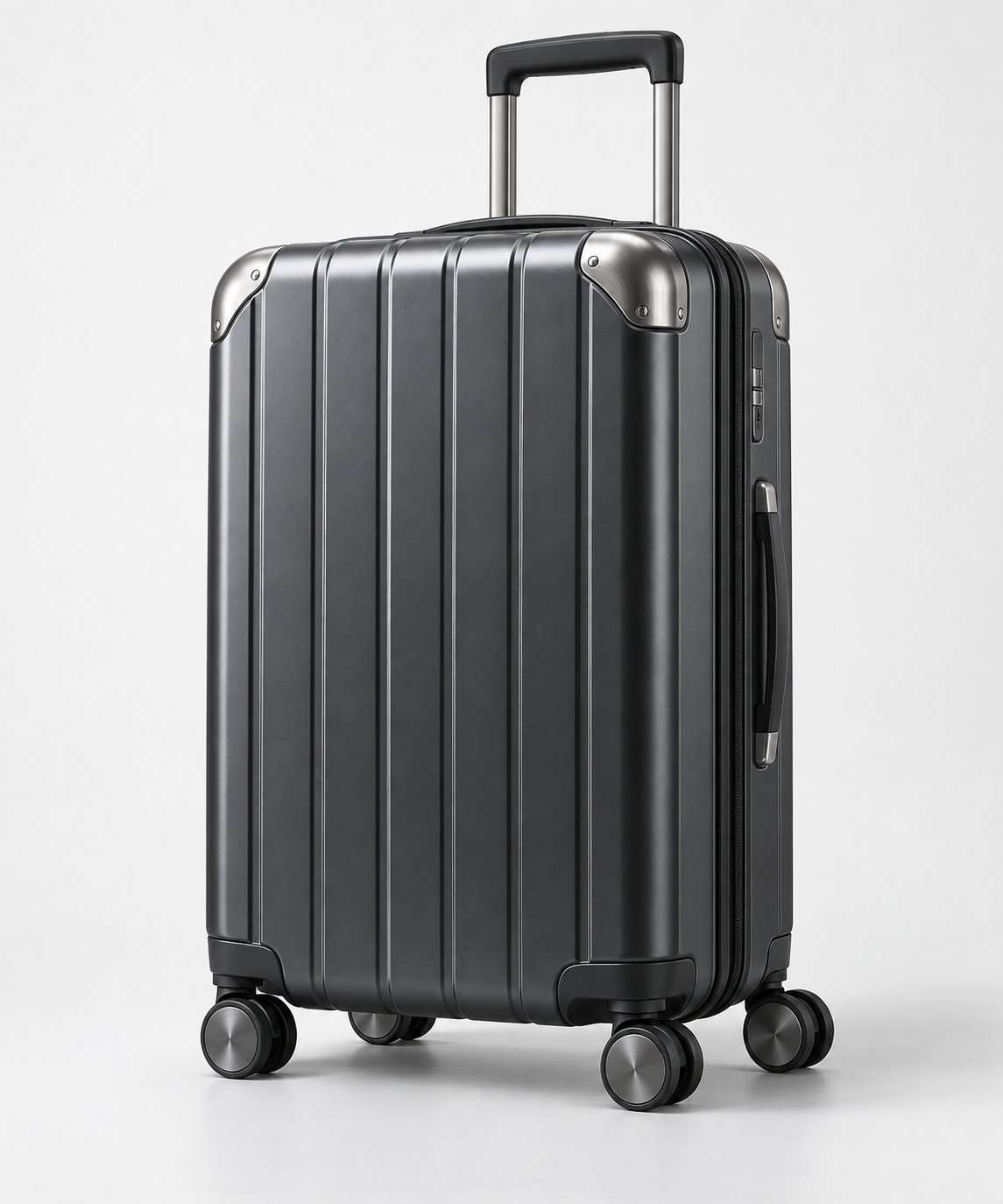
Sourcing Guide
Most trolley case orders that go wrong do so before production starts — at the specification stage, not the shipping stage. A buyer picks a size from a photo, assumes a shell material from a product title, and treats every factory listing "luggage" as equivalent. This guide walks through the three decisions that determine whether the finished order matches your market: size and internal dimensions, shell and frame materials, and how to read a Chinese trolley case factory before you commit a deposit.
- Published trolley case sizes are nominal designations; check measured external dimensions and packing volume before locking a size range.
- Shell material, frame type, and wheel system are separate decisions — a "PC" title does not tell you the shell construction or the frame.
- Factory selection should be based on verifiable production capability, not on catalog photos or trade-show booth size.
- Ask for the same specification sheet for every quoted model so you can compare like with like.
On this page
Trolley case sizes: what the numbers actually mean
Trolley case sizes are quoted in inches or centimeters, and in most catalogs they refer to the external height of the case body, sometimes including wheels and sometimes not. Two suppliers can both list a "24-inch" case and ship boxes that differ by several centimeters. For a buyer, the number that matters is the one your customer will compare against an airline carry-on gauge or against a shelf in a retail store.
When you request a quotation, ask the factory to state each of the following for every model:
- External dimensions (L × W × H), with a note on whether wheels and handles are included
- Internal packing dimensions and usable volume in liters
- Empty weight of the finished case
- Expanded depth, if the model has an expansion zipper
These four values let you match a case to a target market. Carry-on categories are usually defined by the airline's linear dimension limit, not by a single height, so a case that fits one carrier's gauge may not fit another. If your channel sells to travelers who fly multiple carriers, treat the carry-on limit as a range and confirm the gauge the case was measured against.
| Common size band | Typical use | What to verify before ordering |
|---|---|---|
| Cabin / carry-on | Short trips, airline cabin use | External dimensions against the target airline gauge; whether wheels are included in the quoted height |
| Medium checked | 1–2 week trips | Packing volume, empty weight, expansion depth if offered |
| Large checked | Long trips, family travel | Shell rigidity at the corners, wheel load rating, handle stability when fully loaded |
| Nested sets | Retail bundles | Whether each size in the set shares the same wheel and handle components |
The bands above describe common market positions, not fixed industry standards. Confirm the actual measured dimensions for the specific model you intend to order.
Shell and frame materials
Shell material is the single most misread line on a trolley case specification. A title that says "PC" or "ABS" describes the shell polymer family, but it does not tell you the shell thickness, whether the shell is a single molded piece or a bonded panel, or what frame and wheel system sits behind it. Buyers who compare only the material name end up comparing two different products.
Hard-shell options
- ABS — a lower-cost rigid shell, common in entry-price ranges. It is stiffer and less flexible than polycarbonate blends; impact performance depends on shell thickness and ribbing, not on the material name alone.
- Polycarbonate (PC) — a flexible shell that can deflect and return under impact. Cost is higher than ABS. As with ABS, thickness and shell design matter as much as the polymer.
- ABS/PC blends and layered shells — used to balance cost and flexibility. Ask the factory to state the blend ratio and shell thickness if the model uses a blend, because "PC" in a title may not mean a full polycarbonate shell.
- Polypropylene (PP) — a rigid, lightweight shell option. Confirm the exact grade and thickness if the model is specified as PP.
Soft-shell options
- Polyester and nylon fabrics — quoted by denier and coating. Denier alone does not indicate abrasion resistance; ask about the coating and the fabric weight per square meter.
- Frame construction — soft cases use either a soft frame or a hard frame. The frame type affects how the case holds shape when packed and how the zipper is loaded.
Components that decide durability
Wheels, telescopic handles, zippers, and locks are the parts most likely to generate after-sales complaints. For each, ask the factory for the component specification rather than a generic description:
- Wheel type (single or double spinner, inline) and wheel diameter
- Telescopic handle stages and material
- Zipper type and whether it is a standard or anti-theft design
- Lock type, if the model includes one
If the model uses a branded component, the factory should be able to name it. If it cannot, treat the component as an unbranded part and evaluate it on the specification provided.
How to evaluate a trolley case factory
China has luggage production concentrated in a few regions, and within those regions the range of factory capability is wide. A trading company with a small assembly line, a mid-sized factory that molds its own shells, and a large integrated plant can all appear under the same search results. The goal of factory selection is not to find the biggest name — it is to find a supplier whose actual capability matches your order profile.
Questions that separate factories
- Which production steps are in-house? Shell molding, frame assembly, fabric cutting, and final assembly may be split across different workshops or subcontracted. Ask which steps the factory performs itself and which it outsources.
- What is the monthly output for the specific model family you are ordering? A factory's total capacity is not the same as its capacity for your shell type, size, and wheel configuration.
- What is the minimum order quantity per color and per size? MOQ often applies per SKU, not per order, which changes your color and size planning.
- What is the sampling lead time and the production lead time after deposit? Ask for both, and ask what conditions can extend the production lead time.
- Which components are sourced from outside suppliers? Wheels, handles, and locks are frequently bought in. Knowing the supplier lets you assess substitution risk.
What to look for in a factory audit or sample review
If you visit or audit the factory, focus on the steps that reveal process control: shell molding and trimming, frame assembly, wheel and handle fitting, and final inspection. Ask how the factory checks telescopic handle cycles, wheel rolling, and zipper function, and whether those checks are done on every unit or on a sample basis.
With a sample, compare the measured dimensions against the specification sheet, check the shell for consistent thickness at the corners, extend and retract the handle fully, and roll the case loaded to a realistic weight. Note any gap between the sample and the written specification — that gap is what you will be managing in production.
- Written specification sheet for each quoted model, with measured dimensions and component details
- Clear statement of in-house versus outsourced production steps
- MOQ per color and per size, in writing
- Sampling and production lead times, with the conditions that affect them
- Inspection method for handles, wheels, zippers, and shell finish
- Packaging specification, including carton dimensions and units per carton
Planning around China trolley case promotions
Promotional periods in the Chinese luggage supply chain — typically around major trade seasons and factory slow periods — can affect both pricing and lead time. The practical approach is to treat a promotion as a scheduling input, not as a reason to skip specification work.
- Confirm whether a promotional price applies to your exact shell material, size, and wheel configuration, or only to a standard configuration.
- Ask whether the promotional lead time is the same as the standard lead time, or whether it assumes a deposit by a specific date.
- Request the specification sheet for the promotional model before comparing it to a non-promotional quote.
- Check whether the promotional MOQ differs from the standard MOQ for that model.
A lower unit price on a different specification is not a saving. The comparison only holds when both quotes describe the same shell, frame, wheel system, and packaging.
FAQ
What is the difference between a 20-inch and a 24-inch trolley case?
The difference is primarily in external height and packing volume, but the exact measurements vary by model and by whether wheels are included in the quoted height. Ask the factory for the measured external dimensions and internal volume for both sizes before deciding which to stock.
Is polycarbonate always better than ABS?
Polycarbonate is more flexible and generally costs more, but shell performance depends on thickness and shell design as well as the polymer. For an entry-price range, a well-constructed ABS shell may be the better fit; for a premium range, confirm the actual polycarbonate content if the model is described as a blend.
How do I compare quotes from two trolley case factories?
Ask both factories to complete the same specification sheet: measured dimensions, shell material and thickness, frame type, wheel and handle details, MOQ per color and size, lead times, and packaging. Only quotes that describe the same specification can be compared on price.
Should I order a sample before placing a bulk order?
A sample lets you verify dimensions, shell finish, handle function, and wheel movement against the written specification. Treat the sample as a check on the specification, and confirm with the factory how production units are inspected against the same criteria.
Next step
If you are preparing a trolley case order, start by writing the specification you need — sizes with measured dimensions, shell and frame type, wheel and handle configuration, MOQ per color and size, and packaging. Send that specification to the factories you are considering and compare their responses line by line. The factory that answers with specific values rather than general descriptions is the one whose production you can plan around.