Procurement Guide
If you are sourcing spinner suitcases from China, the choices you make on wheel systems and shell materials will decide your return rates, your customer reviews, and how much room you have to build a differentiated product. The good news is that Chinese luggage factories offer a wide range of OEM options. The hard part is knowing what to ask for and how to compare suppliers.
This guide covers the three decisions that matter most: wheel systems (360° spinner vs inline), shell materials (PC vs PP vs ABS), and the OEM customisation you can specify. It also walks through how sampling typically works and what to look for in a manufacturing partner.
Key takeaways
- 360° spinner wheels are the default for retail spinner luggage; confirm wheel diameter, bearing type, and replacement strategy before committing.
- Polycarbonate offers the best impact resistance but costs more; PP is lighter and cheaper; ABS is the budget option with lower durability.
- OEM options typically include logo method, shell colours, lining fabric and print, packaging, and hardware finish.
- Always approve a pre-production sample before mass production — wheel feel and shell flex are hard to judge from photos alone.
Why the wheel system is the first thing to get right
For a buyer, the wheel system is not a minor component. It is the part that determines whether a suitcase rolls smoothly on carpet, cobblestones, and airport tiles, and it is often the first thing that fails in the hands of an end user. A wobbly or noisy wheel generates returns and negative reviews faster than almost any other defect.
Spinner suitcases use four wheels mounted on swivels, allowing 360° rotation. Inline (or upright) luggage uses two fixed wheels and must be tilted to move. Most modern retail ranges are spinner-led because travellers prefer the upright rolling position and the ability to push the case alongside them in a queue.
When you source from China, the wheel specification is one of the clearest ways to differentiate a value line from a premium line. The same shell can feel like a completely different product depending on the wheels underneath it.
Wheel system checklist: questions to ask a supplier
Before you compare quotes, ask these questions. The answers will tell you more about a factory’s capabilities than a brochure will.
- Wheel diameter and material: What size are the wheels, and are they polyurethane, TPR, or another compound? Larger wheels generally roll better over uneven surfaces, but they add weight and cost.
- Bearing type: Are the wheels fitted with ball bearings or plain bushings? Bearings give smoother, quieter rolling and are a common upgrade for premium lines.
- Swivel mechanism: How is the wheel housing attached to the shell or frame? Is it riveted, screwed, or moulded in? Replaceable wheels are a significant after-sales advantage.
- Noise and vibration: Can the supplier provide a sample for you to roll on different surfaces? This is the only reliable way to judge noise.
- Load rating: What is the maximum recommended load per wheel? This should align with the size categories you plan to sell (20, 22, 24, 26, and 28 inch are common).
- Replacement policy: Can you order spare wheels as a separate line item? Retailers increasingly expect this.
Tip: Ask for a sample pair of wheels so your team can evaluate them independently. A supplier who cannot provide this is a risk.
Shell materials: PC vs PP vs ABS trade-offs
The shell material affects weight, durability, appearance, and cost. There is no single best choice — it depends on your target price point and your customers’ expectations. The table below summarises the general trade-offs based on industry knowledge.
| Material | Key characteristics | Typical positioning |
|---|---|---|
| Polycarbonate (PC) | High impact resistance, flexes under pressure and returns to shape, lightweight, takes a premium finish | Mid to premium retail lines; hardshell spinner ranges |
| Polypropylene (PP) | Lighter than ABS in many constructions, good stiffness, lower cost than PC, can feel more rigid | Value to mid-range lines; large-volume programs |
| ABS | Lowest cost, decent rigidity but more prone to cracking under heavy impact, heavier for the same thickness | Entry-level and promotional lines |
Note: Actual performance depends on shell thickness, construction method, and the quality of the PC/PP/ABS blend. Always evaluate a sample, not just the material name.
Polycarbonate is often the material of choice for hardshell spinner trolley cases because it can absorb impact by flexing. This means a dropped case is more likely to bounce back than crack. PP offers a good balance for buyers who need a lower price point without stepping down to ABS. ABS is the traditional budget option and remains common in promotional and entry-level luggage, but it typically has a shorter lifespan.
Softside spinner luggage uses a different construction — usually a fabric shell over a frame — and is often chosen for its expandability and exterior pockets. If your range includes both hardshell and softside, you will need to specify materials and components separately for each.
OEM options you can specify
Chinese luggage manufacturers typically offer a range of OEM and ODM services. The exact options vary by factory, but the following are common areas where you can customise a spinner suitcase program.
Logo and branding
- Logo on the shell (embossed, printed, or metal badge)
- Logo on the lining, zipper pulls, or wheel housings
- Custom hangtags and branded packaging tape
Ask the supplier which logo methods they can do in-house. Some factories can mould a logo directly into the shell; others may only offer printing or badges. The method affects both the look and the minimum order quantity.
Colours and finishes
- Shell colours — matte, gloss, or metallic finishes
- Hardware colour — black, silver, gunmetal, or gold-tone
- Zipper and puller colours
Colour consistency across production runs is a common concern. Ask how the factory controls colour matching — for example, whether they use Pantone references and retain approved colour swatches.
Lining and interior
- Lining fabric type and colour
- Printed lining with your brand pattern
- Interior pockets, straps, and dividers
- Custom labels and care tags
Packaging
- Polybag and foam protection
- Individual cartons or master cartons with your branding
- Retail-ready packaging for direct-to-consumer channels
- Instruction cards or warranty inserts
Size and configuration
Spinner suitcases are commonly sold in sets that include 20, 22, 24, 26, and 28 inch sizes. You can specify which sizes make up your set, and whether you want them sold individually or as a nested set. Confirm the exact external dimensions with the supplier, as nominal sizes are a designation and actual measurements can vary.
Hardware and components
- Telescopic handle — material, number of stages, locking mechanism
- TSA-approved locks (if applicable to your market)
- Zippers — standard or anti-theft
- Top and side carry handles
How sampling works
Sampling is the stage where you confirm that the factory can actually deliver what you have specified. A typical sampling process for a spinner suitcase program looks like this:
- Specification review: You provide the wheel type, shell material, size, colours, logo files, and any packaging requirements. The factory reviews feasibility and may suggest alternatives based on their tooling and experience.
- Sample development: The factory produces a pre-production sample. This may involve new tooling if you require a custom shell shape or a new wheel housing.
- Sample review: You inspect the sample for wheel smoothness, shell flex, colour accuracy, logo placement, lining fit, and overall workmanship. Roll the case on different surfaces and load it with weight to simulate real use.
- Revisions: If changes are needed, the factory adjusts and sends a revised sample. Budget time for at least one revision round.
- Approval and mass production: Once you approve the sample, mass production begins. The approved sample becomes the reference standard for quality inspection.
- Pre-shipment inspection: Before shipment, inspect a sample of finished goods against the approved sample. Check wheel function, shell integrity, zipper operation, and packaging.
Ask the supplier how long each stage takes and whether sampling costs are credited against the mass production order. This is a common arrangement, but it should be confirmed in writing.
What to look for in a China spinner suitcase manufacturer
Not every luggage factory can handle a full OEM program. When you evaluate suppliers, consider the following:
- In-house capabilities: Does the factory handle cutting, sewing, assembly, and inspection under one roof? This reduces coordination risk and makes quality control easier.
- Capacity: Can they handle your expected order volume without long delays? Ask for their monthly output and current lead times.
- Quality systems: Are they certified to ISO 9001:2015 for quality management, and have they undergone social compliance audits such as BSCI? These are indicators of a structured operation.
- Export experience: How many countries do they ship to? Experience with your market can help with packaging and documentation requirements.
- Communication: Do they respond to technical questions clearly? This matters more than you might think during sample development.
Example: Wellmax Luggage
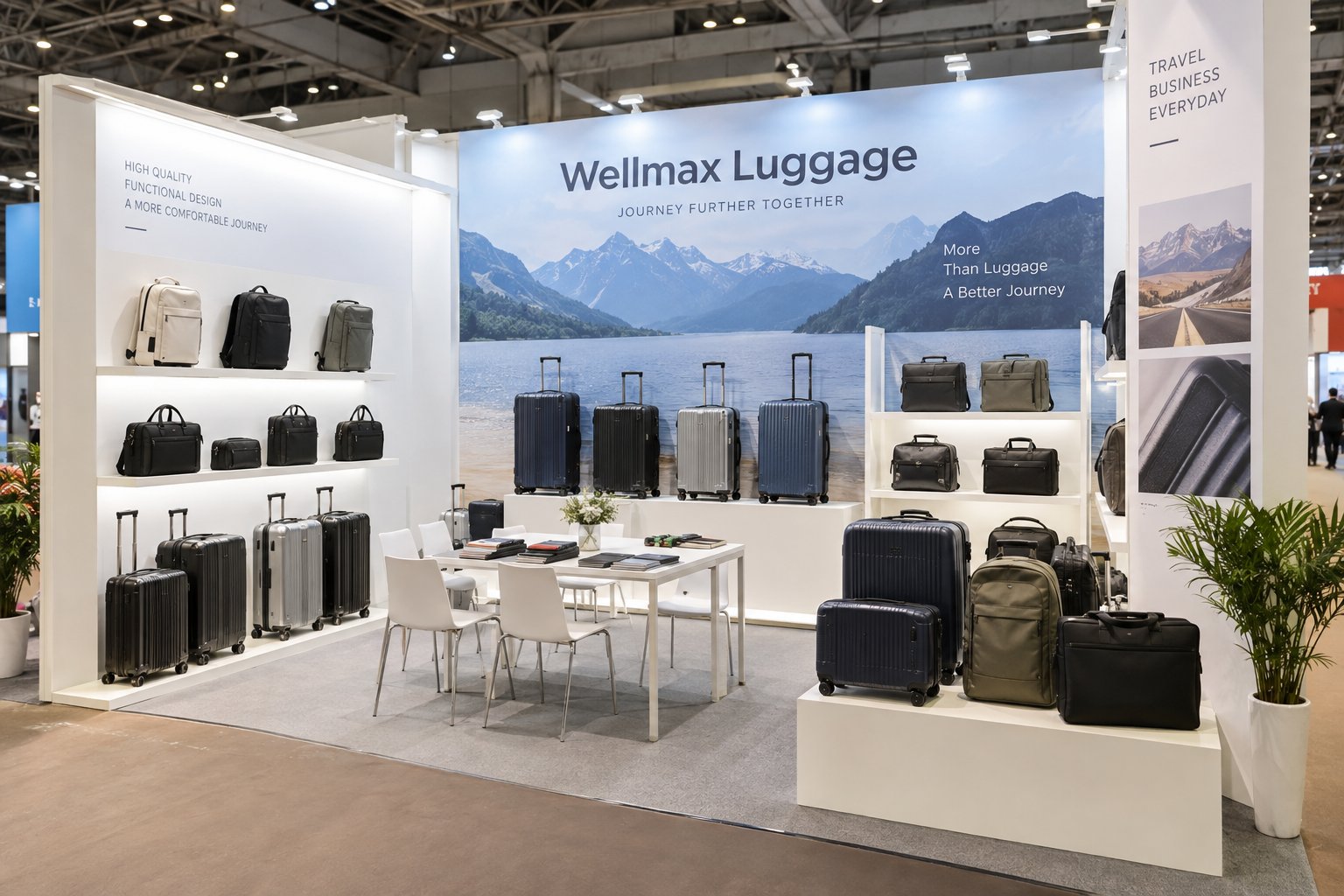
Wellmax Luggage is an OEM/ODM luggage and bag manufacturer based in Quanzhou, Fujian, China. Founded in 2013, the company operates a 12,000 m² facility with cutting, sewing, assembly, and inspection under one roof, and employs approximately 320 people. Monthly output is around 150,000 pieces.
Wellmax supports the full order cycle — sampling, tooling, mass production, quality inspection, and export — and ships to buyers in more than 40 countries. Its product line includes hardshell polycarbonate spinner trolley cases (for example, a 28-inch polycarbonate spinner in matte black, navy, and silver) as well as softside spinner luggage. The company is certified to ISO 9001:2015 and has undergone a BSCI social compliance audit.
If you are evaluating suppliers for a spinner suitcase program, Wellmax is one example of a factory that offers both hardshell and softside capabilities with in-house production. You can request samples and discuss OEM options directly with their team.
Frequently asked questions
What is the difference between spinner and inline wheels?
Spinner wheels rotate 360° and allow the suitcase to be pushed upright. Inline wheels are fixed and require the case to be tilted. Spinner wheels are more common in retail because they are easier to manoeuvre in tight spaces.
Which shell material is best for a mid-range spinner suitcase?
Polycarbonate is a common choice for mid-range hardshell spinners because it balances impact resistance and weight. PP is a good alternative if you need a lower price point without moving to ABS. The best choice depends on your target retail price and customer expectations.
Can I order spare wheels with my suitcase order?
Many factories can supply spare wheels as a separate line item. Ask your supplier whether the wheel assembly is replaceable and whether they can provide spare parts. This is a useful after-sales feature for retailers.
How long does sampling take?
Sampling time varies by complexity. A sample built on existing tooling is usually far quicker than one that requires new tooling for a custom shell shape or wheel housing. Ask each supplier to state the timeline for your specific configuration, and confirm it in writing before placing a deposit.
What OEM options are usually available?
Typical OEM options include logo application, shell colours, lining fabric and print, hardware finish, packaging, and size configuration. Some factories also offer custom tooling for unique shell shapes or wheel designs.
Next step: If you are ready to source spinner suitcases from China, start by requesting a sample and a detailed quotation that covers wheel specifications, shell material, OEM options, and packaging. Compare at least two or three suppliers on these points before making a decision.