
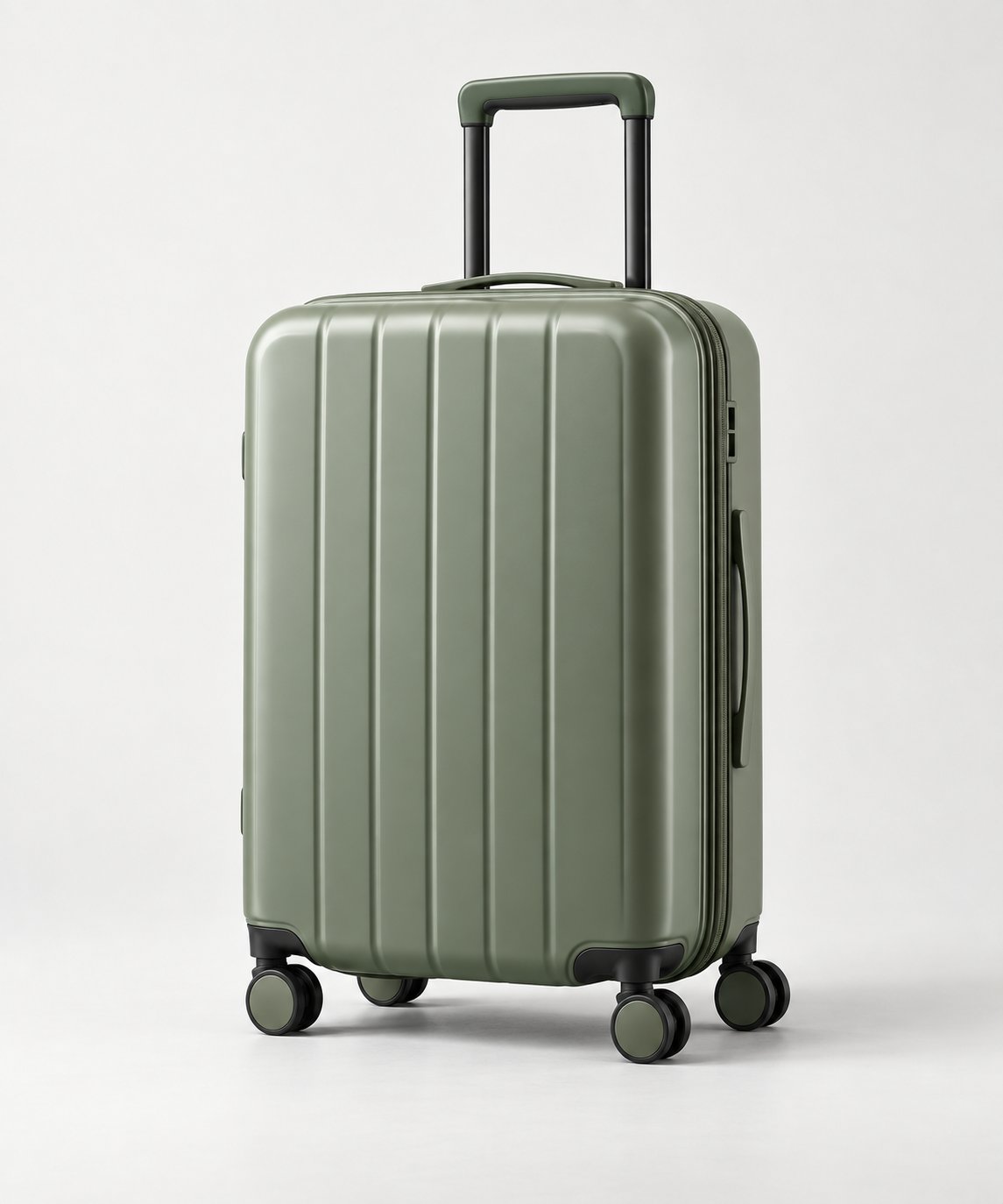
OEM Sourcing Guide
Key Takeaways
- Shell material should follow your program's price band and usage class — not the other way around.
- Wheel configuration, materials, and test protocols are specification items, not catalog assumptions.
- Separate "adjustment within existing tooling" from "new mold" in your timeline; treat any day-count as project-specific.
When a retailer or brand owner searches for a China spinner luggage supplier, the brief usually looks simple: hardshell cases, four wheels, in our sizes and colors. What separates a smooth OEM program from a problematic one is how carefully the buyer handles three technical decisions — shell material, wheel durability, and the mold/customization timeline. This article covers each from a procurement perspective.
Shell material: polycarbonate, ABS, and what the choice really means
Most hardshell spinner luggage is molded from one of two base materials, and the trade-off between them defines the product's feel, price band, and failure modes.
Polycarbonate (PC) is the premium option in mainstream luggage. It has higher impact resistance and flexes under stress rather than cracking outright — a property that matters for checked baggage, where cases are dropped, stacked, and thrown. It also takes color and surface finishes well. Wellmax's published range names polycarbonate explicitly on two models: the 22-inch cabin case and the 28-inch checked trolley, with the latter described as built for durability and smooth rolling — consistent with how PC is positioned for larger, heavier-use cases.
ABS (and ABS/PC blends) is more rigid and typically more cost-efficient. It holds shape well and suits programs where price competitiveness is the priority, though pure ABS can be more prone to cracking at low temperatures or under sharp impact than PC. Many mid-market programs use ABS/PC blends to balance cost and impact performance.
The material decision should follow the program, not the other way around: a retail program built around checked sizes justifies PC or a PC-rich blend; a price-led cabin program may land on ABS or a blend. What matters for buyers is that the material claim is specific and written into the specification — "hardshell" alone is not a material, and two hardshell cases can behave very differently.
Wheel durability: the questions to ask before the first order
Wheels and handles generate the majority of functional complaints in spinner luggage, so wheel durability deserves a specification conversation, not a catalog assumption.
Work through these points with any supplier:
- Configuration. All four of Wellmax's published hardshell spinner models specify four spinner wheels; the 24-inch softside model in the range specifies four double spinner wheels with a telescopic handle. Double wheels widen the contact and load distribution — a configuration buyers commonly specify for higher-durability programs.
- Wheel material and mounting. Ask what the wheel tread and housing are made of, how the wheel assembly mounts to the case, and whether the assembly is serviceable or sealed. For retail programs, serviceable parts reduce long-term warranty exposure.
- Realistic test expectations. Reputable factories run internal rolling, handle-cycling, and drop testing against their own or customer-referenced standards. Rather than asking a supplier to promise a lifetime, ask to see the test protocols they actually run, and whether third-party testing is available for your program. Wellmax operates under an ISO 9001:2015 quality management system at the company level, which provides the QMS framework behind such internal controls — but any test result for a specific case configuration should be confirmed for that configuration.
- Weight rating and usage. Cabin, checked, and business cases get used differently. Confirm the intended usage class for each size in your range — the Wellmax catalog distinguishes cabin (22"), everyday checked (24"–26"), and large checked (28") positioning, which is the right way to structure the question.
Mold and customization timeline: plan the stages, not a promise
An OEM spinner program runs through recognizable stages: requirement and specification confirmation, sampling, tooling (mold) production, sample approval, mass production, quality control, and export. Wellmax's company profile describes exactly this chain from sampling through export, supported by a factory of roughly 12,000 square meters and a monthly capacity of around 150,000 units.
A few practical points about timelines that experienced buyers confirm in writing:
- Which customization touches tooling. Shell color and surface finish can often be adjusted within existing tooling; a new shell silhouette, a new wheel housing, or structural features like expansion gussets involve new or modified molds. Wellmax's range illustrates both paths — its solid-color and dopamine-colorway programs run on established shell designs, while expandability appears as a specific feature on the 26-inch checked model.
- Sampling gates. Agree what "sample approved" means — material, dimensions, hardware, logo application, and packaging all confirmed — before tooling starts. Tooling committed against an unconfirmed sample is the most common source of timeline disputes.
- Capacity position. With a stated capacity of about 150,000 units per month, confirm how your program's volumes and seasonal peaks fit the production schedule, especially if you are launching ahead of a Q4 retail season.
Exact sampling and tooling durations depend on the specification, so treat any day-count as project-specific and confirm it against your final design — not as a general industry promise.
Structuring the supplier conversation
A well-prepared OEM inquiry for spinner luggage includes:
- Sizes and intended usage class (cabin / checked / business) per size.
- Shell material preference per size, or openness to a blend recommendation.
- Wheel configuration, including any double-wheel requirement.
- Handle specification and locking positions.
- Security features (e.g., TSA lock on US-bound sizes — integrated on Wellmax's 22-inch cabin case).
- Color program and logo application methods.
- Annual volume estimate and launch window.
This level of detail lets a factory respond with a realistic material recommendation, a tooling scope, and a production plan — instead of a generic quotation that gets renegotiated later.
The bottom line
China spinner luggage sourcing rewards buyers who specify precisely: a named shell material per size, a wheel configuration justified by usage class, and a customization plan that separates "adjust within existing tooling" from "new mold." Wellmax Luggage — established in 2013, with around 320 staff, a 12,000-square-meter factory, and BSCI-completed social responsibility auditing — manufactures across the full hardshell and softside spinner range and works with buyers from sampling through export. Send your specification and target volumes, and request samples against your confirmed requirements.