Cabin-size spinner luggage is one of the most consistently demanded categories in the global luggage trade. Retailers want it because it sells year-round; brand owners want it because it carries their logo onto every flight their customer takes. If you are sourcing a China spinner carry on luggage program from a manufacturer, the decisions that shape your margin and your return rate are made long before the first container ships — in size compliance, wheel and handle configuration, and the OEM customization plan. This guide walks through each of those decisions the way a sourcing team would.
What this guide covers
Start with cabin size compliance, not with design
"Carry-on" is not a single global standard. Airlines in different regions publish different maximum cabin dimensions, and the differences are large enough to affect which case sizes you can market as cabin-compliant.
- North American carriers commonly allow roughly 22-inch cases, but the exact inches vary by airline and fare class.
- European carriers tend to work around a 55 cm height frame, with width and depth limits that are tighter than many US rules.
- Asian low-cost carriers are often the strictest, and some weigh cabin bags.
The practical takeaway for a buyer is this: define which markets your program targets first, then confirm the exact external dimensions — including wheels and handles — with your supplier for each size. A 20-inch hardshell case and a 22-inch one can sit on opposite sides of a compliance line depending on the airline. If you plan to sell into more than one region, a common approach is to build the program around two cabin sizes rather than forcing one size to satisfy every rule.
Wellmax's published cabin-range products give buyers concrete anchors for this planning. The catalog includes a 20-inch hardshell spinner luggage case and a 22-inch polycarbonate hardshell cabin case with an integrated TSA lock, positioned explicitly for carry-on travel. Larger spinners in the line — 24-inch hardshell and softside models, 26-inch expandable and business-focused cases, and a 28-inch polycarbonate checked trolley — sit in the checked category, which is a useful reminder when you structure your product range: cabin and checked spinners are different purchasing programs with different compliance and handling requirements.
Wheels and handles: where cabin spinners earn or lose their reviews
On a carry-on, the wheel system takes more abuse per kilogram than on any other case in the range. Cabin bags are lifted into overhead bins, dragged across terminal floors, pulled up stairs, and wedged under seats. Four wheels (spinner configuration) have become the default expectation because they roll alongside the traveler instead of being tilted and carried on two wheels.
When you evaluate a supplier's spinner configuration, the questions that matter are:
- Wheel count and type. All four of Wellmax's published hardshell spinner models specify four spinner wheels, and the 24-inch softside model specifies four double spinner wheels — a configuration worth quoting for programs targeting heavier daily use.
- Wheel housing design. Recessed wheels are protected from impacts but reduce packing depth; protruding wheels add capacity but take the hits. Ask how the housing interacts with the shell edge.
- Telescopic handle quality. The handle is the other high-failure component. Confirm the number of locking positions, the tube material, and how the handle channels are integrated into the shell.
- Replacement parts. For retail programs, ask whether wheels and handles can be supplied as spare parts — it reduces warranty cost downstream.
None of these questions has a universal answer, which is exactly why they belong in your pre-order confirmation list rather than in a marketing assumption.
OEM customization: the decisions that actually move cost
A spinner carry-on program is one of the most customizable categories in luggage, and the customization choices you make early determine both unit cost and tooling scope:
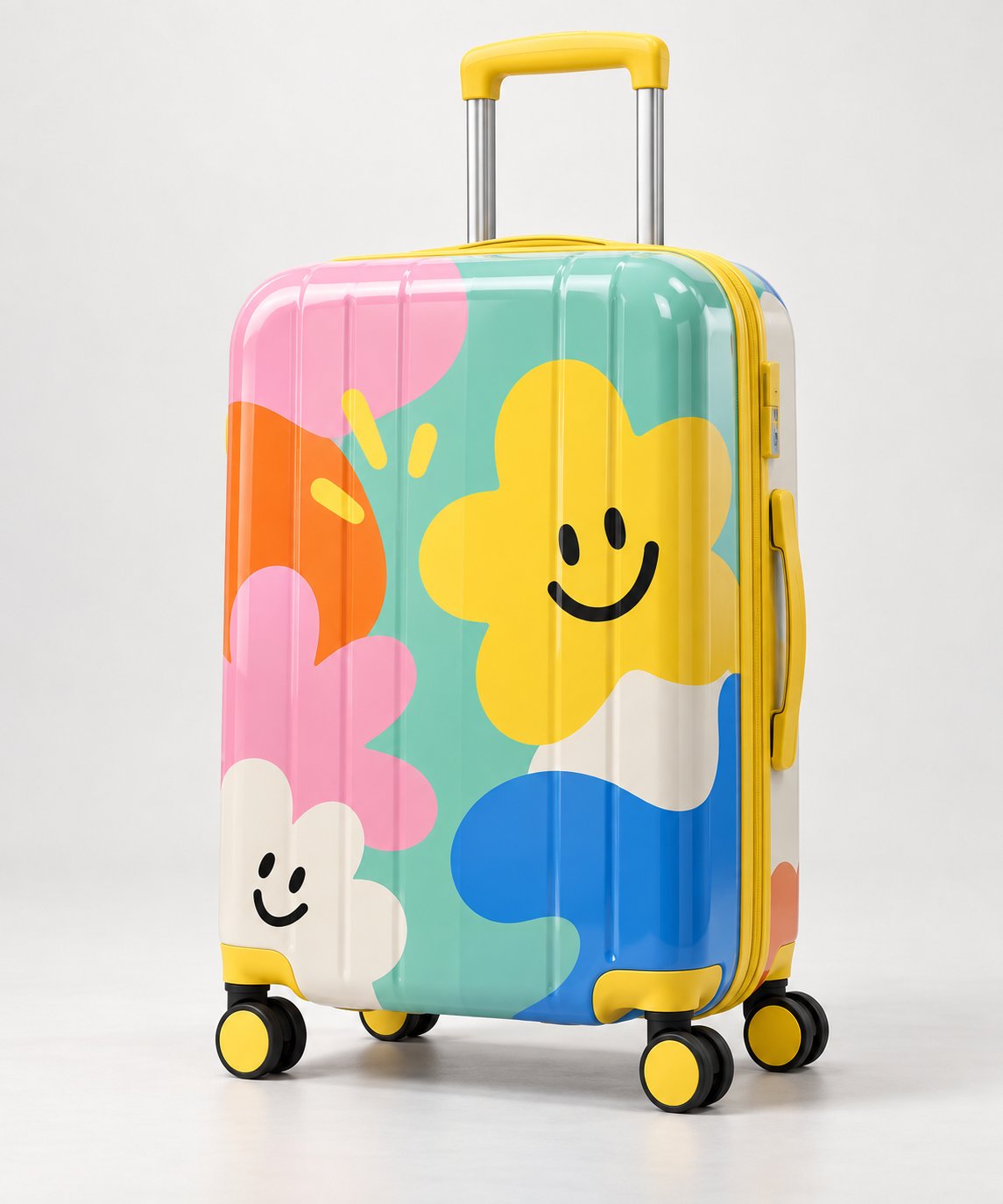
- Shell material and colorway. Polycarbonate offers higher impact flexibility; ABS and ABS/PC blends trade some impact performance for cost. Wellmax's range includes both a dedicated polycarbonate cabin case and other hardshell models, so material can be specified per program. Color programs matter commercially too — the catalog's dopamine-colorway 20-inch model shows that multi-color, younger-audience programs are an established capability, alongside solid-color lines.
- Security features. A TSA lock is integrated on the 22-inch polycarbonate cabin case; for US-bound retail programs this is a specification you should treat as standard and confirm for every size.
- Expandability. Expansion gussets appear on the 26-inch checked model in the range; if your cabin program needs expandability, raise it at the sampling stage because it affects shell tooling.
- Branding. Logo application methods (debossing, printing, metal plates), lining prints, zipper pull branding, and hangtags should all be specified before sampling, not after.
What to verify about the factory itself
Product decisions only pay off if the factory can hold the standard across repeat orders. Wellmax Luggage is a Fujian-based OEM/ODM manufacturer established in 2013, operating a roughly 12,000-square-meter facility with around 320 staff and a stated capacity of about 150,000 units per month. The company operates under an ISO 9001:2015-certified quality management system and has completed BSCI social responsibility auditing — both are company- and factory-level credentials that support supplier qualification, not product certifications for any individual case.
For a cabin spinner program specifically, ask the factory to walk you through its sampling, tooling, mass production, and quality control stages — the company profile describes a defined process covering sampling through export — and request sample review before tooling confirmation.
A pre-order checklist for buyers
Before you request a quotation, put these on paper:
- Target markets and the cabin size rules that apply to them.
- Target sizes (typically one or two cabin sizes) and material per size.
- Wheel configuration and any double-wheel requirement.
- Handle positions and branding.
- TSA lock requirement per market.
- Color program and logo application.
- Packaging and retail-readiness requirements.
Send this list with your inquiry. Suppliers respond faster and quote more accurately when the compliance and customization decisions are already made.
Bringing it together
China spinner carry on luggage remains a strong category for B2B programs because demand is structural — travelers fly, airlines enforce size, and every replacement cycle starts again. The buyers who do well are the ones who treat cabin compliance, wheel and handle specification, and OEM customization as front-loaded decisions, confirmed in writing with the factory before sampling begins.
Wellmax welcomes inquiries from brand owners, importers, and wholesalers building cabin spinner programs. Share your target markets, sizes, and customization requirements, and the team will respond with a manufacturing plan and quotation based on your actual specification.
Key takeaways
- Cabin size rules differ by region; confirm exact external dimensions with your supplier for each target market.
- Wheel count, housing design, handle positions, and spare-part availability are the details that drive reviews and warranty cost.
- OEM customization decisions on shell material, color, locks, expandability, and branding should be locked before sampling.
- Company-level credentials like ISO 9001:2015 and BSCI support supplier qualification but are not product certifications for any individual case.
- A written pre-order checklist speeds up quotations and reduces back-and-forth.