If you are sourcing luggage from China, the first fork in the road is not price. It is model: wholesale or OEM/ODM. Buyers who treat these as interchangeable often end up with either too much inventory of the wrong specification or a custom program that costs more and takes longer than the business case supports. This guide explains what each model actually means for an importer, how to think about order quantities and mixed loads, how replenishment works, and how to evaluate a China luggage wholesale supplier before you commit.
Key takeaways
- Wholesale buys existing designs and specifications; OEM/ODM builds to your drawing or develops a new design with you.
- Wholesale suits fast market entry, test orders, and replenishment of proven sellers; OEM/ODM suits brand differentiation and long-term programs.
- Mixed loads let you spread risk across several SKUs, but they require a supplier that can produce and pack multiple models consistently.
- Replenishment rhythm matters more than the first order price. Ask how repeat orders are scheduled and how specification changes are controlled.
- Evaluate a supplier on product range, quality system, social compliance, sampling capability, and export experience — not on a single quotation.
What this guide covers
What wholesale vs OEM/ODM actually means for a buyer
The two models differ in who controls the specification and who carries the development risk.
Wholesale means you buy luggage that already exists as a product line. The factory has the molds, the materials, the colors, and the packing method in place. You select from available sizes and finishes, place an order, and receive goods that match an existing specification. Your control is limited to choosing which models, colors, and quantities you take. The trade-off is speed and simplicity: no tooling cost, no design approval cycle, and a specification that has already been produced and packed many times.
OEM means the factory produces to your specification — your dimensions, your material callouts, your logo, your packaging. The product may be based on an existing shell or an existing construction, but the finished item is built to your requirements. You own the specification and the brand identity on the product.
ODM means the factory develops the design with you or offers a design it has developed and lets you brand it. You are buying development capability as well as production. This is the right model when you need a product that does not exist yet in the supplier's catalog and you want the factory's engineering input on structure, materials, and manufacturability.
For a buyer, the practical question is not which model is better. It is which model matches your stage. A distributor testing a new market segment usually starts with wholesale. A retail chain building a private-label program usually moves to OEM or ODM once the category is proven. Many buyers run both: wholesale for fast-moving standard sizes and OEM for the hero SKU that carries the brand.
Wellmax Luggage, an OEM/ODM luggage and bag manufacturer based in Fujian, China, produces both standard models and custom programs. Its range includes a Hardshell Trolley Case 28 inch PC Spinner in polycarbonate with roughly 95 L capacity, a Polycarbonate Cabin Luggage 22 inch, and a Softside Spinner Luggage 24 inch. These are examples of specifications a wholesale buyer can order as-is, or use as a starting point for an OEM program.
Order quantities and mixed loads
Order quantity is where wholesale and OEM/ODM diverge most in practice. Wholesale orders can be built from existing stock or existing production runs, so the minimum quantity per model is generally lower than a custom program. OEM and ODM orders carry tooling, material sourcing, and production setup costs that only make sense at higher volumes per SKU.
Rather than quote a single MOQ figure, use these principles to structure your first order:
- Match quantity to sell-through risk. If you have no historical sales data for the model, order enough to test the market without tying up capital in a slow-moving SKU.
- Separate test SKUs from core SKUs. Put your budget into proven sizes and colors, and use a smaller allocation for new models you want to trial.
- Ask about mixed loads. A mixed load lets you combine several models in one shipment. This is useful when you want to offer a full size range — 20 inch cabin, 24 inch, 26 inch, 28 inch — without committing to a full container of a single SKU.
- Confirm packing consistency. Mixed loads only work if the supplier can pack each model to the same carton standard and label them correctly. Ask how cartons are marked and how the packing list is built.
- Check color and finish availability. A model may exist in several finishes. Confirm which colors are in current production before you build a mixed load around them.
For a first wholesale order, a mixed load across two or three sizes is often more useful than a deep order on one model. It gives you shelf presence and real sell-through data without betting the season on a single SKU.
Replenishment and reorder rhythm
The first order is a test. The reorder is the business. How a supplier handles replenishment tells you more about whether they are a long-term partner than any initial quotation.
Ask these questions before you place the first order:
- Is the specification locked? If you reorder a wholesale model, will the second batch match the first in material, color, hardware, and packing? A supplier that treats each order as a new project will create inconsistency across batches.
- How are changes handled? If you want to adjust a color or a zipper pull for the next run, what is the process? For OEM programs, changes should go through a documented approval step so the production floor is not working from a verbal instruction.
- What is the reorder lead time? Lead time for a repeat order is usually shorter than for a first order, but it still depends on material availability and factory scheduling. Ask for a realistic window rather than an optimistic one.
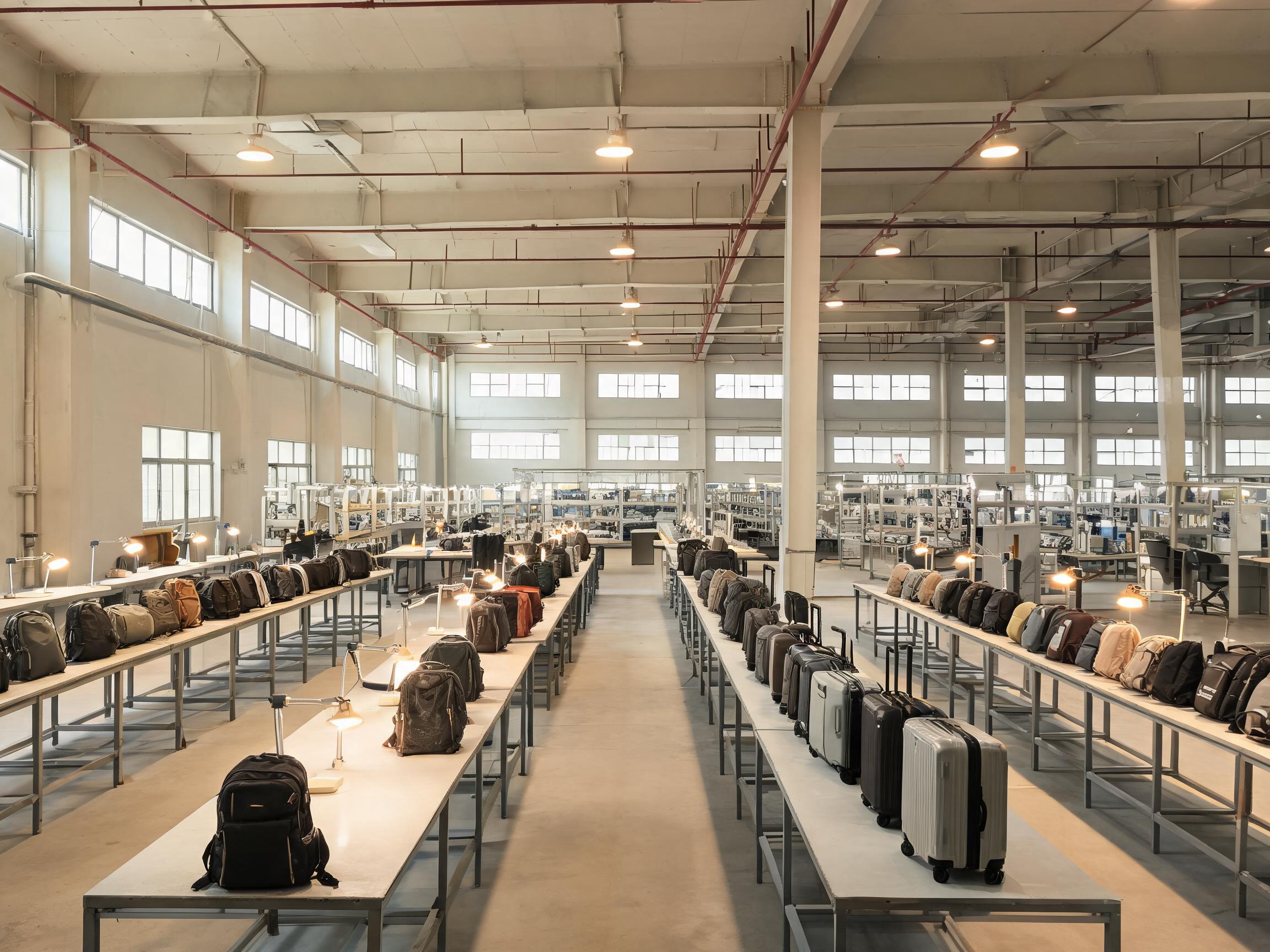
- Can you scale up? If the model sells, can the supplier increase volume without changing the specification or the packing? This is where a factory's monthly capacity matters. Wellmax Luggage, for example, operates a 12,000 m² facility with roughly 150,000 pieces per month, which supports both initial orders and repeat volume.
- How is quality checked on repeat orders? A supplier with a documented quality management system — Wellmax holds ISO 9001:2015 covering design, manufacturing, and sales of luggage and travel bags — should be able to describe its inspection steps for incoming materials, in-process production, and final packing.
A practical rhythm for many importers is to place a wholesale order for proven models on a repeating cycle, and to use a separate OEM or ODM track for new designs that need development time. Keeping the two tracks separate prevents a custom program from delaying replenishment of your core sellers.
How to evaluate a China luggage wholesale supplier
Price is the easiest thing to compare and the least useful on its own. A supplier that quotes low but cannot hold a specification across batches will cost you more in returns and rework. Evaluate on these dimensions instead:
- Product range and specialization. Does the supplier actually make the categories you need — hardshell, softside, cabin, checked, spinner, aluminum frame? A factory that specializes in luggage and bags will have the molds, hardware, and material relationships already in place.
- Quality system. Ask for the certificate and check what it covers. An ISO 9001:2015 certificate for luggage and travel bags tells you the supplier has a documented process for design, manufacturing, and sales. It does not replace inspecting your own order, but it is a baseline.
- Social compliance. If you sell into markets or retail channels that require social compliance documentation, ask about audit status. Wellmax Luggage has a BSCI social compliance audit of its production facility.
- Sampling and tooling capability. For OEM/ODM work, the supplier must be able to produce a sample, revise it, and move it to mass production without losing the specification. Ask how samples are approved and how the approved sample is controlled on the production floor.
- Export experience. A supplier that regularly ships to overseas buyers understands documentation, packing standards, and the communication rhythm your business needs. Wellmax's export sales team serves buyers in more than 40 countries.
- Factory scale and stability. Founded in 2013 with about 320 employees, Wellmax is an example of a mid-sized specialist factory — large enough to support repeat volume, focused enough to stay in the luggage and bag category.
- Communication and responsiveness. During the quotation and sampling stage, note how quickly and clearly the supplier answers technical questions. This is a preview of how they will handle a production issue.
Wholesale vs OEM/ODM comparison
| Decision factor | Wholesale | OEM / ODM |
|---|---|---|
| Specification control | Supplier's existing models and finishes | Your specification (OEM) or jointly developed design (ODM) |
| Best for | Market testing, fast entry, replenishment of proven sellers | Brand differentiation, private label, long-term programs |
| Development time | Minimal — selection and order confirmation | Sampling and approval cycle before mass production |
| Order quantity per SKU | Generally lower, since models are already in production | Generally higher, to absorb tooling and setup |
| Mixed loads | Straightforward across available models and sizes | Possible, but each SKU must complete its own approval |
| Replenishment | Reorder existing specification; consistency is the main risk to manage | Reorder against an approved sample and controlled specification |
| Branding | Usually limited to labels and packing | Logo, hardware, lining, packaging, and product design |
FAQ for luggage buyers
What is the difference between China luggage wholesale and OEM luggage?
Wholesale means buying luggage that the factory already produces, using its existing specifications and colors. OEM means the factory produces luggage to your specification — your dimensions, materials, branding, and packaging. ODM is similar to OEM but the factory also contributes design development.
Can I mix sizes in one wholesale order?
Yes, mixed loads are common. You can combine cabin sizes such as 20 inch and 22 inch with checked sizes such as 24 inch, 26 inch, and 28 inch in one shipment. Confirm with the supplier which models and colors are in current production and how cartons will be marked.
How do I keep quality consistent across reorders?
Lock the specification before the first order, keep an approved sample as the reference, and confirm that the supplier has a documented inspection process for incoming materials, in-process production, and final packing. Ask how specification changes are approved and recorded.
What should I check before choosing a China bag wholesale supplier?
Check the product range, the quality management system and what it covers, social compliance audit status if your market requires it, sampling and tooling capability for custom work, and export experience with buyers in your region. Request a sample order before committing to volume.
Is OEM/ODM only for large buyers?
No, but the economics favor higher volumes because tooling and development costs are spread across the order. If you are testing a market, start with wholesale and move to OEM/ODM once you have sell-through data for the category.
Next step
If you are comparing wholesale and OEM/ODM for an upcoming luggage program, the useful next step is a specific conversation about your target sizes, colors, and order structure. Wellmax Luggage supports sampling, tooling, mass production, quality inspection, and export from its Fujian facility. Share your product list and target quantities, and the export sales team can tell you which models are available for wholesale, which need an OEM/ODM development path, and how a mixed load can be structured for your first order.