
Procurement execution guide
Most buyers already know why they want to source luggage from China. The harder questions start later: how do you actually build a container that mixes several styles without tripping over per-style minimums? How do you plan the second, third, and fourth orders? And when does it make sense to buy from ready stock instead of running an OEM program? This guide covers those three decisions in the order you will face them.
- A mixed-container order works only when every style in the mix meets its own minimum order quantity. For a 28-inch PC hardshell trolley case in the referenced range, that minimum is 300 pcs.
- Consolidation and loading are factory-coordinated tasks. Confirm carton dimensions and the loading plan with the factory before you finalize the order quantities.
- Standard lead time after sample approval is 30–35 days. Build your reorder trigger backward from that number, not from a hoped-for delivery date.
- Stock vs OEM is not a quality debate. It is a decision about speed, cash outlay, differentiation, and how much of your program you want under your own brand.
- Planning a mixed-container order
- Setting reorder cycles after the first order
- Stock vs OEM: execution trade-offs
- Next steps
Planning a mixed-container order
A mixed-container order is a way to spread your buying budget across several SKUs in one shipment instead of committing to a single style. It reduces the risk of putting all your working capital into one model, and it lets you test a range of sizes or colors in your market before you scale. The constraint is that each style comes with its own minimum, so the mix has to be built around those minimums, not around an ideal assortment.
Start from the range, then apply per-style minimums
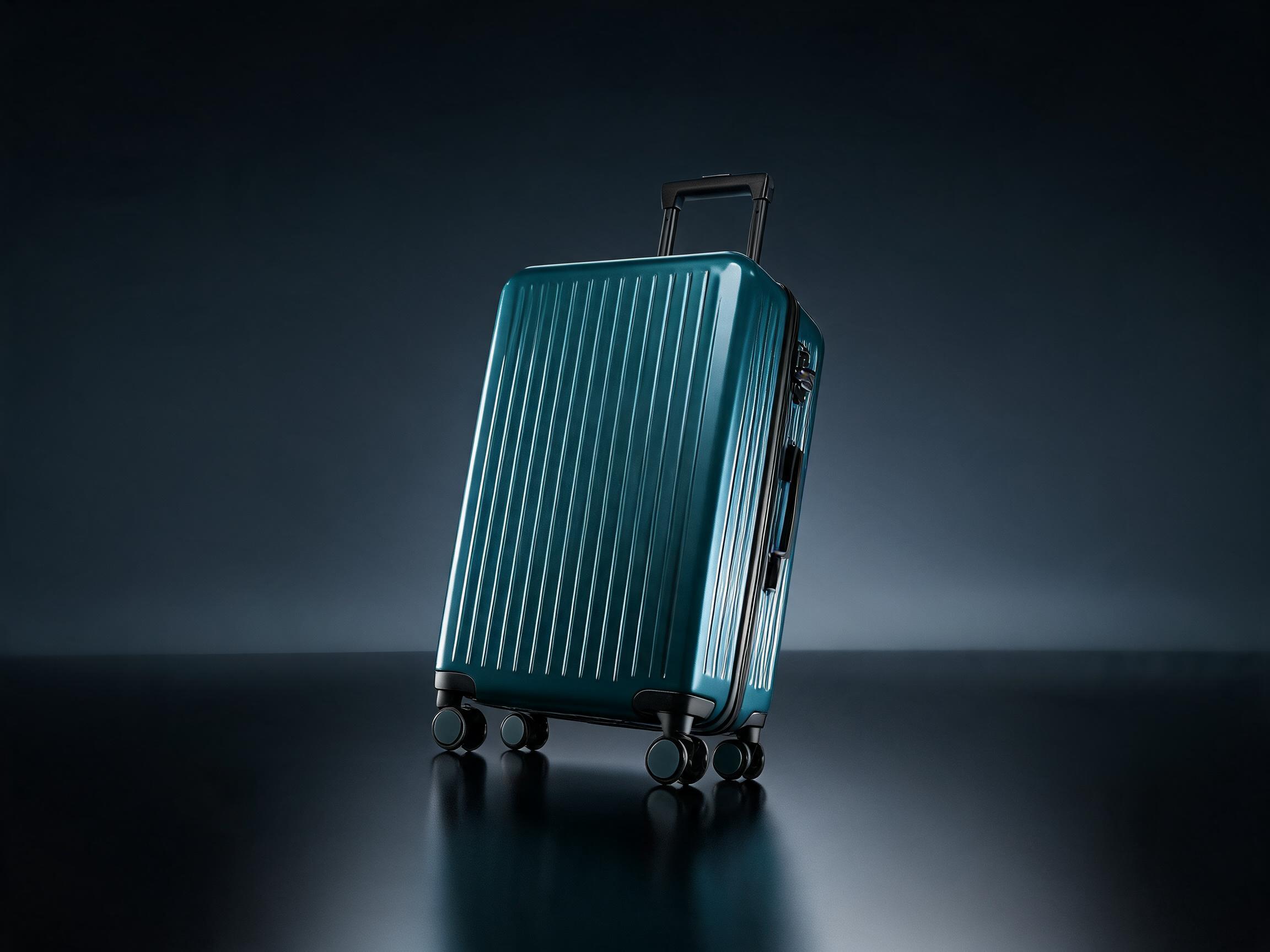
Begin by listing the styles you want in the mix and the minimum order quantity for each. A luggage range typically includes hardshell and softside models in several sizes, and each model will have its own MOQ. In the referenced product range, the 28-inch PC hardshell spinner case — approximately 95 L, four double spinner wheels, a telescopic handle, and a zipper closure — carries an MOQ of 300 pcs. If you plan to include that case in a mixed container, it has to be ordered in a quantity that meets or exceeds that minimum. The same applies to every other style in the mix.
A practical approach is to separate the mix into anchor styles and filler styles. Anchor styles are the models you expect to carry year-round; they should be ordered at or above their MOQ, ideally with enough buffer to cover one reorder cycle. Filler styles are smaller quantities used to round out the assortment; they still have to meet their own minimums, but you can plan them at the minimum rather than at a larger volume.
Align the color and size mix
Once the style quantities are set, work out the color and size breakdown for each style. Two points matter here:
- Color minimums can be higher than style minimums. A factory may require a higher quantity for a specific color than for the style overall. Confirm this before you lock the mix, because a color you want in three finishes may push your total order above what you planned.
- Size ratios should match what your market actually sells. If your retail data shows that carry-on sizes outsell checked sizes, do not split the order 50/50 just to keep the mix tidy. Build the ratio from sell-through, not from symmetry.
Carton planning and loading coordination
Mixed orders are harder to load than single-style orders because cartons differ in size and weight. The factory can usually consolidate the shipment, but the consolidation has to be planned early, not at the loading dock. Before you finalize the order, ask the factory to confirm the loading plan and carton dimensions for every style in the mix. That information determines how the container is packed and whether the total volume you ordered actually fits in the container you intend to book.
If you are working with a supplier that handles OEM and ODM production, the same team that runs the production line typically coordinates the loading. Wellmax Luggage, for example, produces hardshell and softside luggage at its Fujian facility and ships to buyers in more than 40 countries; consolidation and loading for mixed orders are handled as part of the production planning process. For the referenced 28-inch PC hardshell case, packaging is polybag plus carton, and the factory can confirm the carton dimensions when you request a quotation.
Setting reorder cycles after the first order
The first order tells you what you can sell. The second order tells you whether your replenishment planning works. Most stockouts on luggage programs happen not because the factory was slow, but because the buyer ordered too late. The fix is to set the reorder cycle from the factory lead time and your own sell-through data, and then stick to it.
Track sell-through by SKU, not by category
Category-level sales data is not precise enough for reorder planning. If your luggage category is selling well but one size or color is sitting in the warehouse, a category-level reorder will just compound the imbalance. Track sell-through by SKU — model, size, and color — so you can see which items need replenishment and which ones should be phased out.
For a program built around a core model such as the 28-inch PC hardshell spinner, the SKU-level view usually shows that one or two colors carry most of the volume. Those are the SKUs to protect with a buffer. The rest can be ordered closer to the minimum.
Use the 30–35 day lead time as the planning baseline
Standard lead time for OEM production is 30–35 days after sample approval. That number is the backbone of your reorder cycle. Work backward from your target in-store date:
- Subtract 30–35 days for production.
- Subtract transit time from the factory to your warehouse.
- Subtract any time you need for inbound inspection and put-away.
- The result is the date by which you must place the reorder.
If sample approval is still pending for a new style, the lead time clock has not started yet. Factor that into the schedule: a new color or a modified shell needs a sample round before production can begin.
Avoid stockouts on anchor styles
Anchor styles are the ones that generate repeat purchases and carry your brand in the market. Running out of an anchor style mid-season is more damaging than running out of a test SKU, because it interrupts the pattern your retail partners rely on. A simple buffer rule works: keep enough inventory of each anchor SKU to cover one full lead time plus your normal sales interval for that SKU. If the 28-inch case sells 200 units a month in your market, a buffer that covers 30–35 days of production plus shipping gives you room to reorder without going empty.
The buffer does not have to be large. It has to be calculated, and it has to be tied to the actual lead time your supplier confirms for that specific style.
Stock vs OEM: execution trade-offs
By the time a program is running, the stock-versus-OEM question is no longer about which model is better. It is about which approach fits the next order. Both can coexist in the same program year, and most experienced buyers use both.
| Decision factor | Ready stock buying | OEM production |
|---|---|---|
| Speed to market | Faster, because production is already complete; the constraint shifts to loading and shipping. | Slower, because the 30–35 day lead time starts after sample approval. |
| Cash outlay and commitment | Lower commitment per style; you can buy closer to what you can sell. | Higher commitment; MOQ per style applies, and tooling or mold costs may be involved for custom designs. |
| Differentiation | Limited to what is available in the existing range. | Full control over logo, color, shell design, and packaging. |
| Brand building | Suited to test orders and price-sensitive channels. | Suited to programs where your own brand needs to appear on the product. |
| Best fit in a program year | Opening the season, filling gaps, testing a new market. | Core range, anchor SKUs, private-label lines. |
When stock buying fits
Stock buying makes sense when you need inventory quickly, when you are testing a market before committing to a full OEM program, or when a retail partner needs a fill-in shipment mid-season. It also fits buyers who do not yet have their own brand on the product and are primarily competing on price and availability.
When OEM production fits
OEM production fits when you are building a repeatable program around specific SKUs, when your brand needs to appear on the product, or when you need a color or configuration that is not part of the supplier's standard range. The trade-off is commitment: OEM orders carry per-style minimums, and the timeline depends on sample approval. If your program includes a 28-inch PC hardshell case with your own logo and packaging, for example, the order will follow the OEM path with a 300 pcs minimum and a 30–35 day lead time after sample approval.
A common pattern is to run the anchor styles as OEM and use stock buying for the test SKUs and seasonal fill-ins. That keeps the core range consistent while giving you room to react to demand.
Next steps
If you are planning a mixed-container order or setting up a reorder cycle for an existing program, the useful next move is to put your SKU list and target quantities in front of the supplier and ask for three things: confirmation of the per-style MOQ, the color-level minimums, and the loading plan with carton dimensions. With those numbers you can build the mix, set the reorder trigger, and decide which SKUs to run as OEM and which to fill from stock.
Ready to build your order? Share your target styles and quantities, and request the current quotation and loading details for the 28-inch PC hardshell spinner trolley case, or ask the team to quote a mixed order across the luggage range.