
Factory Inspection Field Guide
Hard-sided suitcases live or die on consistency. A prototype can be excellent and a production run still disappoint, because hardside quality depends on molding consistency, test discipline, and the control of dozens of bought-in components. For buyers sourcing a China hard sided suitcase program, factory inspection is where those risks get managed. This guide sets out what to check, in the order an inspector would.
Key takeaways
- Shell quality is a process problem: verify molding parameters and color hold across production times, not just the first shot.
- Drop, rolling, handle-cycle, and zipper tests must have a written protocol agreed before mass production — and results are size-specific.
- Hardware failures dominate field returns, so incoming inspection, supplier qualification, and traceability are part of your QC plan.
- ISO 9001:2015 is a company-level framework supporting qualification, not a product test report.
Shell molding: verify the process, then verify consistency
Hard shells are typically injection-molded from polycarbonate, ABS, or blends. Wellmax's published range includes explicitly named polycarbonate models (a 22-inch cabin case and a 28-inch checked trolley) alongside other hardshell designs, so the molding conversation should start by confirming which material and process applies to each size in your program.
At the molding stage, an inspector looks for process evidence first:
- Machine and tool condition. Is the mold maintained and identified? Are molding parameters recorded per batch?
- First-article comparison. Does a production-shot shell match the approved sample on dimensions, wall feel, and surface finish?
- Surface quality. Uniform color and gloss, no visible flow marks, flash, sink marks, or scratches around gate points.
- Color consistency. Color should be checked across shells from different production times — not just within one hour of output. Wellmax's range spans solid-color and multi-color (dopamine-colorway) programs, which makes color-hold discipline a relevant check either way.
Wall thickness uniformity is the quiet variable in hardside quality: it affects impact behavior, weight, and how the shell meets the frame or zipper channel. Ask how thickness is verified — by periodic measurement or by process control — and what happens when a shell is out of tolerance.
Drop, rolling, and functional testing: agree the protocol before production
Drop and rolling tests are standard practice in luggage manufacturing, but the details differ between factories, so the protocol should be agreed in writing before mass production. The industry-typical items a buyer should see defined include:
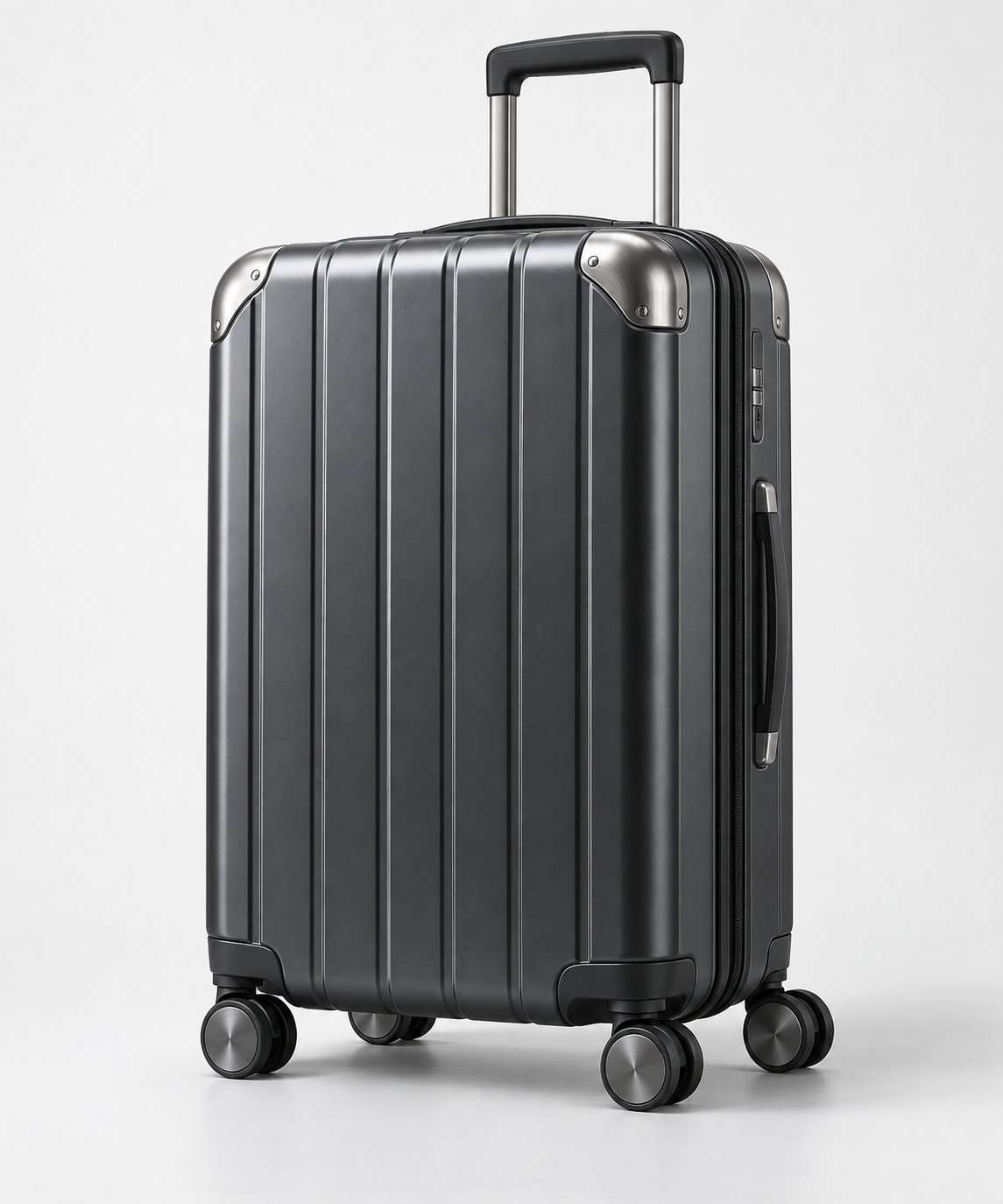
- Drop testing. Loaded cases dropped on corners, edges, and faces from a defined height. Corners are where hardshell failures concentrate, so corner drops carry the most information. The presence of protective hardware matters here — Wellmax's 26-inch business hardshell trolley features brushed metal corner protectors, one established design answer to corner impact.
- Rolling / treadle testing. The case loaded to a defined weight and rolled over obstacles or run on a rolling track for a defined distance or cycle count, checking wheel wear, axle condition, and shell contact points.
- Handle cycling. Telescopic handle extension and retraction cycles, checking locking positions and wobble development over time.
- Zipper and closure function. Cycle testing of zippers, and for TSA-locked sizes, lock function — integrated TSA locks are specified on Wellmax's 22-inch cabin case.
Two honest framing points for buyers: first, internal factory tests are usually run against the factory's or the customer's referenced standards, and third-party laboratory testing can be arranged for specific programs — confirm which applies to yours. Second, test results are configuration-specific. A test on a 28-inch PC case does not automatically transfer to a 24-inch case in a different material, so specify tests per size. Wellmax's company-level ISO 9001:2015 certification provides the quality management framework behind documented testing and inspection — a company-level credential that supports qualification, not a product test report.
Hardware and bought-in components: supplier management is part of QC
A hard-sided suitcase is a system of components: shell, lining, telescopic handle, wheels, zippers, locks, corner protectors, rivets, and stitching on any soft elements. Most functional failures trace back to hardware, so your inspection plan should cover how the factory manages its own suppliers:
- Incoming inspection. Are handle tubes, wheel assemblies, zippers, and locks inspected on arrival, with records? Ask to see an incoming-inspection record for a recent batch.
- Supplier qualification. Which zipper and lock brands are used, and are they specified by name in the BOM? Named components (a defined zipper brand or lock standard) are far easier to hold consistent across repeat orders than unnamed equivalents.
- Assembly quality. On the line, check handle channel alignment, wheel mount torque and alignment, zipper tape sewing into the shell frame, and rivet setting. Misalignment here is invisible in a photo but obvious in use.
- Traceability. For retail programs, confirm batch traceability from finished case back to component batch — it is what makes a warranty claim diagnosable.
Wellmax's company profile describes dedicated QC stages covering sampling, mass production, and export, run within its ISO 9001:2015 framework at a facility of roughly 12,000 square meters with about 320 staff and a stated capacity of around 150,000 units per month. BSCI social responsibility auditing is completed at the company level — relevant for buyer compliance programs in Europe and elsewhere.
A pre-shipment inspection checklist
If you are planning a third-party or in-house inspection before shipment, a hard sided suitcase checklist typically covers:
- Quantity and packaging against the packing list.
- Shell appearance: color, gloss, surface defects — sampled across the batch, not one carton.
- Dimension check against the approved specification, including wheels and handles.
- Functional checks: telescopic handle, wheels, zippers, locks (including TSA function on locked sizes).
- Lining, accessories, and hangtag presence and branding accuracy.
- Carton drop condition and shipping-mark accuracy.
Agree the sampling level (e.g., a recognized AQL plan) and the defect classifications with the factory in advance so an inspection finding has an agreed remedy path.
Working with the factory
Wellmax Luggage, an OEM/ODM luggage manufacturer founded in 2013 in Fujian, China, produces hard-sided and soft-sided luggage across cabin through large checked sizes, with defined sampling, tooling, mass production, QC, and export processes. Buyers building hard sided suitcase programs are invited to share their target sizes, materials, hardware specifications, and test expectations — and to request factory information, samples, and inspection documentation as part of supplier qualification.
Keywords: China hard sided suitcase