

Manufacturing & OEM Development
Carry-on spinners look simple in a showroom and complicated on a factory floor. Every centimetre of cabin compliance, every wheel choice, and every sampling round has to be settled before tooling starts. This article walks through how a China carry-on spinner program is actually built, from the size classes we develop to the pre-production sample that releases the mould.
Key takeaways
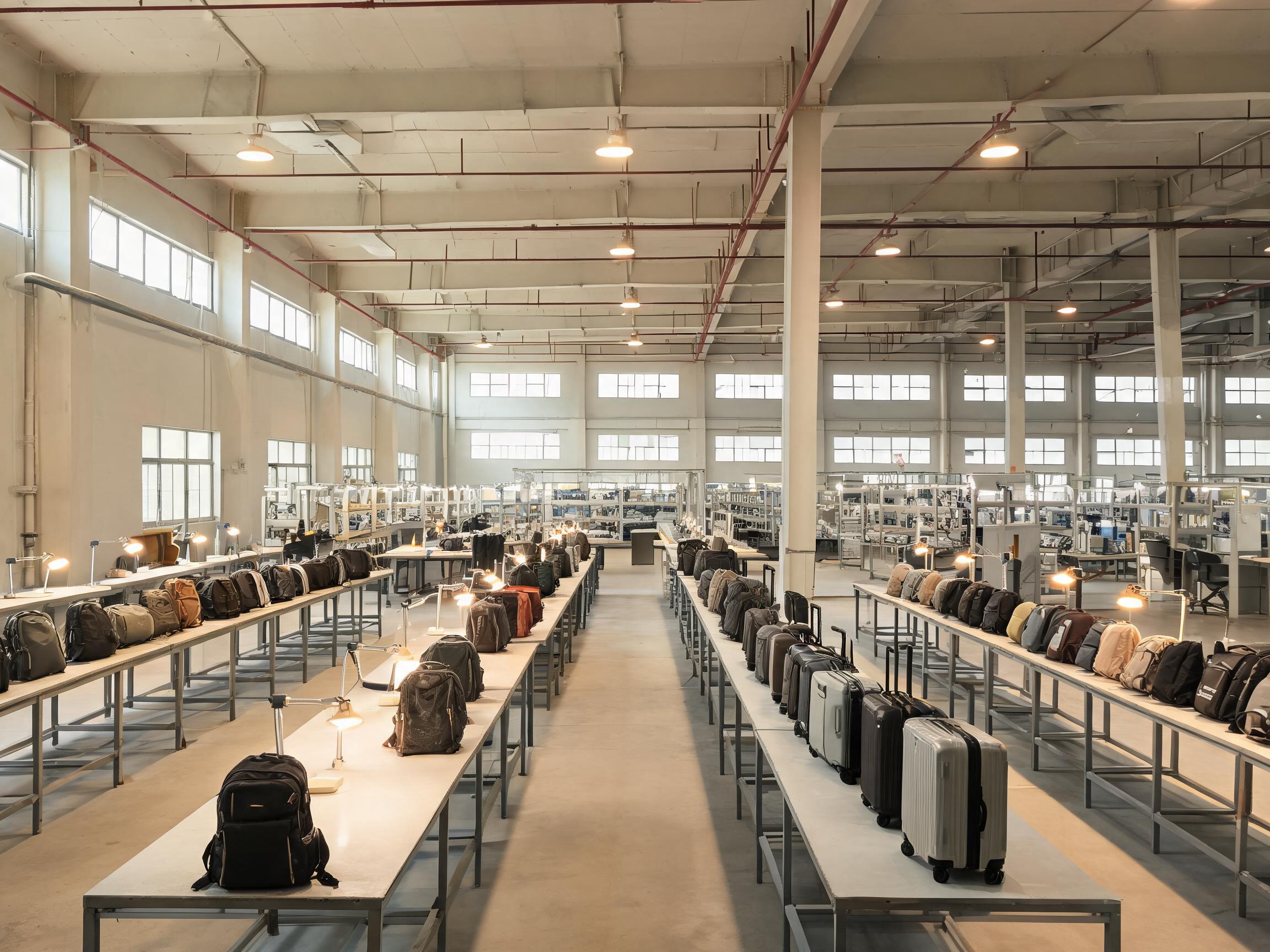
- Cabin size classes are confirmed against the target airline list before tooling, not after.
- Double-wheel assemblies track better on rough surfaces; single wheels save weight and internal space.
- OEM sampling runs in five practical stages: design brief, material selection, first sample, revision rounds, pre-production sample.
- Buyers verify trolley handle stroke, wheel rolling, zipper and seam integrity, lining alignment and corner protection at the inspection station.
- Wellmax Luggage develops OEM/ODM samples in-house at its Fujian facility and ships to buyers in more than 40 countries.
On this page
- Cabin size compliance in OEM development
- Wheel assembly selection for carry-on spinners
- The OEM sample development flow
- QC points buyers verify at the inspection station
- How to start a carry-on spinner inquiry
- FAQ
Cabin size compliance in OEM development
Cabin compliance is a sizing and volume problem, not a single number. Carry-on allowances differ between carriers and often differ between aircraft types on the same carrier. A case that clears one airline's overhead bin may be rejected at another gate. That is why compliance has to be treated as a specification set during development rather than a label printed on a carton at the end.
We develop cabin spinner cases in two constructions: a 20-inch ABS build and a 22-inch polycarbonate build. Both sit in the cabin class, and both are developed around exterior dimensions rather than shell size alone. Wheels, trolley handle housing, top and side carry handles, and any expansion gusset all consume part of the total footprint. Buyers who quote a shell dimension and forget the wheel projection usually discover the gap at the airline test frame.
For larger check-in spinners, the same factory runs 24, 26 and 28 inch shells in polycarbonate, ABS and polyester softside. Keeping the cabin and check-in programs under one roof matters during sampling, because hardware, wheels and trolley components can be shared and compared across sizes.
Confirm the target airline list before tooling
Airline cabin requirements vary by carrier, route and aircraft, and they change. We do not treat a fixed centimetre threshold as universal, and buyers should not either. The working method is a checklist agreed before the mould is cut:
- List the airlines and routes the case will actually fly on.
- Record the published cabin allowance for each, together with the measuring method the airline uses — some include wheels and handles, some do not.
- Convert the strictest figure into a maximum external dimension for the finished case, wheels and handles included.
- Verify the internal packing volume that remains after handles, wheels and lining are subtracted.
- Re-check the list against the target market before the pre-production sample is approved.
Buyers should confirm specs against their target airlines before tooling begins. A size class agreed in writing is cheap to change; a mould is not.
Wheel assembly selection for carry-on spinners
Wheel choice drives the feel of the case, the usable interior volume and the spare parts list. For carry-on spinners, the practical decision is between single-wheel and double-wheel spinner assemblies, and both are viable depending on the program.
| Consideration | Single-wheel spinner | Double-wheel spinner |
|---|---|---|
| Ground contact | Narrower contact patch | Wider stance, two wheels share the load |
| Rolling feel on rough surfaces | More sensitive to pavement gaps and carpet edges | Generally smoother over uneven terminal floors |
| Weight and interior space | Lighter, less intrusion into the shell corner | Heavier, more housing volume inside the corner |
| Repair and spares | Simpler assembly, fewer parts per corner | More parts per corner, wheel sets replaced as a pair |
| Typical fit | Weight-focused cabin programs | Programs where rolling comfort is the priority |
Wheel selection also interacts with the size class. On the 20-inch ABS cabin case, saving a few millimetres at each corner helps hold the external dimension inside a tighter allowance. On the 22-inch polycarbonate build, a wider wheel housing is easier to accommodate and gives the case a more stable roll.
Other wheel assembly variables worth fixing early: wheel diameter, tyre material, bearing type, housing colour match to the shell, and whether the corner housing is moulded into the shell or fastened separately. Each affects tooling, so these are settled at the sampling stage rather than during mass production.
The OEM sample development flow
Wellmax Luggage, founded in 2013, is an OEM/ODM luggage manufacturer in Fujian, China, with about 320 staff and a 12,000 m2 facility producing around 150,000 pieces per month. It holds ISO 9001:2015 and has completed a BSCI audit, and its in-house design and development studio prepares OEM/ODM samples. The sampling flow below reflects how a cabin spinner program moves from brief to production release.
Design brief
The brief fixes the commercial frame: shell construction, size class, target external dimensions, wheel assembly, trolley system, lining and interior layout, colour direction, logo placement and packaging expectation. For cabin programs, the airline checklist above sits at the top of this document, because it constrains everything else.
Material selection
Shell material is chosen against the brief and the price band. Polycarbonate offers a different flex and finish profile from ABS, and the two behave differently during forming and impact. Wheel tyres, trolley tubes, handle grips, zippers and lining fabrics are specified at the same stage so the first sample is a complete expression of the brief rather than a shell-only mock-up.
First sample
The studio builds the first physical sample. This is where section thickness, wheel clearance, trolley handle stroke, handle return, lining fit and hardware placement get their first real test. Buyers receive photos and measured dimensions and can request the physical sample for a hands-on check.
Revision rounds
Samples rarely pass on the first attempt, and they are not supposed to. Revision rounds address the specific items the buyer flags — a corner radius that intrudes on packing space, a trolley that wobbles at full extension, a colour that reads differently on the formed shell than on the swatch. Each round produces an updated sample and an updated dimension sheet.
Pre-production sample
The pre-production sample is built with production tooling and production materials. It is the reference piece: what it measures is what the mass production run is expected to measure, and it is held as the comparison standard during quality inspection. Finished cabin spinners are checked at the inspection station before packing, and the pre-production standard is applied to the production run.
From sampling, tooling, mass production, quality inspection and export, the full cycle sits under one operation. That matters for a cabin program: if the sample passes but the tooled case drifts, the correction happens inside the same building.
QC points buyers verify at the inspection station
Inspection for a carry-on spinner is largely dimensional and functional. The points below are the ones buyers most often ask to see, and they apply to both the cabin and check-in sizes.
- External dimensions — measured with wheels and handles in place, against the agreed maximum for the target airline list.
- Trolley handle — extension, retraction, locking at each stop position and lateral play at full extension.
- Wheel assemblies — rotation, rolling resistance on a flat surface, wheel-to-housing clearance and colour match.
- Zippers and seams — pull force, stitch density and continuity along the main opening and any expansion gusset.
- Lining and interior — alignment to the shell, divider and strap fixing, and the absence of loose thread or adhesive marks.
- Corner and edge protection — attachment of bumpers or reinforced corners, and their alignment with the shell contour.
- Shell surface — scratches, forming marks, colour consistency across the batch and print or logo accuracy.
- Handles — top and side handle load feel, grip seating and return to rest position.
A factory operating to ISO 9001:2015 documents these checks and records results against the pre-production standard. Buyers running their own third-party inspection should share the inspection checklist before the production window, so the same measurements are taken the same way.
How to start a carry-on spinner inquiry
The fastest sampling round starts with a complete brief. Buyers who send the following get a more useful first sample and fewer revision rounds:
- Target size class — cabin or check-in — and the airline list the cabin case must clear.
- Shell construction preference: 20-inch ABS or 22-inch polycarbonate for cabin; polycarbonate, ABS or polyester softside for 24, 26 and 28 inch programs.
- Wheel assembly preference, or a note that you want a recommendation.
- Trolley system, handle and hardware expectations.
- Interior layout, colour direction, logo artwork and packaging requirements.
- Target quantity band and destination market, so compliance and logistics questions can be addressed in the same reply.
Send the brief to the development studio and ask for a sample plan with the tooling sequence attached. If the airline allowance is still open, say so — it is better to resolve it before the first sample than to rework the mould.
For background reading before you write the brief, see our guides to cabin compliance, wheels and OEM customization for spinner carry-on luggage and to wheel systems, materials and OEM options for spinner suitcases.
FAQ
Do you develop cabin cases in more than one size?
Yes. Cabin spinners are offered in a 20-inch ABS construction and a 22-inch polycarbonate construction. The right one depends on the airline allowance and the packing volume the buyer needs.
Can the wheel assembly be changed after sampling?
A different wheel housing usually changes the shell tooling, so the wheel assembly is best fixed at the first sample. Changes after tooling are possible but they are rework, not a specification tweak.
How many sample rounds should a buyer expect?
It depends on how far the first sample lands from the brief. Programs with a clear airline checklist, a fixed wheel assembly and confirmed colours generally need fewer rounds than programs where those items are still open.
Which certifications apply to the factory?
The manufacturing operation holds ISO 9001:2015 and has completed a BSCI audit. Buyers with market-specific requirements should raise them in the inquiry so they can be addressed against the target destination.
Who confirms the airline cabin requirement?
The buyer confirms the target airline list and the measuring method each carrier uses. The factory builds to the agreed maximum external dimension and verifies it on the pre-production sample.