Sourcing Guide
You've approved the sample. The factory has your sign-off, and the next step is turning that single unit into a production run that arrives at your warehouse exactly as expected. For importers, brand owners, and distributors, the real risk sits in the gap between sample approval and shipment — that's where quality drifts, timelines slip, and surprises appear at the port.
This guide walks through what actually happens during that phase with a China backpack manufacturer. It covers the pilot run, inline quality control, material inspection, packed-goods checking, and export documentation, with practical checkpoints you can set at each stage to keep the order on track.
Key takeaways
- The sample is a reference, not a guarantee — mass production needs its own controls.
- Set checkpoints before the pilot run, during inline production, and again at packed-goods stage.
- Ask for documented inspection results at each gate, not verbal assurances.
- Export documentation should be prepared while production is still running, not after.
Stage 1: Pilot Run — Validating the Sample on the Line
Before the full run begins, a pilot run (sometimes called a pre-production run) confirms that the approved sample can be replicated at line speed. A sample made by a senior technician in a sample room may differ from a unit produced on a busy sewing line.
During the pilot run, the factory typically produces a small batch using the same materials, patterns, and operators that will handle mass production. The goal is to catch issues early: pattern adjustments, stitch density problems, hardware alignment, or color variation in fabric lots.
Checkpoint for buyers: Ask for the pilot-run units to be inspected against the approved sample. Compare key details — zipper pulls, logo placement, lining color, strap padding — using the signed sample as the reference. If the factory has an inspection station, the pilot units should pass through it before the line is cleared for mass production.
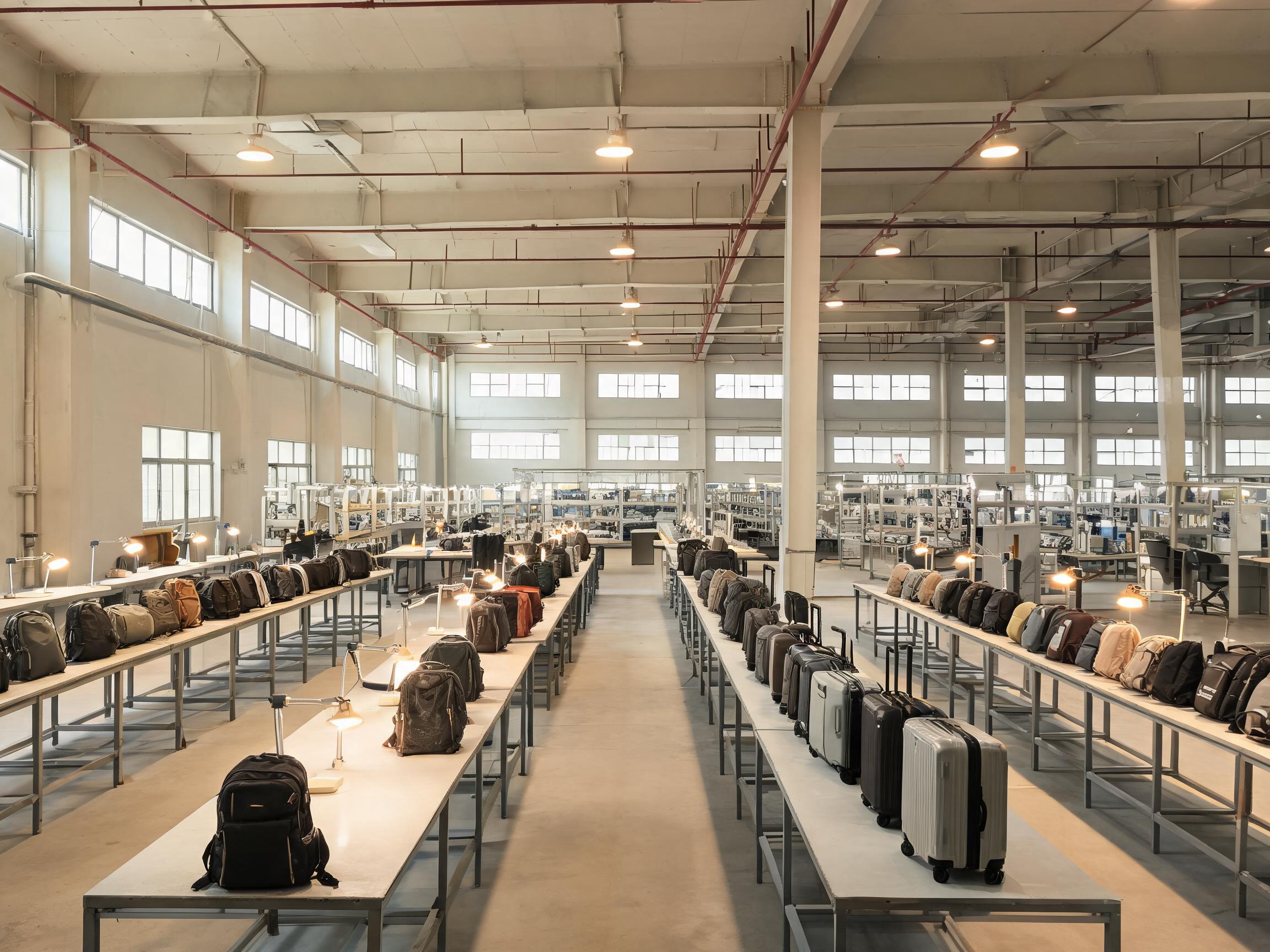
At a facility like Wellmax Luggage, which runs cutting, sewing, assembly, and inspection under one roof in Fujian, the pilot run can be reviewed without waiting for parts to travel between buildings. That shortens the feedback loop, which matters when you're trying to lock in quality before committing to full production.
Stage 2: Material Inspection — Checking What Goes In
Quality problems often start before a single stitch is sewn. Fabric width variations, coating inconsistencies, zipper defects, or wrong hardware finishes can derail an order even if the sewing is flawless.
Material inspection typically happens when incoming goods arrive at the factory. For backpacks, that includes:
- Main fabric and lining: check for shade variation against the approved standard, width consistency, and visible defects.
- Zippers and pulls: confirm brand, size, color, and smooth operation.
- Buckles, D-rings, and adjusters: verify material, finish, and load-bearing appearance.
- Foam and padding: check thickness, density feel, and cut dimensions.
- Labels and logo patches: confirm artwork, spelling, and placement markings.
Checkpoint for buyers: Request that the factory document material inspection results, especially for fabric lot consistency and hardware. If you have a color standard, make sure it is physically present at the inspection station, not just in a file. Small color shifts between fabric rolls are one of the most common reasons buyers reject finished goods later.
Wellmax Luggage holds ISO 9001:2015 and BSCI audit credentials, which means there is a documented quality management system in place. That system should define how incoming materials are checked and what happens when they fail. Ask to see how non-conforming materials are segregated and returned — that process is a useful signal of factory discipline.
Stage 3: Inline Quality Control — Catching Issues While They're Cheap to Fix
Inline QC is the heartbeat of production quality. It happens while bags are moving through cutting, sewing, and assembly — not after they're boxed. The earlier a defect is caught, the less it costs to fix, and the less disruption to your delivery schedule.
Typical inline checks for backpacks include:
- Cutting accuracy: panels match pattern dimensions.
- Sewing quality: stitch length, seam strength, no skipped stitches, clean edges.
- Hardware attachment: zippers, buckles, and straps are secure and functional.
- Symmetry and alignment: pockets, straps, and logo placements are level and centered.
- Functionality: zippers run smoothly, straps adjust, and compartments open and close as intended.
Checkpoint for buyers: Agree on an inline inspection schedule before production starts. For example, the factory checks the initial units off the line, then performs periodic checks at defined intervals. Ask for daily or shift-based inspection records. If you can't be on-site, request photos or short videos of the inline process — not staged shots, but real inspection points.
At Wellmax Luggage, finished-product inspection stations check bags before packing. That final gate is your last line of defense. But it should not be the only one. Inline QC prevents defects from multiplying; final inspection catches what slipped through. Both matter.
Stage 4: Packed-Goods Checking — Verifying the Order Is Complete and Correct
Once bags pass final inspection, they move to packing. This stage is about accuracy and presentation: the right product, in the right quantity, with the right labels and packaging, ready for export.
Packed-goods checking usually covers:
- Quantity per carton and total carton count against the order.
- Product-to-carton matching: no mixed styles or colors unless specified.
- Packaging integrity: polybags, hangtags, and retail packaging meet your requirements.
- Carton labeling: shipping marks, barcodes, and handling instructions are correct.
- Carton condition: no crushing, water damage, or poor sealing.
Checkpoint for buyers: Provide a packing list with clear carton markings before production ends. Ask the factory to photograph packed cartons and label details. If you use a third-party inspection service, this is the stage where a pre-shipment inspection (PSI) typically happens. Schedule it before the goods leave the factory, not after they reach the port.
Wellmax Luggage exports to buyers in more than 40 countries. That volume means packing and labeling standards are routine — but your order still deserves its own verification. Specify your carton marks, label language, and any retail-ready requirements in writing, and confirm them against photos before shipment.
Stage 5: Export Documentation — Preparing While Production Runs
Documentation is not a back-office afterthought. Missing or incorrect paperwork can delay your shipment at the port, trigger customs holds, or create compliance problems in your market.
Typical export documents for backpack orders include:
- Commercial invoice
- Packing list
- Bill of lading or airway bill
- Certificate of origin (if required by your country or trade agreement)
- Inspection certificate (if you've arranged third-party inspection)
Checkpoint for buyers: Share your documentation requirements early — ideally before the order is confirmed. Confirm the exact company name, address, and tax ID that must appear on the commercial invoice. If your market requires specific labeling or compliance marks on the product or packaging, communicate that during sampling, not after production.
Ask the factory to send draft documents for your review while production is still running. Catching a spelling error or a wrong HS code before the goods ship is far easier than correcting it after they've left the factory.
Checkpoint Summary for Buyers
| Stage | What to Verify | Your Checkpoint |
|---|---|---|
| Pilot Run | Mass-production units match approved sample | Request pilot-run inspection against signed sample |
| Material Inspection | Fabric, hardware, and labels meet standards | Ask for documented material inspection results |
| Inline QC | Defects caught during sewing and assembly | Agree on inspection schedule; request records |
| Packed-Goods Checking | Quantity, labeling, and carton condition | Review packing photos; schedule pre-shipment inspection |
| Export Documentation | Invoice, packing list, origin, and compliance | Review draft documents before shipment |
FAQ
How do I know the mass production will match the sample?
The pilot run is your first proof. Ask the factory to inspect pilot-run units against the signed sample and share the results. If the pilot run passes, the line is cleared for mass production. If not, the factory should correct the issue before proceeding.
Do I need a third-party inspection?
It depends on your order size, risk tolerance, and relationship with the factory. Many buyers use third-party inspection for the first order or for complex designs. If you do, schedule it at the packed-goods stage and make sure the factory knows the inspection criteria in advance.
What documents should I receive before shipment?
At minimum: commercial invoice, packing list, and bill of lading or airway bill. Depending on your market, you may also need a certificate of origin or compliance documentation. Confirm your requirements with the factory early so nothing is missing at the port.
How can I verify quality if I can't visit the factory?
Ask for documented inspection records at each stage — pilot run, inline QC, and packed goods. Request photos or videos of actual inspection points. If you need independent verification, arrange a third-party inspection at the packed-goods stage.
Next Steps
Working with a China backpack manufacturer doesn't have to be a black box. The process from sample approval to shipment follows a logical sequence, and each stage offers you a chance to verify quality before the goods move forward. The key is to set your checkpoints early, ask for documented results, and keep communication open with the factory.
If you're planning a backpack order and want to understand how these stages apply to your specific design — commuter, laptop, travel, or outdoor styles — reach out to a manufacturer with the systems in place to support the full cycle. A factory that runs sampling, tooling, mass production, quality inspection, and export under one roof can give you clearer visibility from start to finish.