
Bucket bags have earned their place in seasonal assortments because they solve a design problem most handbag styles ignore: they hold an unstructured-looking volume while staying genuinely usable every day. But that apparent effortlessness is exactly what makes the category construction-heavy. When you work with a bucket bag manufacturer, the decisions that decide whether your private-label run succeeds are structural — silhouette, base, closure, hardware and stitching — and they all need to be settled before sampling, not discovered after it. This guide walks through each one from the manufacturer's side.
Why Construction Matters More Than Usual on Bucket Bags
A tote with a flat base forgives small construction variances; a bucket bag does not. The style's signature is a body that stands upright and keeps its rounded profile whether empty or loaded, which means the round base, the body panels and the closure system all have to work together. A sample that slouches, tips or loses its opening shape is not a minor sample issue — it is a pattern problem that will repeat across every unit in production. That is why experienced buyers evaluate a bucket bag manufacturer on construction capability first and price second.
Silhouette and Structure
Round base construction
The round base is the defining element. It is what lets the bag stand upright on a counter and keeps the interior usable, because the opening stays accessible instead of collapsing shut. When briefing a manufacturer, specify the base diameter and body height you want rather than accepting “standard” — the ratio between the two determines whether the bag reads as compact and structured or large and slouchy, and your market's expectations live in that ratio. A pattern matched to the market's expectations is precisely the kind of detail a manufacturer will ask you to confirm before sampling, because changing it later means re-cutting every panel.
Body material and surface
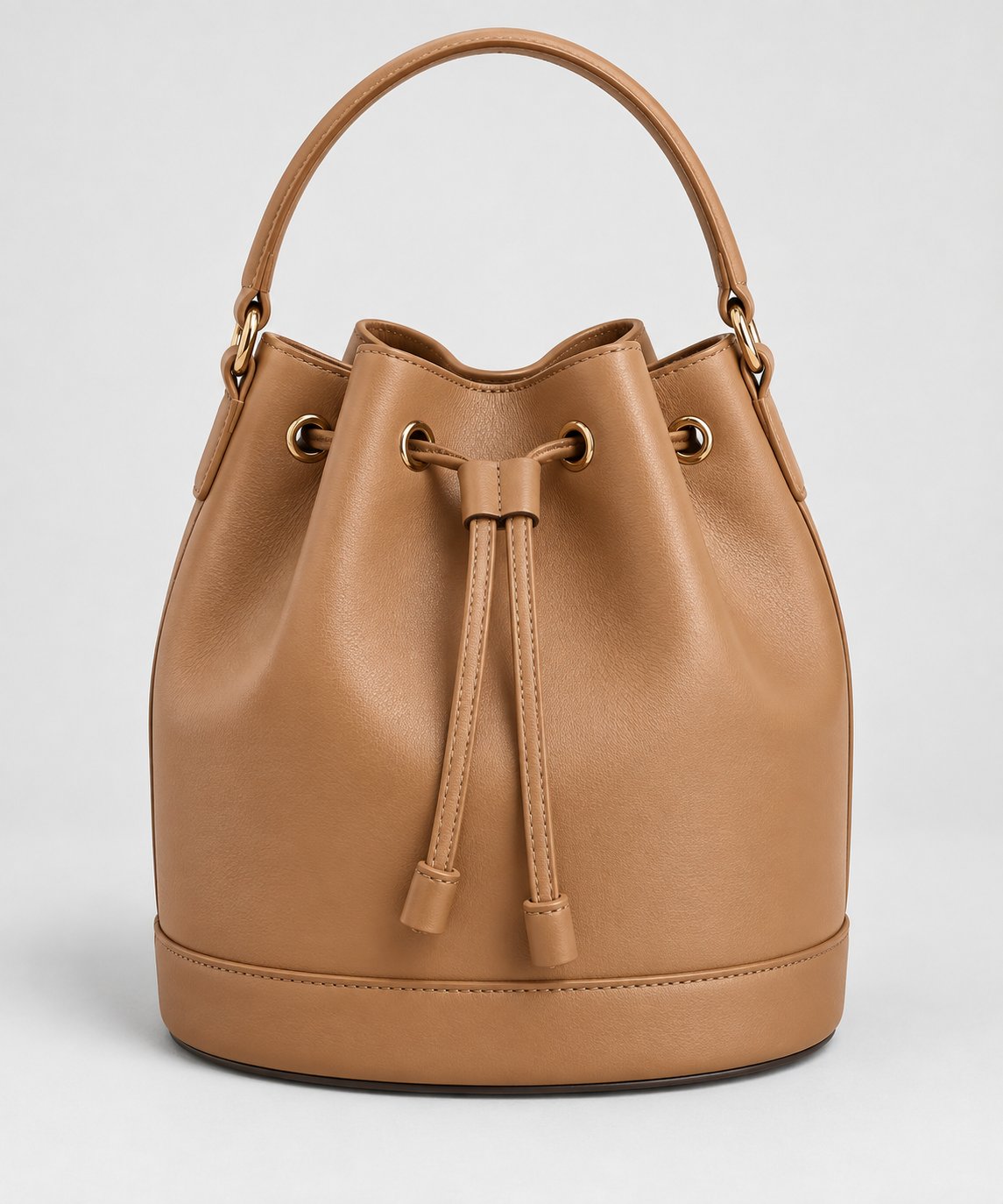
The worked example here is Wellmax's Bucket Handbag: a structured everyday bag in PU leather with a smooth, matte surface that gives a consistent, uniform look across the colorways. PU leather suits bucket construction because it holds shape without heavy reinforcement and delivers even color across units — a real consideration when your retail program displays multiple units side by side. Standard colorways are tan, black and camel, three neutrals chosen to fit most seasonal assortments; on the OEM side, color, lining and hardware can be adjusted to a brand direction, with specific options and any related tooling or minimums confirmed before sampling.
Closures
Drawstring closures
The drawstring is the bucket bag's classic closure and the one this example uses. Its appeal is functional: it keeps contents secure while staying easy to reach into — no zips to fight when the bag is on your shoulder — and it doubles as a silhouette adjuster, since cinching the drawstring changes the bag's profile. It is also a construction-critical detail: the drawstring channel, cord and any stopper hardware all affect how the closure holds over daily use, so ask what cord and hardware the sample will carry rather than leaving “drawstring” as the whole specification.
Alternatives worth discussing
Magnetic snaps and top zippers both appear on bucket-style bodies, trading some of the drawstring's ease for a flatter profile or fuller security. The right choice follows your market and price point, and a manufacturer running OEM programs can build any of the three into the sample — the decision just needs to be made at sampling, because the closure type affects the pattern, the lining layout and the hardware set together.
Hardware and Stitching
Hardware finishes
Hardware is where a bucket bag's price tier becomes visible. Finishes such as gold, silver and antique are the standard set buyers specify for the sample, and the choice should be made together with trim and lining color so the bag reads as one design rather than an assembly of options. Confirm hardware finish in the sample brief; it is one of the cheapest changes to make on paper and one of the most visible to change in production.
Stitching and inspection
Because bucket construction puts curved seams and load-bearing junctions in the same bag, stitching consistency matters more than on flat-panel styles. Wellmax's workflow gives buyers something concrete to verify here: each order moves through dedicated sewing lines followed by finished-product inspection before packing, with stitching consistency and final quality checks built in before goods are boxed into export cartons. When you compare manufacturers, ask what specifically is checked at that inspection stage — a supplier who can answer precisely controls their process.
| Buyer decision | What to confirm before sampling |
|---|---|
| Round base | Base diameter and body height ratio |
| Body material | PU leather surface finish; colorway set |
| Closure | Drawstring, magnetic snap or top zipper; cord and stopper hardware |
| Hardware | Finish (gold, silver, antique) set with trim and lining color |
| Stitching | What is checked at finished-product inspection |
Structuring a Private-Label Bucket Bag Run
Sampling and customization
Bring four decisions to the first sampling conversation: target dimensions (interior size and handle drop), lining fabric and pocket layout, hardware color and finish, and packaging or labeling requirements. Preparing these in advance is what produces an accurate quotation and a sample that is close to shippable on the first round. OEM customization on this style covers color, lining and hardware, with any tooling implications confirmed before sampling.
MOQ and lead time
The Bucket Handbag carries an MOQ of 500 pieces — a workable entry point for testing the silhouette with your customers — and standard lead time is 30–35 days after sample approval and order confirmation, with final timing dependent on order volume and the production schedule. Plan backwards from sample approval, and treat additional sampling rounds as time added in front of production, not absorbed within it.
Packaging
Units ship in an individual dust bag packed into export cartons, which protects the structured silhouette in transit. Branded packaging and hang tags are quoted on request — flag them before quotation so the cost is visible from the start.
The Factory Behind the Spec
This handbag is produced by Wellmax Luggage, an OEM/ODM luggage and bag manufacturer in Fujian, China, founded in 2013. The 12,000 m² facility houses cutting, sewing, assembly and inspection under one roof, with about 320 people producing roughly 150,000 pieces per month across trolley cases, backpacks, business bags and handbags for buyers in more than 40 countries. The quality management system is certified to ISO 9001:2015 and the facility is audited under the BSCI framework for social compliance — company- and factory-level evidence of how the operation runs, which matters most to retail chains and brands with vendor-compliance programs.
A bucket bag succeeds on structure. Choose a manufacturer on construction capability, brief the silhouette, closure and hardware before sampling, and the private-label run follows the same path as the sample you approved. To see the construction described above in a production-ready style, review the Bucket Handbag and contact the export team with your target quantity and customization needs.
Keywords: bucket bag manufacturer, bucket bag OEM, private label bucket bags