
Warranty conversations begin long before the first container leaves the factory. A buyer who settles spare components at the order stage avoids the awkward case where a customer needs a replacement wheel in São Paulo and nobody can name the housing that fits the shell. An OEM luggage manufacturer with a documented parts list keeps the conversation short.
Wellmax Luggage builds trolley cases, backpacks, business bags and handbags in Fujian for buyers in more than 40 countries. The notes below cover the four consumable groups behind most after-sales requests, the figures to fix before mass production, and the questions to settle during quotation.
Which components belong in a spare parts kit
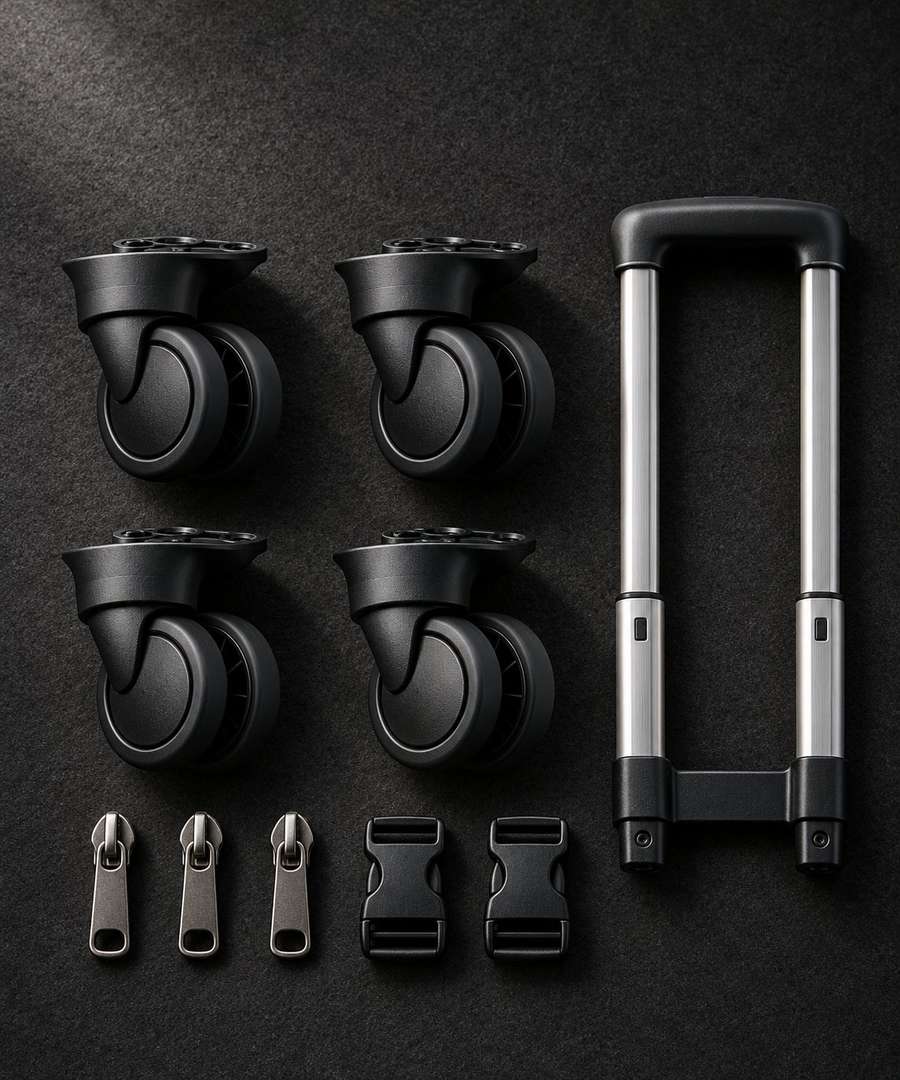
Four groups account for most repair requests on luggage and bags: wheel assemblies, telescopic handle units, zipper sliders, and buckles or snap hooks. Each group fails at a different rate, and each group needs a different level of matching.
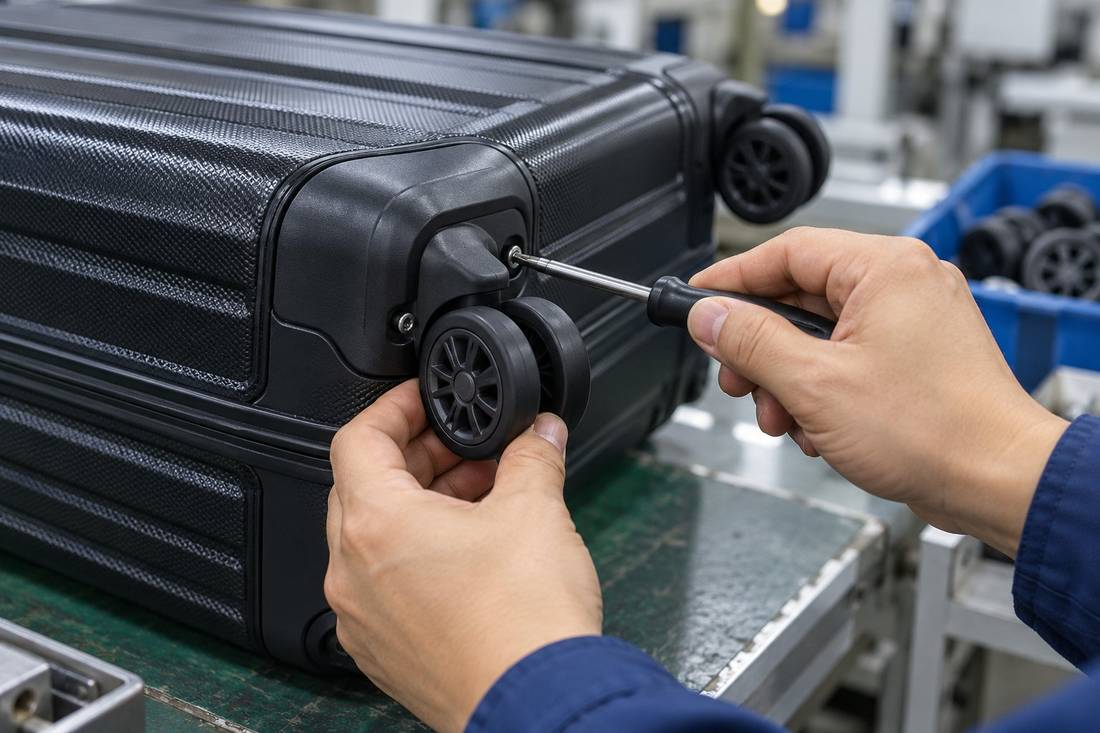
- Wheel assemblies — wheel, axle and housing usually form one moulded unit; a replacement must match the housing screw pattern and the shell cut-out.
- Telescopic handle units — tube diameter, stage count and mounting plate differ between styles, so a handle rarely transfers from one mould to another.
- Zipper sliders — a slider matches the tape gauge of the zipper, so a replacement needs the same nominal size and the same slider family as the original.
- Buckles and snap hooks — strap width decides the fitting; a 25 mm buckle does not seat on 38 mm webbing.
Setting quantities before production, not after
Spare quantities are a planning decision, and the arithmetic is short once the failure group is known. Take a program of 5,000 twenty-four-inch trolley cases. A decision to cover wheels at 2% of order quantity calls for 100 wheel assemblies; at 5% the same program calls for 250.
The percentage stays the buyer's call, and the figure only helps when the number is written into the purchase order instead of being settled at the first complaint.
Two rules shorten the exercise. Count complete corner units rather than single wheels, because a service centre replaces a corner unit. Tie spare quantities to the packing list, so carton numbers and parts travel together and the destination warehouse can locate spares by carton reference.
Matching a part to the approved sample
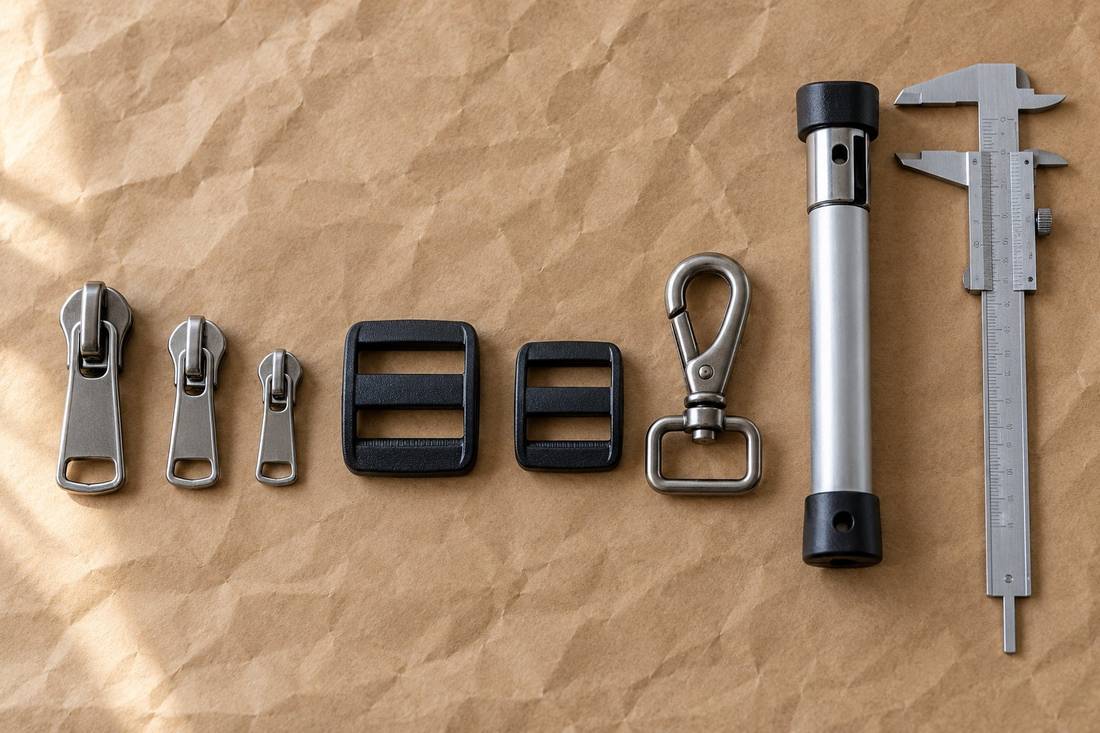
Compatibility is decided on the approved sample, not on a product photograph. Three measurements close most questions: the screw pitch of the wheel housing, the outer diameter of the handle tube, and the tape gauge of the zipper. An OEM luggage manufacturer that records the three figures in a parts list gives a service centre enough information to order a replacement without returning a whole case.
Nominal sizes are designations, not measurements. Zipper gauge numbers and webbing widths describe a component family, and the caliper reading on the approved part decides whether a replacement seats correctly. Keep the caliper reading beside the nominal size in the parts list, so the nominal size and the measured value never separate during a model change.
What the parts list should record
A parts list that survives two seasons carries more than a component name. For each part, record the mould or supplier reference, the material and finish, the colour reference, the nominal size plus the measured size, and the packing quantity per carton. Colour is the field most often missing, and colour produces the most visible mismatch on a repaired bag.
A buyer who asks an OEM luggage manufacturer for the mould reference before tooling can copy the field straight into the parts list at production. The parts list also protects a buyer during a model refresh. When a shell mould changes, the wheel housing usually changes with the shell, and a parts list naming the mould makes the difference between an old housing and a new housing visible before a customer discovers the mismatch.
Who holds stock, and how a repair is handled
Three arrangements cover most programs: the factory ships spare components with the order, the buyer holds stock in the destination market, or a service partner in the destination market sources parts locally. Each arrangement shifts cost and response time, and each arrangement needs a written answer to one question — who pays for the part, and who pays for the labour.
Warranty wording settles the rest. Ask an OEM luggage manufacturer to state which components the warranty covers, how long coverage runs, and whether coverage replaces a component or a whole unit. A warranty covering the shell but not the wheels differs from one covering both, and the warranty difference belongs in the comparison sheet rather than in a later email thread.
Where the parts plan meets the product range
Consumable exposure follows the category a buyer actually orders. Trolley cases carry wheels and handles, so the Travel Luggage range carries the longest parts list. Backpacks carry sliders, webbing and buckles, and the Backpacks range records the fittings style by style. Handbags carry sliders, snap hooks and base feet, and the Handbags range usually needs the shortest list with the highest cosmetic sensitivity.
Three current styles show the pattern. The Polycarbonate Cabin Luggage 22" runs on four spinner wheels and a telescopic handle, so a parts list for the cabin case starts with the wheel housing and the handle mounting plate. The Convertible Travel Backpack 35L pairs a luggage pass-through with a padded laptop compartment, and main-compartment sliders are the components a commuter repair asks for most often.
In handbags, the Structured Satchel Handbag takes a top handle and metal hardware, and colour matching on the metal parts matters more than mechanical life.
Questions to put to an OEM luggage manufacturer
- Which components does the quotation treat as spares, and which are available only as part of an assembly?
- What lead time applies to a repeat order of a single component?
- Can the parts list carry the mould reference and the measured dimensions of each consumable?
- Do spare components travel inside the master carton or as a separate carton?
- Which colour reference governs a replacement part — the original standard or the current production batch?
FAQ
How many spare wheels should a first order include? The count follows the failure group a buyer wants to cover. Calculate from order quantity and a stated percentage, write the result into the purchase order, and keep the calculation with the parts list.
Does a wheel from one style fit another style? Only when the housing screw pattern and the shell cut-out match. Style names and shell sizes do not prove interchangeability, and a supplier should confirm the match against the mould reference.
Does a longer warranty remove the need for a parts plan? No. Warranty defines who pays, while a parts plan defines whether a replacement exists when a service centre needs one.
Which document carries the parts information? A parts list attached to the approved sample and repeated in the purchase order keeps the mould reference, the measured size and the packing quantity in one place.
Next step
Wellmax Luggage works from a 12,000 m² facility in Fujian with cutting, sewing, assembly and inspection under one roof, producing roughly 150,000 pieces a month under an ISO 9001:2015 quality system with a BSCI social compliance audit on record. Send the target market, the order quantity and the components a program needs to cover, and the export sales team at Wellmax Luggage can build the parts discussion into the quotation.
Buyers comparing offers from more than one OEM luggage manufacturer can place the spare-parts list in a separate row of the comparison sheet.