
Sourcing Guide
When you source small leather goods — clutches, coin purses, card holders — the first thing to check is not the price list. It is whether the factory can hold a defined structure, hardware spec and finish across a small run, and still give you a repeatable sample. SLGs are small, but the decisions that drive unit cost and perceived quality are concentrated: a zip-around coin purse has more in common with a precision assembly than a tote does. This guide walks through the typical structures, the hardware and material choices that dominate cost, and how low-MOQ customization is usually discussed with a purse manufacturer. It also marks clearly where you should confirm SLG feasibility, specifications, MOQ and lead time with the supplier before ordering.
Key takeaways
- SLG structures are defined by closure and internal layout — get the construction drawing agreed before anything else.
- Hardware (zip type, snap, rivets, D-rings) and material grade are the two biggest cost levers.
- Low-MOQ customization is a program conversation: colors, lining, hardware finish and logo placement can be discussed, but SLG-specific MOQ and lead time must be confirmed with the supplier.
- Wellmax’s current handbag products are PU-leather compact and shoulder bags (MOQ 500 pcs, lead time 30–35 days after sample approval); SLGs are presented here as category knowledge, not as listed SKUs.
What to check first when sourcing small leather goods
Start with the structure, not the color card. A card holder with six card slots and a central bill compartment is a different construction from a slim three-slot holder, and the factory needs to confirm the pattern, interlining and edge finish before quoting. Next, lock the hardware spec: zip brand or type, slider size, snap diameter, and finish (gold, silver, antique). These items are often sourced per order and their availability drives both cost and lead time. Finally, ask how the factory handles low-MOQ customization — whether colors and lining are selected from a stock range or developed, and whether hardware finish changes are possible at your quantity. For SLG-specific MOQ and lead time, the correct answer is always to confirm with the supplier; do not assume they match the handbag terms.
Typical SLG structures and where cost sits
Below is a generic category view. These are common constructions you will see across the small leather goods market; they are not claims about any specific current model.
Clutches
Two dominant constructions: a flap clutch with a magnetic snap or magnetic flap closure, and a zip-top clutch with a full-length zipper. The flap version usually has a cleaner front panel and simpler lining, which can reduce assembly time; the zip version adds hardware and a zip tape, and the slider and puller become visible design elements. Internal layout (slip pocket, card slots, wrist strap) changes the pattern and the number of sewing operations. Hardware leverage: the closure type and any decorative plate or chain are the main cost items.
Coin purses
The zip-around coin purse is the most common: a single zipper running around three sides, with a lined interior and sometimes a key ring or split ring. A frame coin purse with a metal clasp is a different animal — the frame is a purchased hardware component and its quality (spring tension, finish) matters. For zip-around, the zipper length, slider quality and the way the zip is set into the curve affect both cost and how neatly the purse closes. Hardware leverage: zipper and puller, plus any ring or clasp.
Card holders
Card holders are deceptively simple. A flat card holder with multiple slots requires precise skiving and folding; the slot depth and the interlining determine whether cards slide in easily and whether the holder keeps its shape. Some designs add a central compartment or a ID window, which introduces a clear PVC panel and additional stitching. Hardware is minimal — often none — so cost is driven by material consumption, skiving labor and edge finishing (painted or folded). Hardware leverage: low, unless you add a money clip or a snap closure.
Structure / hardware / customization table
| Structure | Typical hardware | Where customization has the most leverage |
|---|---|---|
| Flap clutch | Magnetic snap or magnetic flap | Hardware finish, lining color, flap shape, logo embossing |
| Zip-top clutch | Full-length zipper, slider, puller | Zip type and puller style, interior pocket layout, wrist strap |
| Zip-around coin purse | Zipper, slider, split ring | Zip tape color, lining, ring finish, embossed logo |
| Frame coin purse | Metal clasp frame | Frame finish, body material, lining |
| Flat card holder | None or snap | Material color, edge finish, slot count, embossing |
| Card holder with ID window | None or snap | Window material, stitching color, lining |
This table is a category reference, not a specification of available models. Confirm actual structures and hardware options with the supplier.
Hardware and material decisions that dominate unit cost
On a small leather good, hardware is a higher share of unit cost than on a large bag because there is less material to absorb the cost. A zip-around coin purse might use one zipper, one slider and one puller — but those three components can vary widely in price depending on the zip type (nylon coil, metal, molded plastic) and the finish. The same applies to snaps: a standard magnetic snap versus a concealed magnetic flap changes both the look and the assembly method. Wellmax discusses hardware finish options (gold, silver, antique) with buyers before sampling, and the same logic applies to SLGs: agree the finish and the supplier’s available range early, because finish changes can affect both MOQ and lead time.
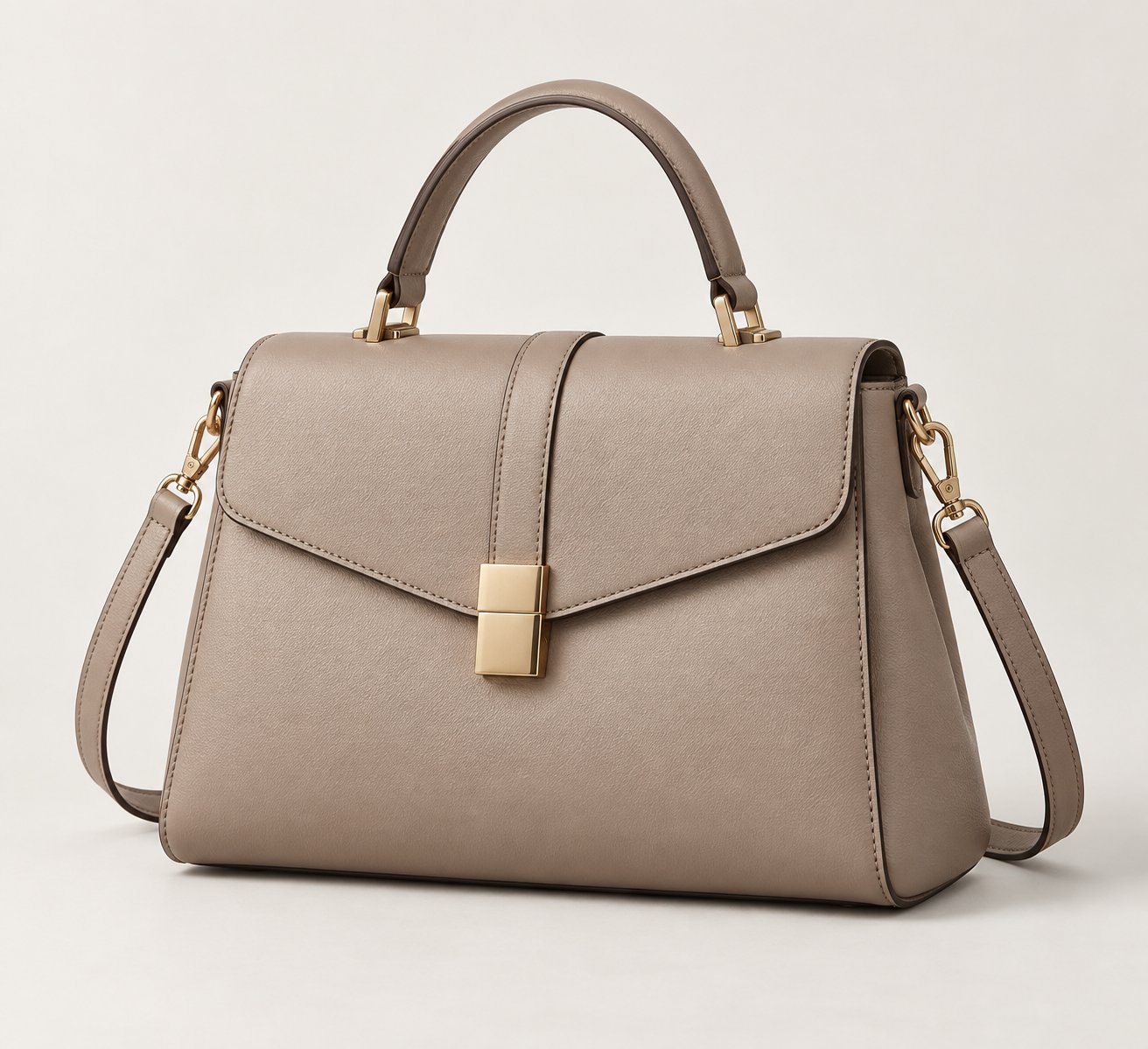
Material is the other lever. PU leather is the main handbag material in Wellmax’s current production, and it is also common in SLGs. Within PU, thickness, backing and embossing affect how the item folds, skives and wears. For SLGs, a thinner PU may be preferred for card slots to reduce bulk, while a slightly thicker PU gives a clutch more body. Lining choice (polyester, cotton blend, or a contrast color) is a low-cost way to add perceived value and is usually part of the customization discussion. If you are considering a compact bag as an anchor product alongside SLGs, the top-handle shoulder bag and the quilted chain shoulder bag show the PU-leather and hardware finish approach in a larger format.
How low-MOQ customization actually works
Low-MOQ customization is not a single switch; it is a set of decisions the factory can support at different quantities. In practice, the conversation usually covers:
- Color and lining: selecting from an existing PU and lining range is typically easier than developing a new color. Ask which colors are stock-supported and which require a minimum dye lot.
- Hardware finish: gold, silver and antique finishes are standard discussion points; the available finishes and any minimums should be confirmed before sampling.
- Logo placement: embossing, foil stamping or a metal plate. The method affects tooling cost and may have its own minimum.
- Structure tweaks: adding a slip pocket, changing a flap shape or adjusting slot count. These are pattern changes and should be quoted as such.
The reason some customization options raise the minimum order is mechanical, not commercial posturing. Each customization item either uses stock components or requires its own setup — a dye lot for a new color, plating capacity for a non-standard hardware finish, a die or stamp for a logo. Setup items carry a fixed cost that has to be spread over the run, so suppliers usually apply a minimum quantity (or a setup fee) to that item alone. The table below shows the general pattern for SLG customization items. It is industry practice, not a Wellmax price list; the actual minimums for your combination must be confirmed with the supplier.
| Customization item | What it involves | Typical MOQ trigger pattern |
|---|---|---|
| Color from existing stock range | Selection from materials the factory already stocks | Usually the lowest-friction option; no separate material setup |
| New custom color (material dye/development) | Dye lot or material development for a color that is not stocked | Often carries its own minimum tied to the dye lot or development cost |
| Hardware finish from supplier’s standard range | Selection among finishes the hardware supplier already offers | Usually negotiable at low quantities; limited to available range |
| Non-standard hardware finish or custom hardware | Separate plating run or custom-machined component | Frequently carries the highest minimums; plating houses run batches |
| Logo — embossing or foil stamping | Die or stamp setup, applied during production | Die cost spread over the run; small minimums are more achievable than for hardware |
| Logo — metal plate or custom puller | Purchased custom component, ordered separately | Component supplier’s own minimum applies on top of the bag minimum |
| Structural change (pocket, flap shape, slot count) | New pattern, new cutting die or template, re-sampled | Quoted as a development item; minimums depend on how much changes |
The pattern above is category-general practice for small leather goods. It is included so buyers know which levers are cheap to pull and which are not — the actual quantities for each item must be confirmed with the supplier before planning an order.
Wellmax’s current handbag products carry an MOQ of 500 pcs and a lead time of 30–35 days after sample approval. For SLGs, those figures should not be assumed — SLG-specific MOQ and lead time must be confirmed with the supplier, because smaller items often have different production economics. The factory’s in-house design and development studio can develop styles, select materials and prepare samples for OEM/ODM programs, which is the right channel for a low-MOQ SLG discussion.
Sampling and production checks for SLGs
SLG samples are small, so inspect them closely. Use this checklist when you review the sample or approve bulk:
- Zip action: does the zipper run smoothly along the curve of a zip-around or zip-top style, without snagging at the turn?
- Snap alignment: does the flap sit flat and close without twisting the front panel?
- Edge finishing: painted edges should be even with no gaps; folded edges should be clean and symmetrical.
- Stitch density at stress points: corners, handle anchors and card slot edges should show consistent stitching.
- Card insertion: test slots repeatedly — a slot that is too tight or too loose is a pattern issue to fix before bulk.
- Hardware finish check: compare the finish against your approved sample under daylight; variation is easier to spot on small items.
Wellmax runs cutting, sewing, assembly and inspection under one roof in a 12,000 m² facility with about 320 staff and roughly 150,000 pieces per month. Dedicated sewing lines and finished-product inspection before packing are part of the current handbag production flow; the same disciplines apply when discussing SLG programs, but the specific line assignment and inspection criteria for SLGs should be confirmed with the supplier. ISO 9001:2015 and BSCI are held at company/factory level, not as product-specific certifications.
FAQ
Can I order small leather goods at a low MOQ with custom colors and hardware?
Low-MOQ customization is a program discussion. Color, lining and hardware finish are typically discussed before sampling. As a general pattern, stock colors and standard hardware finishes are the easiest to combine with small runs, while custom colors and non-standard hardware usually carry their own minimums. Whether a specific SLG can be run at your target quantity, and what the MOQ is, must be confirmed with the supplier — do not assume the handbag MOQ applies.
How do I choose hardware for a clutch or coin purse?
Start from function: a magnetic snap or magnetic flap for a clutch gives a clean front; a zip gives security and a visible design element. For coin purses, the zip type and slider quality matter most. Ask the supplier which finishes (gold, silver, antique) are available and whether they carry minimums. Approve the finish on a physical sample.
What does the sampling process look like for SLGs?
The factory’s design and development studio develops the style, selects materials and prepares a sample. You review structure, hardware, finish and logo placement. Sampling time and cost for SLGs should be confirmed with the supplier, as they may differ from handbag sampling.
What should I confirm before placing an SLG order?
Confirm the specific SLG structure and dimensions, hardware specifications and finish, material and lining, logo method, MOQ, lead time, and inspection criteria. Also confirm whether the supplier currently produces the SLG type you need — Wellmax’s listed products are compact and shoulder bags in PU leather, so SLG feasibility should be discussed directly.
Next step
If you are sourcing SLGs alongside a compact bag program, the most useful first move is to send the structure sketch, hardware spec and target quantity to the factory’s development team. They can tell you what is feasible, what needs adjustment, and what MOQ and lead time apply to the SLG specifically. For reference on the PU-leather and hardware approach, you can review the top-handle shoulder bag or the quilted chain shoulder bag.