Wholesale Buying Guide
Garment bags — suit covers, dress bags and hanging travel bags — sit in a quietly profitable corner of the bag trade. They are bought by bridal shops, uniform suppliers, hotel groups, travel-retail distributors and fashion brands protecting high-value garments in transit. For wholesale buyers and distributors, the category rewards planning: garment bags are low-weight, high-volume goods whose landed cost and shelf appeal are decided by three things — fabric weight, structure, and how cleverly the order is packed into a container. This guide covers each decision area from a distributor's buying perspective.
On this page
Price tiers: read fabric weight before you read the price

Across any wholesale quotation sheet, garment bag pricing clusters into recognizable tiers, and the sorting key is fabric weight. Use these tiers to benchmark quotes before comparing factories:
- Lightweight tier (roughly 60–120 gsm non-woven or lightweight PEVA-based materials): Disposable or semi-durable covers used by dry cleaners, hotels and event organizers. Lowest unit cost, lowest perceived value, usually ordered in very high volumes. Note that many suppliers in this tier are non-woven specialists rather than sewn-goods factories.
- Mid tier (roughly 190T–300T polyester taffeta and lightweight canvas, often 120–250 gsm): The mainstream distributor tier. Durable enough for repeated use, printable for branding, and the level where most retail and uniform-program garment bags sit. Washability and zipper quality become the differentiators here.
- Premium tier (heavier canvas, dense polyester, or PU and genuine leather trim, typically 250 gsm and up): Suit covers and hanging travel bags where the bag itself is part of the product experience — bridal, luxury retail, executive travel. Hardware, lining and stitching finish dominate both cost and quality perception.
When comparing quotes at any tier, ask for the fabric weight in gsm (or ounces per square yard) and the coating, in writing. A "600D polyester" claim without a weight and coating spec is not comparable to a quote that includes them — and the gap between them is exactly where quality disputes are born. As a sewn-goods OEM/ODM manufacturer working across canvas, nylon, polyester and PU materials in our existing bag ranges, we recommend buyers lock fabric weight, coating and trim into the approved sample, then hold the bulk run to that sample.
Folding versus hanging structures
Structure is the second big fork in the road, and it drives both retail price and freight economics:
Flat-folding suit covers. The garment folds once or twice inside the bag; the bag folds flat for storage and shipping. These pack efficiently, cost less to freight, and suit uniform programs and retail shelves. Confirm fold-line reinforcement and how the closure (zipper, velcro, or snap) behaves at the fold.
Tri-fold and compact travel designs. The garment folds in three sections with interior securing straps, turning a full-length suit cover into a briefcase-style carry. Higher pattern complexity means higher cost and more sampling rounds, but stronger retail positioning in the travel category.
Hanging designs with hooks and shoulder gussets. A hook or loop lets the bag hang in a wardrobe or hotel closet; a gusseted shoulder area gives tailored garments breathing room. These are the standard for bridal, tuxedo and premium uniform programs, and they demand more from the factory's pattern engineering — ask how the hook attachment is reinforced, because it is the most failure-prone point.
Convertible designs. Bags that switch between hanging mode and shoulder-strap carry mode serve the travel segment best, and they add hardware that must be specified (and inspected) explicitly.
Match the structure to your channel, not to the catalog: a dry-cleaning program and a bridal boutique need different bags even at the same price point.
Mixed-SKU carton planning for distributors
Garment bags are light and bulky, so container planning often decides whether the order is profitable. Wholesale buyers should approach packing as a negotiation item, not an afterthought:
- Standard packing baseline. Our bag products ship in individual polybags packed into export cartons — the same baseline applies to soft-goods programs generally. For garment bags, confirm fold dimensions and carton internal dimensions together, because a bag that folds 2 cm too tall can waste a carton layer across thousands of units.
- SKU labeling at polybag level. For mixed orders, require size/color labeling on every polybag so goods can be cross-docked without unpacking.
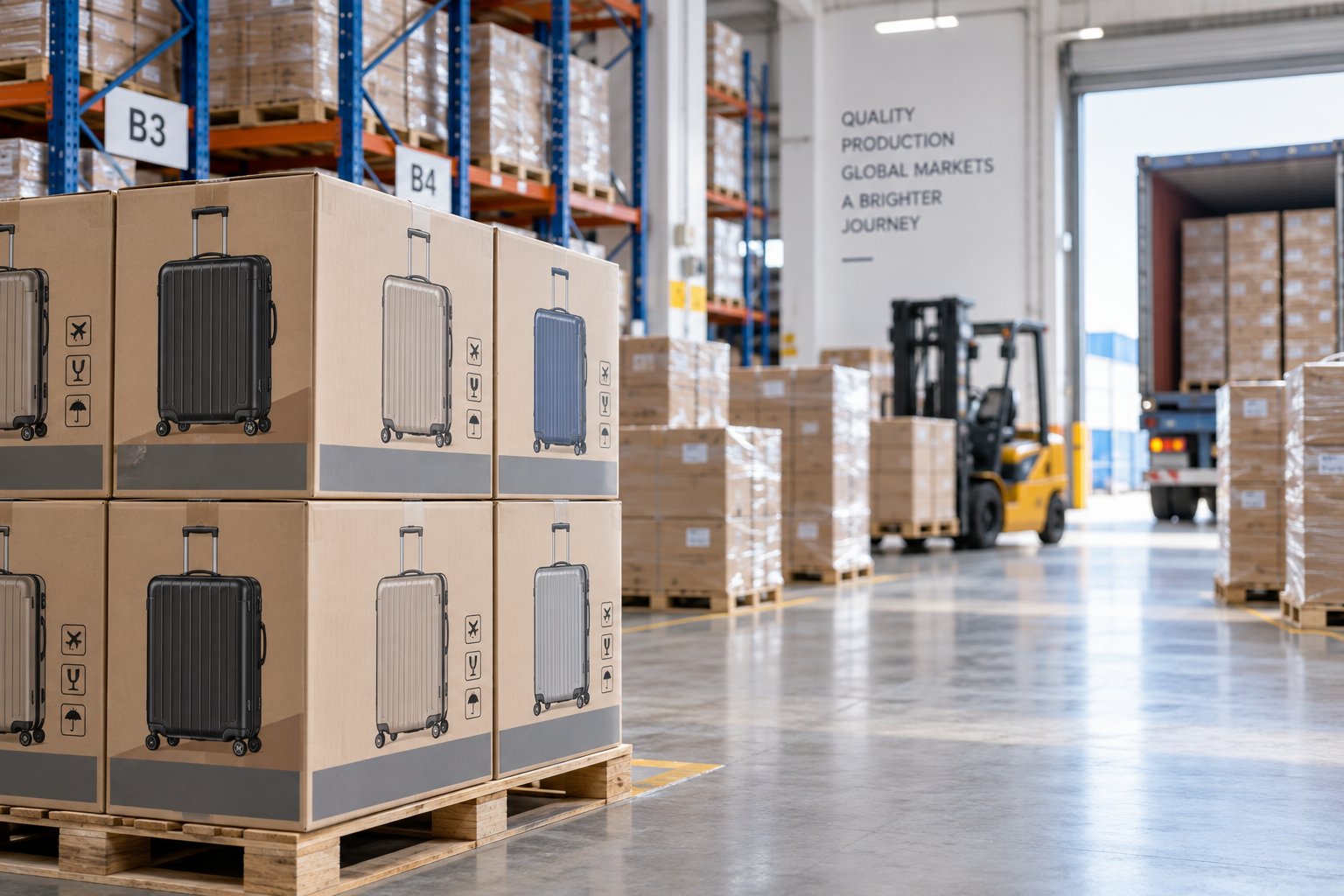
- Mixed-SKU cartons. If your distribution model needs assorted cartons (say, three SKUs per master carton for regional warehouses), agree the assortment ratio, carton marking and pallet configuration before production, not at loading time. Our export warehouse packs cartons ready for container loading, and mixed-SKU planning works best when the factory builds the carton plan into the production sequence.
- Weight and cube checks. Lightweight goods cube out before they weigh out; ask for the carton cube and pieces-per-carton for each SKU so you can compare container utilization between suppliers' quotes on equal terms.
Commercial terms to confirm before ordering
Before committing to a wholesale garment bag order, put these on the checklist with your supplier: fabric weight and coating in writing; structure and hardware spec with the sample; MOQ per SKU and per color; lead time after sample approval and order confirmation — for orientation, published soft-goods styles in our ranges carry MOQs of 300–500 pieces with 30–40 day lead times, and your garment bag program will be quoted against its own spec; acceptance of third-party inspection; Incoterms for your destination port; and whether branded packaging and hang tags are quoted separately.
From buying guide to buying decision
Wellmax Luggage is an OEM/ODM luggage and bag manufacturer founded in 2013 in Fujian, China, with a 12,000 m² facility, about 320 staff and monthly output of roughly 150,000 pieces, certified to ISO 9001:2015 and audited under the BSCI framework at the company and factory level. Our in-house design and development studio selects materials and prepares samples for custom bag programs, and our export team serves buyers in more than 40 countries.
If you are planning a garment bag wholesale program — suit covers for a uniform client, hanging bags for retail, or a mixed-SKU distribution order — send us your target quantities, fabric weight tier and structure preference. Our team will confirm feasibility for the design, return a quotation with a carton plan, and prepare samples for your approval.