Carry on spinner luggage is the most contested shelf in travel retail — and the most accessible one for a private-label brand. The product is compact, the specification is well understood by travelers, and a clean, well-executed cabin spinner carries a brand logo through every airport it enters. The real question for small and growing brands is not whether to sell carry on spinners, but how to start a customized program without committing to container-scale volumes on day one.
This article lays out how factory-side small orders work, what logo customization actually involves, and how a trial program grows into a volume reorder — based on how a full-range OEM luggage manufacturer in Fujian, China structures its OEM and ODM programs for buyers in more than 40 countries.
Key takeaways
- Carry on spinners are ideal for private label because they concentrate branding surfaces — shell, zipper pulls, lining, handles, wheels — in a standardized size.
- MOQ is not a fixed number; it depends on customization depth and material minimums.
- Logo customization ranges from printed stock shells to fully branded hardware, each with its own cost and minimum.
- The realistic path is sampling → trial order → volume reorder, using sell-through data to justify scale.
In this article
Why carry on spinners suit private label programs
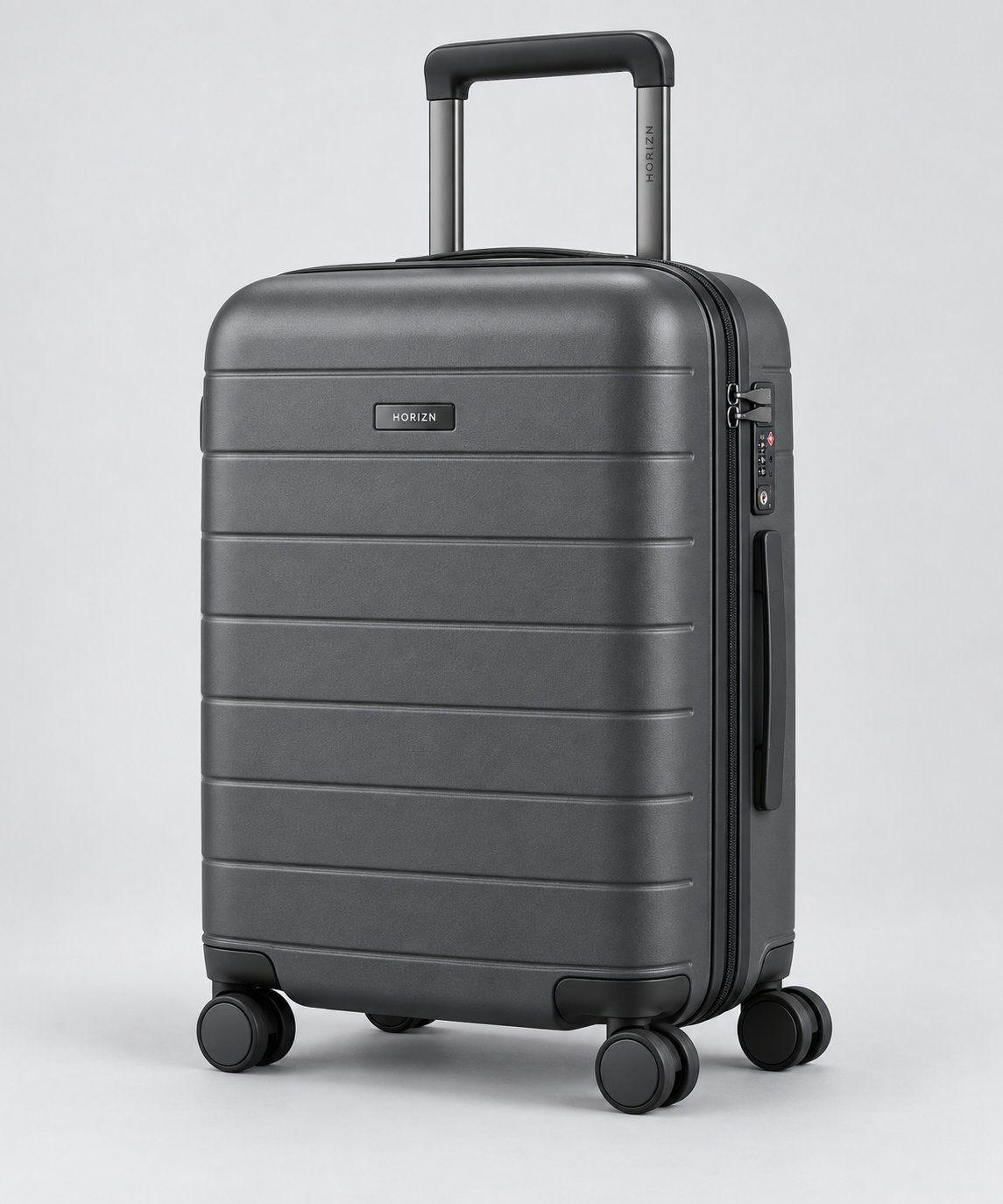
A carry on spinner concentrates every branding surface a luggage brand needs: the shell itself, the zipper pulls, the interior lining, the handle grips and the wheels. Because the size is standardized by airline cabin limits — which is why our cabin trolleys sit at 20 and 22 inches — buyers compare finish and details rather than dimensions. That favors brands that invest in color, finish and hardware identity, all of which are customization decisions, not engineering ones.
For a small brand, this means you can compete on design without developing a new chassis. The core engineering — wheels, telescopic handle, zipper or frame closure — is proven and shared across the category. Your differentiation comes from the shell finish, the interior, and the small details that travelers touch and see. That is exactly where private label adds value.
Understanding MOQ structure without guesswork
What drives the minimum order quantity
MOQ in customized luggage is not a single fixed number; it is the interaction of your customization depth and the factory's production economics. A stock shell in a standard colorway with a printed logo sits at one tier. A custom shell color, custom lining and branded hardware sit higher, because each custom input has its own minimum run at the material supplier. This is why two buyers asking "what is your MOQ?" can get different answers — and both be correct.
The practical way to frame your first order
Rather than asking for the smallest possible number, tell the factory what you are actually trying to test: how many units you can credibly sell in a first season, in which colorways. A manufacturer that runs around 150,000 pieces a month across trolley cases, backpacks and bags has the production depth to schedule a smaller customized run, but the honest framing still comes from you. Any specific MOQ for your specification is something to confirm directly with the factory's export team — never assume a number you read in a generic article.
Logo customization methods, from lightest to deepest
Logo customization is not one decision. It is a spectrum, and each step adds cost, minimums, and lead time. The right level depends on where you are in your brand's development.
| Customization level | What it involves | Best for |
|---|---|---|
| Printed / heat-transfer graphics | Stock shell with your logo or graphic applied | Brand testing, fastest route to market |
| Custom colorways and linings | Custom shell color plus branded interior lining | Brands ready to move beyond generic shells |
| Branded hardware and details | Custom zipper pulls, wheel housings, handle grips, trims | Brands with validated demand and volume |
Printed and branded shells
The lightest customization keeps a stock shell and adds your identity through printing or heat-transfer graphics. It is the fastest route to market and suits brand testing. Our Colorway and Surface Customization work for OEM/ODM programs covers exactly this range of surface treatments.
Custom colorways and linings
The next step is a custom shell color and branded interior lining — visible every time the case opens. For a clean solid-color base such as our Solid Color Spinner Luggage 24" in polycarbonate, a custom colorway transforms a generic shell into a recognizable brand product at modest incremental cost.
Branded hardware and details
Deeper programs customize zipper pulls, wheel housings, handle grips and interior trims. Each custom component carries its own tooling or sourcing minimum, which is why this tier belongs to brands that have validated demand.
From small order to volume: the realistic path
Stage 1 — sampling
Start with sample development. A manufacturer with an in-house design and development studio prepares samples against your brand inputs; the sampling and tooling process is the phase where specifications — shell material, wheel spec, handle system, closure type — get fixed in writing. Treat the sample approval as a contract document.
Stage 2 — the trial order
The first production run should be sized to sell through, not to fill a warehouse. Cabin spinners in one or two colorways, with the logo treatment you validated on samples.
Stage 3 — the volume reorder
Once sell-through data exists, the reorder is where private-label economics improve: larger runs per color, stable specification, and a supplier relationship that already understands your quality standard. At this stage many buyers expand the assortment from carry on spinners into checked sizes and complementary categories from the same production base — which is precisely the advantage of a full-range manufacturer.
What to put in your first inquiry
Include: your brand positioning and target market; the cabin size you want (20 or 22 inch); your preferred shell material — ABS for economy, polycarbonate for impact resistance; your logo customization level; and your realistic first-season quantity. Ask for the sampling timeline and what the sample cost is credited against in production. A factory that answers those questions concretely — and can show you its inspection process, not just its catalog — is the one worth sampling with.
Ready to discuss your carry on spinner program? Share your specifications and target volume — our export team will respond with concrete next steps.
Contact us