Corporate travel kits almost always end up as a pair: a roller case for the hold or cabin, and a backpack that rides on top of it. If you are writing the spec for that backpack, the detail that decides whether the kit works is the trolley sleeve. Get it right and the traveler pulls one case with both bags. Get it wrong and the backpack slides sideways, wears through at the handle opening, or bulges when worn. This article covers what to specify for a backpack with trolley sleeve, which shell materials make sense for corporate programs, and what bulk OEM terms look like in practice.
Why the backpack with trolley sleeve is the standard corporate pairing
The logic of the kit is simple. The roller carries the heavy load. The backpack sits on top of the telescopic handle through a pass-through sleeve, so the traveler moves through airports and stations with hands free for documents, coffee, or a phone. When the traveler needs to walk faster than a roller allows, the backpack comes off the handle and goes on the back.
For procurement, the pairing also has an administrative benefit. Ordering a coordinated backpack and trolley combination from one supplier simplifies specification, branding, inspection and onboarding. New employees receive one consistent kit instead of mismatched pieces. This is why many corporate programs and the retailers serving them treat the trolley sleeve not as an accessory feature but as a core specification item.
Specifying the sleeve: the details to agree on before sampling
The sleeve itself is where most quality problems originate, so break it down into checkable points. These are the specification items to agree with your OEM in writing, then verify on the physical sample.
Opening height and width versus the paired trolley
The pass-through opening has to accept the telescopic handle of the specific trolley case in your program, including any grip housing at the top of the handle. Ask the supplier to confirm the opening dimensions against the paired case, and check on the sample that the backpack sits level on the handle without rocking. Since the pairing differs by program, confirm exact dimensions with the supplier at inquiry rather than assuming a standard size.
Position on the back panel
A sleeve that sits too high or too low shifts weight oddly and can make the stacked pair top-heavy. Agree on the vertical position of the sleeve relative to the back panel so the backpack rests stably on the case when stacked.
Retention and reinforcement
Two construction details matter most:
- Retention. A slide-over strap panel or similar closure keeps the backpack from sliding off the handle when the case is tilted or rolled over curbs.
- Reinforcement. The fabric at the handle opening takes concentrated abrasion every time the bag is loaded and unloaded. Specify reinforcement at the opening and check the stitching density there on the sample.
Behaviour when worn
The sleeve should stay flat against the back panel when the backpack is worn. A sleeve that flaps or pockets out is uncomfortable and looks unprofessional in a corporate context. This is a sample-stage check: wear the sample, walk with it, and look at the back panel profile.
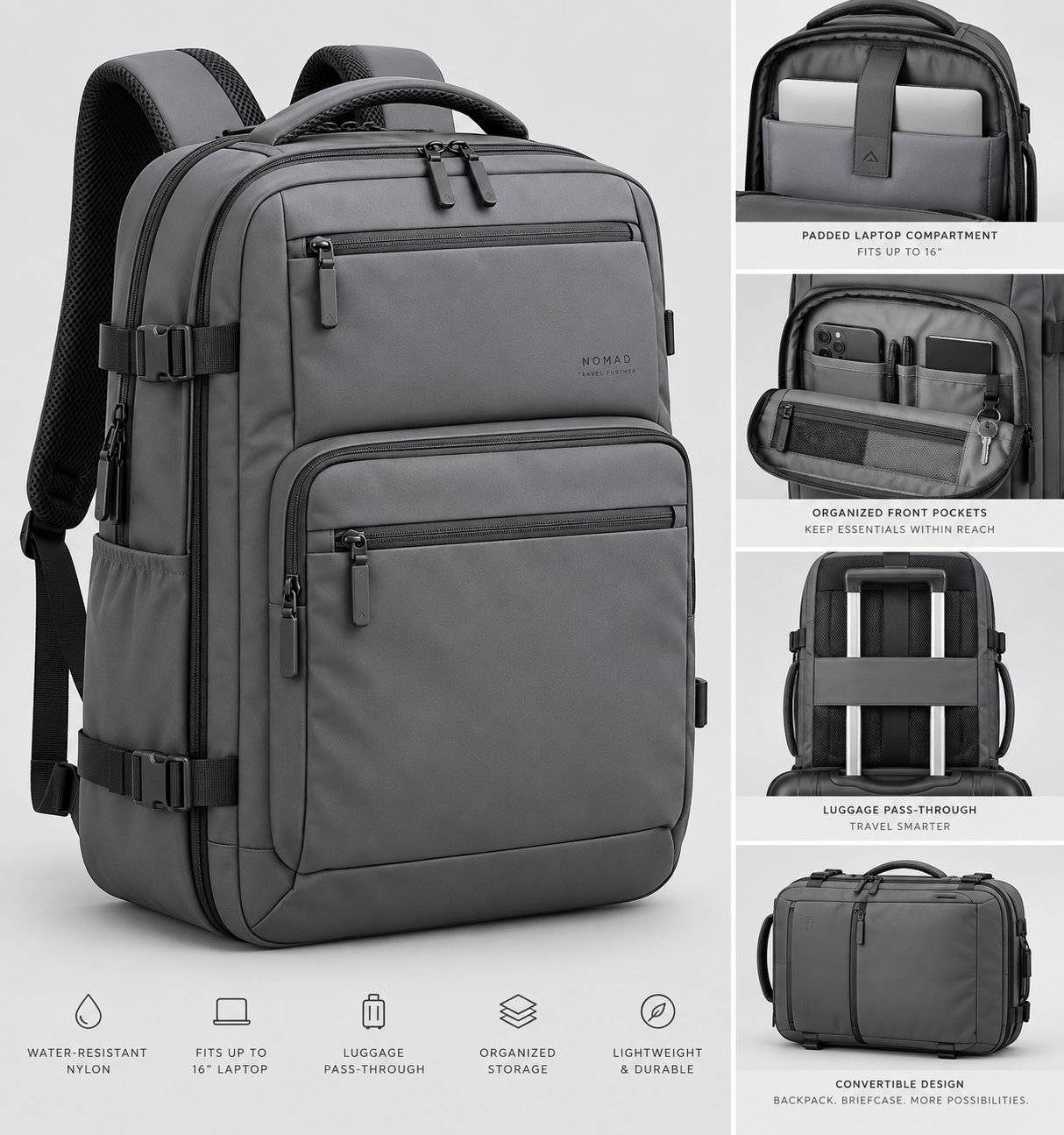
One reference point from our own range: the Convertible Travel Backpack 35L is built around this use case, with a closure spec of zipper with luggage pass-through and a padded laptop compartment. It is positioned for travel, commuting and outdoor contexts, which covers most corporate kit scenarios.
Shell materials: water-resistant nylon versus polyester
For corporate programs the realistic choice is between water-resistant nylon and polyester. Both are in regular production at our factory, so the trade-offs below are practical rather than theoretical.
The 35L travel backpack uses water-resistant nylon. Nylon generally offers a softer hand feel and good strength-to-weight performance, which suits a travel-grade bag that gets stacked, dragged and loaded frequently. It typically sits at a higher price position than comparable polyester.
The Laptop Commuter Backpack 18L uses polyester with a padded dedicated laptop compartment sized up to 15.6 inch. Polyester is cost-efficient, holds color well, and works well for commuter retail and corporate programs where price positioning matters as much as hand feel.
One boundary worth stating clearly: the 18L commuter pack's specification does not include a trolley sleeve. It works in programs as the lighter everyday piece, while the 35L convertible carries the pass-through function. Denier, fabric type, shell color and laptop sleeve size are adjustable within an OEM program, so the material decision is not fixed at the catalog level. If you need verified water-resistance test data for a specific fabric construction, ask for it during sampling rather than relying on generic material claims.
Corporate program extras worth confirming early
Branding and configuration options are easier to lock in before sampling than after. For bag lines, the factory supports branding via woven labels, embroidery, screen printing and branded packaging. That covers most corporate requirements, from a small embroidered logo on the front panel to fully branded retail packaging.
Color is another area where corporate palettes drive the spec. The 35L convertible is available in black, grey and navy; the 18L commuter pack comes in dark gray, black and navy. All six are standard corporate tones, and custom shell colors are possible through the OEM route.
Standard packaging is individual polybag plus carton. At quotation stage, corporate buyers typically also confirm third-party inspection arrangements and Incoterms with the export sales team, so build both into your RFQ.
Quality checks already built into backpack lines
On the backpack sewing lines, zipper function and strap strength checks are built into the production workflow, and finished-product inspection happens before packing. Company-level quality management is certified to ISO 9001:2015 and the facility is audited under the BSCI framework. Note that these are factory-level certifications, not product-level certifications of any individual SKU; if your program requires product-specific testing, arrange it separately and confirm scope with the supplier.
Bulk OEM terms: the real reference numbers
To make planning concrete, here are the terms on both anchor backpacks:
| Term | Convertible Travel Backpack 35L | Laptop Commuter Backpack 18L |
|---|---|---|
| MOQ | 500 pcs | 500 pcs |
| Lead time | 30–35 days after sample approval | 30–35 days after sample approval |
| Packaging | Individual polybag + carton | Individual polybag + carton |
Sampling is part of the OEM/ODM order cycle, not an extra step outside it. Our in-house design and development studio develops new styles, selects materials and prepares samples, and the same facility in Quanzhou, Fujian runs cutting, sewing, assembly and inspection under one roof, producing roughly 150,000 pieces per month for buyers in more than 40 countries. Exact program terms, including pricing and any custom requirements beyond these reference points, are confirmed at inquiry.
Frequently asked questions
Can the 18L commuter pack be converted to include a trolley sleeve?
It is not in the current specification. If your program needs it, raise it as a custom requirement at inquiry; the OEM/ODM route allows new constructions, and the sample stage is where the sleeve position and opening would be validated against your paired trolley.
What laptop size does the 35L convertible fit?
The specification lists a padded laptop compartment but does not state a maximum laptop size. Confirm the compartment dimensions against your company-standard laptop at sampling.
Do the MOQ and lead time change for a fully custom style?
The 500 pcs MOQ and 30–35 day lead time are the reference terms on the two catalog backpacks. A fully custom development may carry different terms, so confirm them in the quotation.
Can we split an order between the 35L and the 18L?
Both are produced on the same factory backpack lines, which makes mixed programs practical. How MOQs apply across a split order is a quotation-stage question; ask the export sales team to structure it.
Is ISO 9001:2015 certification attached to the backpacks themselves?
No. It is a factory-level certification covering design, manufacturing and sales of luggage and travel bags, and BSCI is a facility-level social compliance audit. Treat them as supplier qualification criteria, not product certifications.
Next step
Send your program specifications: the paired trolley case details, preferred shell fabric and denier, branding method, target volumes and destination market. We will prepare samples for the trolley sleeve fit and material confirmation, then quote based on the agreed specification.